The House that Neddy Built: Remembering Morris Street and Daybrook.

I made my entrance into the world in the glorious summer of 1964. It seems that I didn’t add all that much to the sunshine that was on offer though. In fact I turned out to be as much of a financial burden as I was the proverbial bundle of joy. Consequently, my mum and dad ended up having to sell their new house in the ultra modern, and still emerging, Rise Park estate, near to the town of Bulwell, Nottingham. In its place, we all became temporary lodgers at my Grandparents house, in nearby Bestwood Park, two miles up the hill towards Arnold. Because of my tender age at the time, I have no memories of the house, on Brownlow Drive, that I was born in. Whilst I do have fond recollections of my temporary second home, 17 Twycross Road, these are generally connected with visiting my grandparents, George and Barbara, in the later years that they lived there. None of them… as far as I can tell… are from the brief period when I lodged there as a baby.
After a few months sojourn at Twycross Road, the time eventually came for us to move back into a home of our own. And so it was that, by the Autumn of 1966, we were ensconced at 34 Morris Street, in the tiny community of Daybrook, near to the sprawling town of Arnold. It is this house that gave me my first memories of ‘home’. After (at that time) around 85 years of its existence, we were the last family ever to live there and, maybe partly because of this, it is still a place that evokes for me a level of nostalgia not triggered by anywhere else. Many of my child-level memories of Morris Street are still crystal-clear pictures that have not faded, in the well over five decades since we parted company.
![Morris Street circa 1960s. [Nottingham Central Library Collection].](https://theredwriteralanwilliams.com/wp-content/uploads/2024/08/morris-street-1960s.jpg)
Morris Street was built on a hill rising up from the Mansfield Road (originally the Nottingham to Mansfield Turnpike, now more commonly known as the A60). If you walked up it from the direction of the Mansfield Road, you would find number 34 right at the crest of the hill, on the right-hand side, the first building of a red-bricked terrace which stared out onto the back yards of Salop Street. Salop Street was effectively our sister street and ran parallel to Morris Street. Halfway down the hill there was a gap, which used to be occupied by a separate terrace (unsurprisingly named Morris’ Terrace) that once sprouted off at right angles from the street. At the bottom of the hill on our side of the street stood our ‘corner shop’ (which was actually number 155 Mansfield Road – the building on the right in the picture above). On the opposite side of the road to our house, below the back yards of the Salop Street houses, the buildings became three storeys high and spilled down the lower part of the hill in pairs, towards a motor mechanics garage, which stood on the opposite corner to the shop at 153 Mansfield Road.
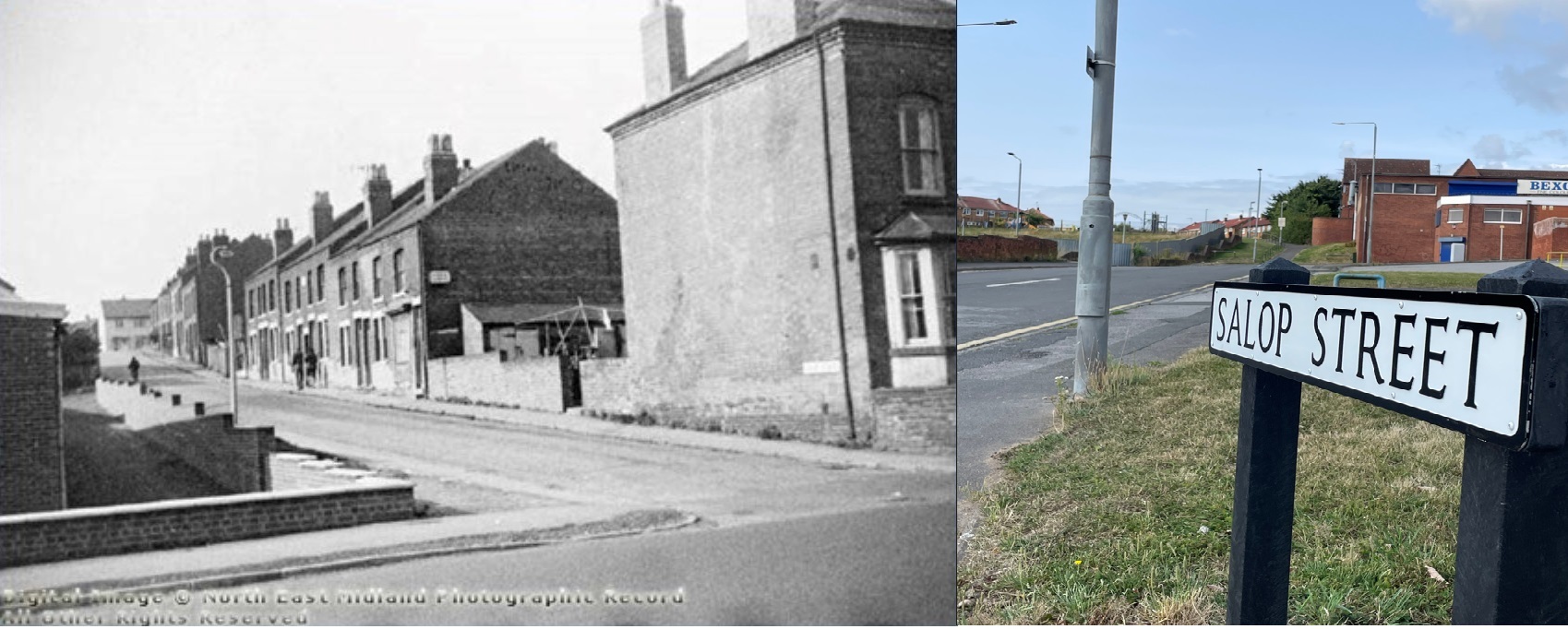
Morris Street resided, for postal purposes at least, within the community of Daybrook, which was by then part of Arnold’s suburban sprawl. In reality, however, Morris Street and Salop Street (plus the modern Keats Close that was by then appended to the two older streets) were in a kind of world of their own, neither really parts of Arnold, nor at the centre of Daybrook. They were situated just as close to the area known as Redhill and, at the time they were built, the land behind them, on the Oxclose Lane side, formed part of the Bestwood Park Country Estate belonging to the Dukes of St. Albans.

(Original photograph courtesy of North East Midland Photographic record http://www.picturethepast.org.uk)
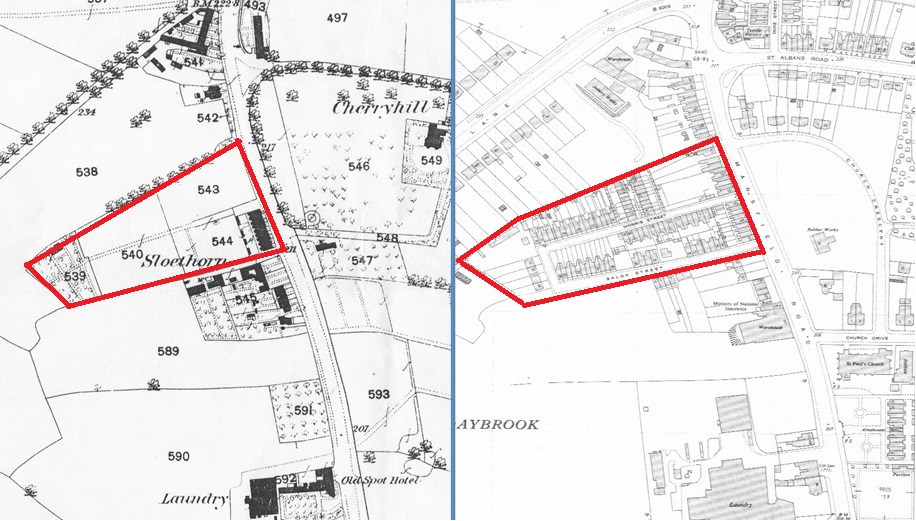
A further reason for this identity crisis was because the land which was destined to be occupied by Morris Street and Salop Street, including their gardens and yards, together with the houses fronting onto the Mansfield Road, was once known as ‘Sloethorn’. It was described as such on ordnance survey maps as late as 1881. This is particularly significant to me, because my Great Great Grandmother, Emma Oscroft, was born in ‘Sloethorn’ on 22nd February 1874 (this was ten years before Morris Street was built, so she probably came into the world at one of the dwellings on the Mansfield Road, or one of the farm buildings standing near to where Salop Street was built). At the time I lived there, however, I had no idea at all that I was potentially treading upon ancestral ground.
Daybrook ‘proper’ was dominated by a number of buildings that were the legacy of the Robinson family. Sir John Robinson (1839-1929) started a brewery on the Mansfield Road in the 1870’s, utilising water from a nearby spring, and which he eventually named the ‘Home Brewery Co.’ after his family residence – ‘Home Farm’ – which stood just off Oxclose Lane, at approximately where Queen’s Bower Road runs now.

Right – the founder and chairman of the company Sir John Robinson in a portrait by ‘Spy’ from Vanity Fair dated 1911. By this time Sir John was the owner and squire of Worksop Manor.
A new brewery building was built on the site in the 1930s (pictured above). It’s bright green and yellow neon sign, which flashed the words ‘Home Ales’, followed by ‘Home of the Best Ales’, was a landmark I always looked for from the back seat of our Renault Dolphin, or Ford Popular 100E, when returning home from family trips out. If, as a special treat, we stopped off at the fish and chip shop on the corner of Sherbrook Road, my dad would park the car on Mansfield Road in full view of the brewery’s flashing sign and I was fascinated by it. 34 Morris Street stood half a mile from the brewery and the aromas of malt and hops often hung heavily in the air.
Sir John, together with his brother Samuel, later founded the Daybrook Laundry, which stood just across the road from the brewery. This was, in effect, a massive laundry ‘factory’. The old laundry buildings were replaced in the 1930s with the modern art deco edifice that still stood at the time I lived in Daybrook. In fact the building stood until 2008-2010 during which time it was demolished to make way for a value supermarket. In addition to its industrial business, it also had a small domestic dry-cleaning outlet on the site (in the old reception building), to which my mum occasionally took clothes to be cleaned with me in tow. The laundry’s steaming chimneys were visible from our house. For years, the very word ‘laundry’ was synonymous in my young mind with this place.

(Original photograph courtesy North East Midland Photographic record http://www.picturethepast.org.uk)
Just before the turn of the century, on land next to the brewery, Sir John built a row of elaborate alms houses in memory of his son, John Stanford Robinson, who had died in 1896. Equally elaborate (for such a small parish) was the neo-gothic St. Pauls Church, built next to the alms houses on land donated by Sir John and partly funded by Sir Charles Seeley, another local magnate. The building was constructed between 1892 and 1896. My sister was baptised there in 1967.
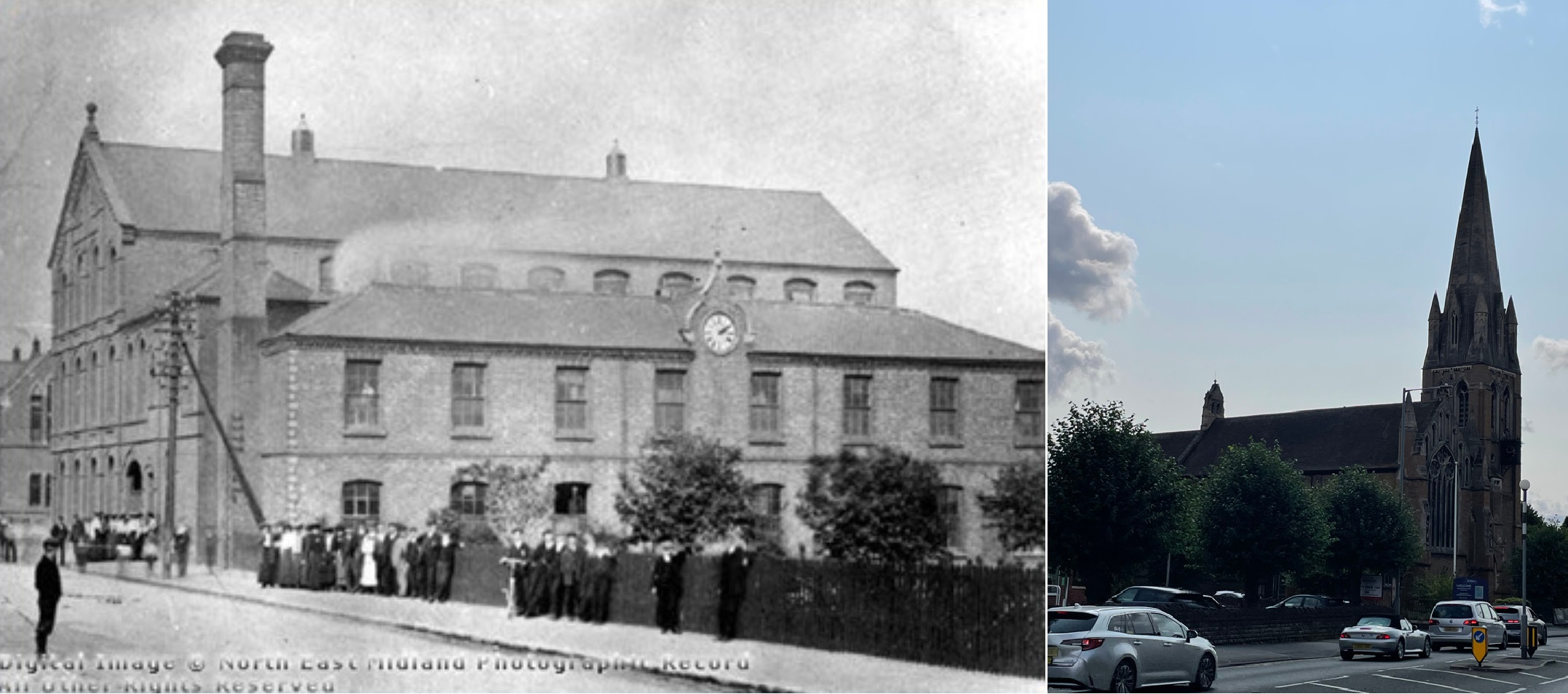
Daybrook also boasted a number of Hosiery and Lace mills. I & R Morley’s knitwear factory stood next to the brewery in Daybrook Square and ceased to trade around the time that we moved into Morris Street, after exactly one hundred years of business. The expansion of Daybrook’s industry and trade in the 1870s and 1880s no doubt encouraged demand for new houses to be built close by. For this new population, therefore, the building of Morris Street was opportune.
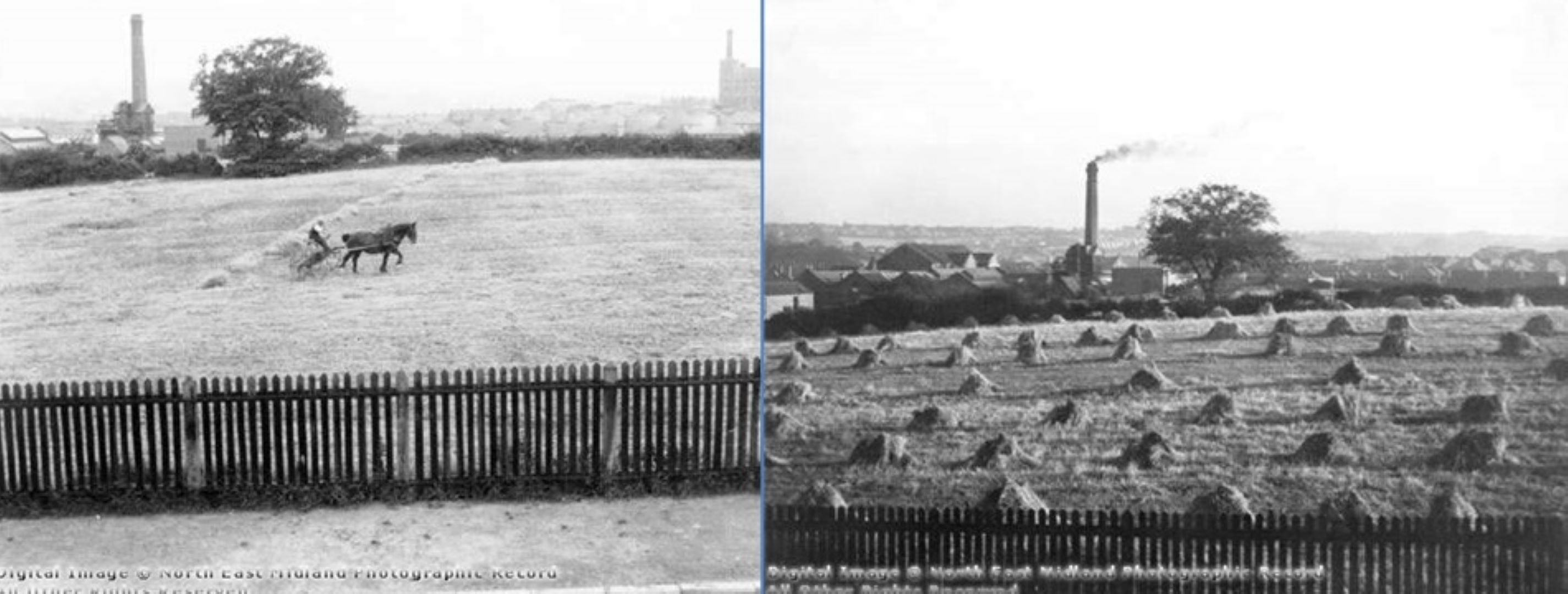
When the street was first erected, it was built alongside oat fields and allotments, but these had long since gone by the mid-1960s. In their place, a post-war council estate had consumed the farmland, as Daybrook housed more and more families, and not just those engaged in local industries. In between Salop Street and the newer houses, just one of the old fields remained. It had become an unkempt open space where the children played, and where a communal bonfire was built every November 5th. I clearly remember the feelings of terror as I hid behind my dad, clinging onto him for dear life, as the noisy fireworks crackled into the air on ‘bonfire night’.
The roads on the new council estate were named after poets (taking their cue from a slightly older thoroughfare, Byron Street, which ran from Mansfield Road up to Oxclose Lane). As a result, Morris and Salop Streets’ close neighbours were Shelley Road, Wordsworth Road, Browning Close and Coleridge Crescent. The newer, funkier, Keats Close was a more recent addition and was almost an extension of Morris Street itself (number 1 Keats Close was next door to our number 34). I recall having a discussion (although I can’t remember with whom) about whether or not the ‘Morris’ in Morris Street was also a poet – perhaps it was even named after the artist and occasional poet, William Morris? This speculation couldn’t have been further from the truth. The street was actually named after the man who built it; and his name was Edwin Morris.

Morris was, like his father before him, a bricklayer by trade. He was born in Shrewsbury on 15th December 1844 and lived there for at least the first twenty-five years of his life. Soon after that, however, he was on the move; both geographically and in terms of his own ambition.
By 1881 Morris was living in Monks Coppenhall, Cheshire (now part of Crewe). By then he was the father of two sons and was married to his second wife, Miriam. Sometime between April 1881 and the summer of 1884 the Morris family made the move to Nottinghamshire. On 12th August 1884 he submitted a copy of plans to the Arnold Local Board of Planning, for “Four houses at Daybrook for Mr. Morris”. The four houses were the first ones to be built on a “New Road – 24 feet wide”, which ran down to the Mansfield Turnpike Road. The plans were drafted by Arthur Marshall, an architect and surveyor based in Nottingham, and they were signed by Edwin Morris himself. The “New Road” was to become Morris Street, and the four houses in question were those eventually numbered 34 to 28.

The house that I remember from my childhood is easily identifiable from those original plans for number 34. It shows a ground level parlour accessible via the front door, with a fireplace and a bay window facing out into the street. This became our play-room, and my dad built a road system for me, painted onto a unit that had been built into the space underneath the bay window. Here I played with my Batmobile’, fire engine and other toy cars (plus, my favourite, a shiny green Interceptor from the TV series ‘UFO’ which fired little red missiles). The other main ground floor room shown on the 1884 plans (shown above) was a kitchen, also with a fireplace, and a small window overlooking the yard. When we lived in the house, this room was our ‘living room’. I recall looking out of this window near to Christmas one year as snow floated down in large flakes and settled heavily on the yard; this is an image that still comes to mind whenever I hear the song ‘White Christmas’. Beyond the ‘kitchen’ there was a scullery, complete with a large sink. This room became our kitchen. Also built into the house at ground level, but only accessible from outside, was a coal store.
The stairs, situated between the kitchen and parlour, led up to the first floor where there were two bedrooms. The one at the front of the house became my Mum and Dad’s bedroom, the one to the rear I eventually shared with my sister. It was here also that I suffered through a bout of measles, where I was puzzled by the sight of my dad wearing a toupee as he put us to bed one night, and where I clearly recall dreaming that a large tiger was prowling around my bed.
Beyond the ‘back bedroom’, a further room was accessible down a couple of steps. This room had been converted into a bathroom by the time of our arrival, but there was no indoor plumbing in 1884. Instead, the yard and a small garden at the rear of the house came complete with four ‘closets’, two on each side of a block. In between them was an ‘ash pit’, which also acted as a cesspit. From the plans it was clear that this block was designed to be shared between all four houses. These ‘closets’ or ‘privvies’ were obsolete during the time we lived in the house and were, by then, used for storage. We kept our lawnmower in one of them.
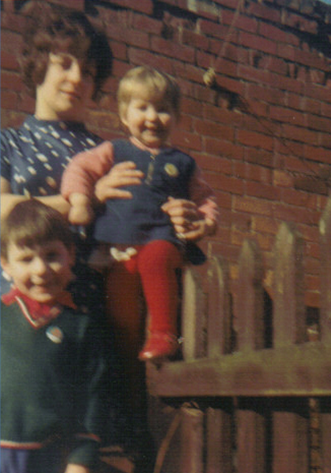
The back yard was one of my favourite playgrounds and, amongst the many memories associated with it, are ones of endless summer days, with the old lady next door standing by her fence… and of a cat called Oliver. One day a group of kittens appeared in the yard. We put out milk for them, and my Aunty Merry eventually gave one of them a home (she named it Oliver, no doubt after the popular musical of the time, and he lived well into the 1980s). Once the remaining houses had been built, access to the rear of our house was via a narrow alley between numbers 28 and 26. I used to love running down the alley, with its black-tiled floor, because of the echoing sound it used to make. The end of the garden was marked by a high red-bricked wall. Whilst playing in the garden on one occasion, I heard a voice from the top of the wall, and then, to my surprise and excitement, a face appeared. The face belonged to a boy called Alistair who lived in one of the ‘big houses’ on Oxclose Lane. He lowered down a basket of apples from his lofty perch. To this day, I have no idea how he got up there!
All of the main rooms in the house had fireplaces in them. One year I was given a toy fort for Christmas. I remember the keen pang of disappointment upon discovering that there were no soldiers included with it. When I questioned my Mum and Dad about this they looked confused and told me that they had very definitely asked Santa Claus for some soldiers to go with my fort. They suggested that the soldiers might have got stuck in the chimney when Santa delivered the presents, so we checked all of the fireplaces. Sure enough, to my great delight, a bag of toy soldiers was found stuck in one of the chimney spaces!

Morris’s plans for his new houses have an approval date of 12th January 1885, so we can assume that construction probably started during that year. An early public sale of houses on the street took place at an auction at the nearby White Hart Inn on 6th September 1886. The sale consisted of 5 lots, 3 of which concerned the sale of 16 houses on Morris Street, plus a further 7 on a new street which was later named Salop Street, after the county of Morris’ birth (Salop is an ancient abbreviation for Shropshire). He went on to build houses on other streets in the area, including one that he rather narcissistically named Edwin Street.
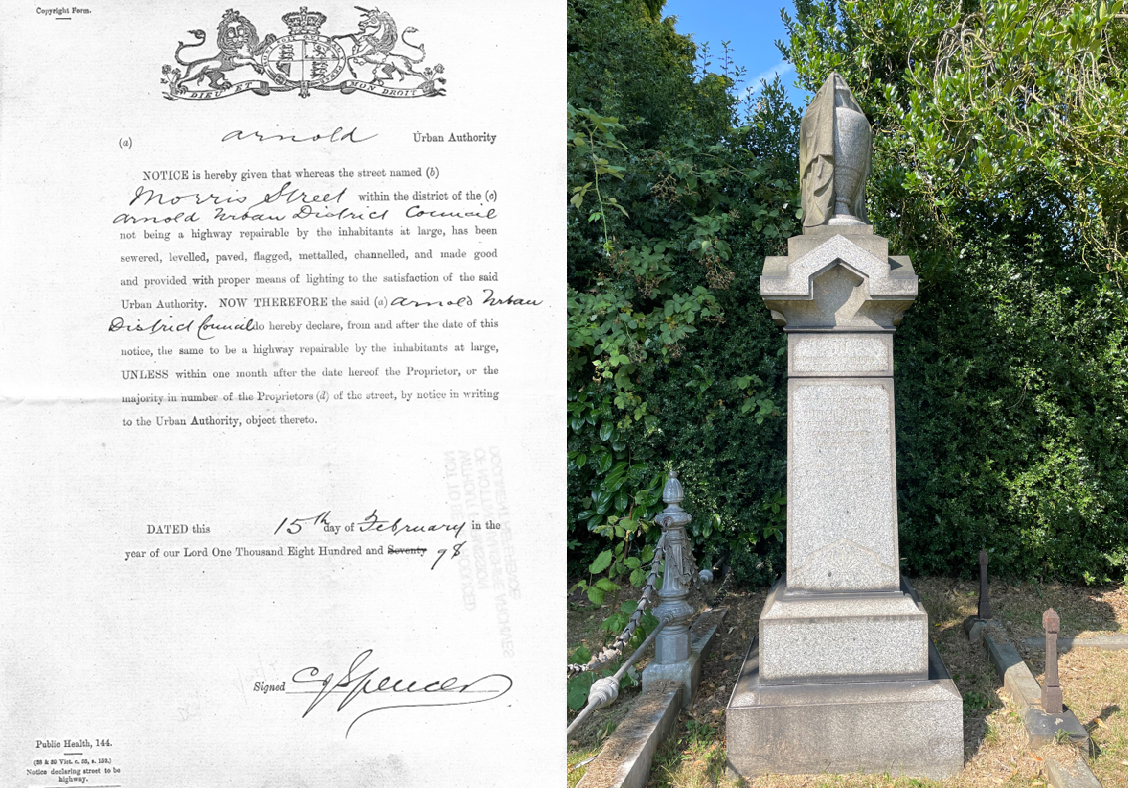
Morris prospered from his property development. In 1891 he was himself living on Morris Street, possibly even in number 34 itself. By 1901 he occupied a larger house in central Daybrook, close to the Old Spot pub. By 1911 he lived at the grandly titled Salisbury Farm, just off Byron Street, behind what is now Coronation Buildings. At this time he was also serving as a Conservative member on the Arnold Urban District Council. Councillor Morris was well known locally and Arnold historian Bill Spick refers to him in one of his books of reminiscences as ‘Neddy’ Morris. Spick remembers him living at the farm towards the end of his life. He evidently still owned houses on Morris Street, and 11 of them were sold off in March 1920, alongside some of his other properties on Edwin Street, Byron Street and Sherbrook Road. Morris died at Salisbury Farm on 5th June 1923, aged 78 years. He is buried, alongside Miriam (who died in 1912) at Redhill Cemetery.
During the time we lived on Morris Street, several of our neighbours could claim an unbroken connection back to the first families who lived on the street during Neddy Morris’ time. In 1967 Edith Broadhead and her husband Joseph lived at 11 Morris Street; this could well have been the very same house that her grandparents (Joseph and Kate Terry) lived in 1891. In fact families with the surname Terry and Armson were still living on the street in 1967, just as they were in 1891. Another example of this continuity over time was that, in total, six of the families who were living on the street in 1901 were still there at the time of National Registration in 1939. Nine of the families living there in 1939 were still there in 1967.
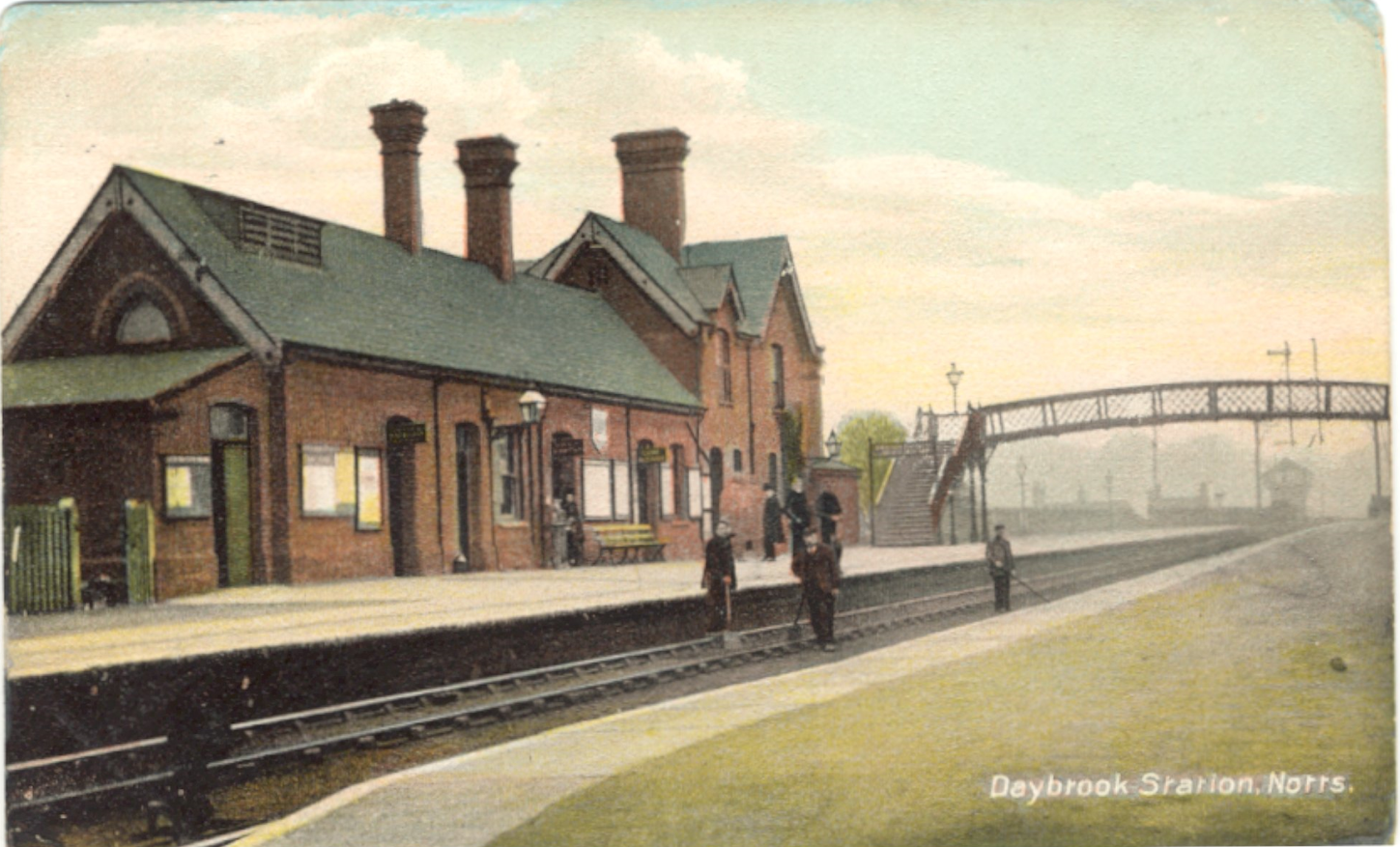
Between 1901 and 1939 the main occupations of men living on the street were in hosiery or lace, coal mining, the building trade or brewing. In 1901 agriculture and the railway also featured prominently as occupations; until the reorganisation of the railway in the 1960’s Daybrook had its own railway station. The closure of both Morley’s factory and the Railway Station, however, signalled the beginning of the end for Daybrook’s ‘heyday’. In recent years both the brewery and the laundry – the two centres of the Robinson’s empire – have also closed down and the latter demolished.
The boundaries of my childhood universe, with Morris Street at the centre of it, were clearly defined. The Cecil Hall, a community building on Byron Street linked to St. Pauls Church, where I attended ‘play group’ and where Mum worked for a while, was situated towards the southern edge of this world. Cecil Hall’s place in my life was eventually superseded in 1969 when I started at St. Albans’ Infant School on Sherbrook Road and, latterly, by Roundwood Junior School, across the other side of Oxclose Lane, where I attended form 1971. I walked home the half a mile from St. Albans’s Infants on my own, which would be a rare occurrence for a five or six-year-old these days. This did give me a certain amount of freedom; once I was made to take home a piece of ‘art’ I’d made in class (a large flower made out of scrunched up tissue paper). I hated it so much, that I ran up onto the footbridge over Oxclose Lane and threw it back onto the school field! On another occasion I stopped mid journey to talk to the Herring sisters, who were school friends, outside the Cecil Hall. I must have been there quite a while because my Mum came to look for me… I could hear her shouting my name from the top of Wordsworth Road… and she was understandably none too happy that I hadn’t gone straight home. I can remember being very conscientious about crossing roads, however, this possibly stems from a visit to infant school by ‘Bertie the Belisha Beacon’ and, consequently, the phrase, “look left, look right, look left again” was never far from my mind.
The ‘other side’ of Oxclose Lane marked the northern boundary of my world. Here we might walk up Gladehill Road, and Mosswood Crescent, en route to my Grandparents, a thirty-minute stroll away. Or we might just visit Mace, to go shopping. Mace was the closest thing we had to a Supermarket. I was fascinated that the name above the door of the shop, presumably that of the manager, was ‘A. Williams’. While visiting Mace, we might also pop into see Steve the Grocer, or into Mr. Probert’s Newsagents, or Mum might buy some wool from a shop run by a lady who had her grey hair styled in a ‘bun’. Often we went to the shops which stood further east, on the ‘Arnold side’ of Mansfield Road, opposite the junction with Oxclose Lane. Here we would be served by the always cheerful Les, at Dewhurst’s Butchers, or I would get my hair cut at Rex Weston’s barbers shop.

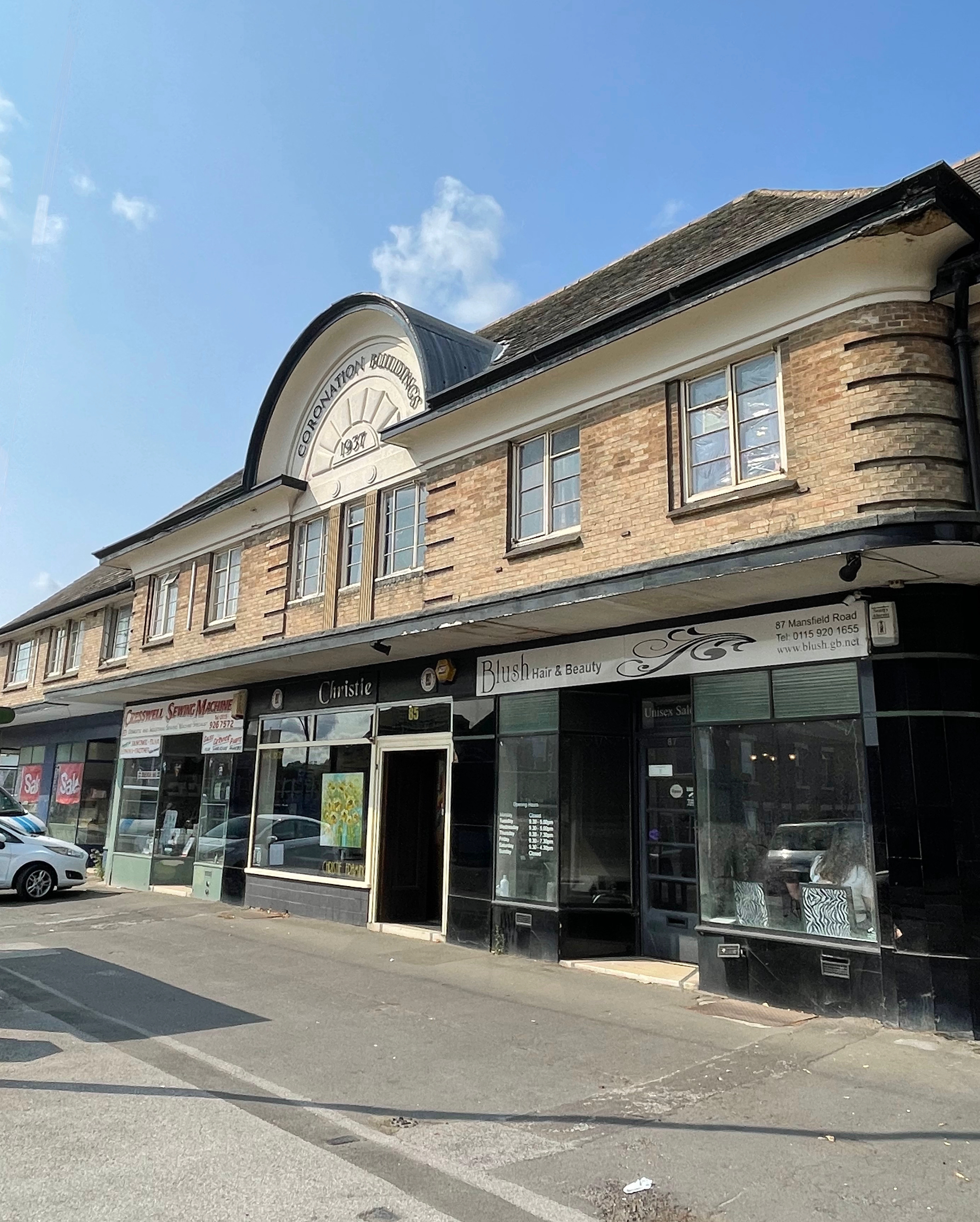
Close to these shops was our doctor’s surgery which was on the corner of St. Albans Road and Mansfield Road, where the scary (to me at least) Doctor Kendrick, who had the deepest voice I’ve ever heard, looked after our health. My favourite place, however, was probably Bexon’s sweetshop, which stood in Coronation Buildings, on Mansfield Road opposite the brewery and occupying the south-eastern edge of my world. It was run by two ladies of advancing years and housed a mind-boggling treasury of sweets, which they would pour out from large jars, in order to measure the precise amount required on an old-fashioned set of scales.
Alongside the buildings, the people who inhabited my world at that time also feature strongly in my memories. The other children I played with during those endless summers included Brett and his brother Clive, who lived at 1 Keats Close, with their parents Keith and Wendy. When they moved to Oxford, in around 1970, I remember waving at their car as they drove away for the last time.

At the top end of Keats Close, lived Mark – another of my friends. I was sent round to play with him when he had German measles, in the hope that I would catch it too (I didn’t). I also recall us both digging a very large hole in his garden with the aim of tunnelling through to Bombay, for reasons that are now lost in the mists of time! Mark’s dad, Tom, was a Policeman and when my Mum badly cut her finger whilst slicing an orange, it was Tom who drove us to the hospital. Then there was Paula, who lived in the last house on Salop Street, who was a school friend and a regular on the birthday party circuit; and a dark-haired girl called Lynne who lived across the ‘oat field’ in Browning Close. Lynne, and her sister and brother, have a starring role in another one of those memories that is burned into my brain. It is a remembrance of one of those endless blazing hot summer days that only seem to exist in our childhood. Myself, Lynne and her siblings are running around the ‘oat field’, before marching over to our house, through the echoing alley, in strict military formation. We break formation in our back-garden, playing with a push-along wooden trolley and then line up to jump through the gap between its handles, each of us taking a turn. We repeat this this over and over until my dad calls us over and hands us cooling lemon drinks from the kitchen, made with PLJ and sugar.
Not all was sweetness and light, however. In time honoured tradition there was a local ‘bully’. He liked to throw punches at me, and once pushed me into a hedge on Shelley Road when I was on the way home from infant school. He also used to turn up at the front door of the house and demand that I give him my best toys. In fairness, he must have mellowed with age, because later, at junior school, I got on very well with him and we used to go swimming together.
Amongst the other cast of characters who passed through Morris Street’s stage on a regular basis was the rent man, on his motorised scooter, the insurance man, and the ‘rag and bone’ man. I remember walking up the hill behind his cart, as he rang a bell and shouted “rag and bone” on his way up the street.
Occasionally, I was asked to go down to the corner shop. Once I was sent on my own to fetch some potatoes. I was provided with a handful of old pennies for this purpose. I can still recall the bell ringing when I entered the shop, and the dusty wooden floor. The shop was dimly lit, and there was a split counter with provisions stacked up on high shelves behind it. Some things, like potatoes, were deposited in sacks in front of the counter. The old man who ran the shop had snow white hair. He must have been Douglas Trusswell, who lived in the shop with his wife Grace from the late 1950’s until the early 1970’s. The previous owners were called Gretton, and I have this niggling feeling at the back of my mind that we referred to the shop as ‘Gretton’s’. When I asked for the potatoes, Mr. Trusswell asked me sternly (or so it seemed to me) whether I wanted “reds or whites”. I can clearly remember being completely confused by the question and not knowing the answer. I still don’t recall which sort of potatoes I ended up with!
Of all of our Morris Street neighbours, there are two who stand out in my mind more clearly than the rest. At 32 Morris Street, the house adjoining ours, lived Mrs. Fitchett. I called her ‘the old lady,’ and she did indeed present the archetypal image of just that, grey-haired with a shawl around her shoulders and always sporting a kindly smile. I can recall her standing, smiling benevolently, at the low wooden fence that separated her part of the yard from ours and offering to fetch me a piece of cake. She had a son called Sam, a jovial sort of chap, who used to visit her on a regular basis. However, I was slightly bemused that someone’s son could look as old as he did.
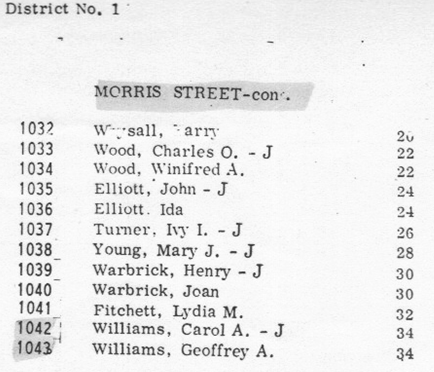
Mrs. Fitchett was actually born Lydia Maud Woodhouse, in Shepherds Bush, London, on 18th February 1887. Her father was a bricklayer, and they had moved to Nottingham (Carrington) by 1901. She married Joseph Fitchett in 1907 and they set up home in Bulwell, where they brought up their two sons, William born in 1908 and Sam in 1910. It’s not clear what happened to Joseph… it’s possible that he died in one of the wars… but Lydia moved into 32 Morris Street in 1945. Apart from a couple of years in the late 1940s, when Sam and his wife Lily lived with her, she lived in the house on her own for over twenty years. Mrs. Fitchett outlived Morris Street and died in 1978 aged 91. Sam died a little later in the same year aged 67.
I also considered the sole occupant of number 28 to be an ‘old lady’. However, she wasn’t the benign smiling old lady personified by Mrs. Fitchett, instead she appeared to us kids as a dour and humourless figure. Reclusive and drably dressed, usually with a hairnet in place and not a smile to be seen; we knew her as ‘Janet’. I must confess to some feelings of guilt, with regard to Janet. She didn’t have the best of relationships with the children around Morris Street, and in turn they called her names and treated her with great disrespect. I know that, at the very least, I never stood up for her point of view (my defence is that I was only seven years old when we moved away from the street, but it is a poor excuse).
My moment of shame, which has lived with me all of my life, is that I witnessed other children pushing ‘dog dirt’ through her letter box and that I never did anything to stop them, nor did I even remonstrate against them. Afterwards she came to the door and mumbled something, presumably a rebuke, before shutting herself away again. Now, having lost the naivety of my childhood, I know how wretched she must have felt, and I can’t even begin to understand how alone and hurt she must have been. If only, I keep thinking, she had engaged with the children in a more positive way, and even given them an insight into her life story… because she did have one hell of a story to tell. Instead she cut a lonely and frustrated figure. How different it all could have been.
‘Janet’ was born Mary Janet Young on 28th January 1910. The first revelation, therefore, is that at that time and by today’s standards she wasn’t an ‘old lady’ at all when I lived on Morris Street. Her father, Nicol, was a lace worker, who was born in Galston, Ayrshire, in 1872. He and his family later moved to nearby Newmilns, which was also a lace making town. It was a family trade with Nicol’s father, George, employed as a lace weaver and some of his siblings fulfilling other roles in the industry. By the mid-1880s the whole family had moved to Arnold, where Nicol married Mary Ann Rockley in 1899. By 1901 they were living on Church Drive. However, Mary Janet, their first child, was not born in Arnold, or even in the United Kingdom. The second revelation comes from the 1911 census, which gives her place of birth as ‘United States’.
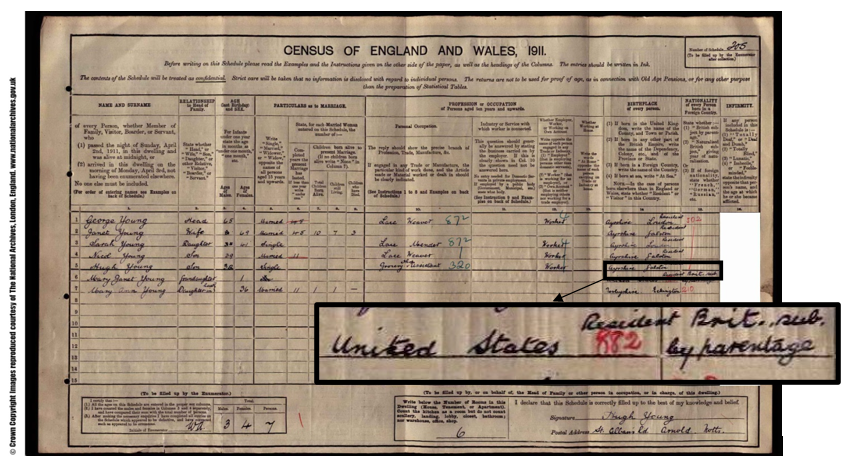
Mary Janet was actually born in Gouverneur Village in St. Lawrence County, New York State. Gouverneur stands close to the Canadian border, on the Oswegatchie River (a tributary of the St. Lawrence River), not far from the edge of the Adirondack mountains. Although the local economy was historically largely reliant on the production of talc and marble, in 1902 the village opened their very own lace mill. Because they were starting lace production production from scratch, they would have required skilled workers and Nicol Young would have fitted the bill perfectly. Nottingham, of course, was the world leader in the trade, and the type of lace that the Gouverneur mill specialised in was, you’ve guessed it… Nottingham Lace.
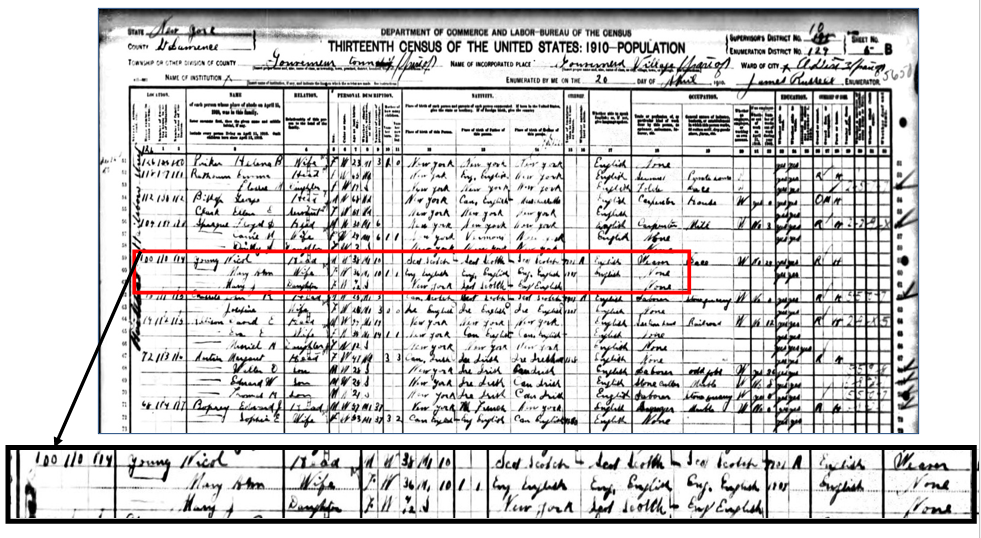
Nicol and Mary Ann travelled out, initially to Philadelphia, in separate journeys, in 1907. The Young family hold the (presumably) rare distinction of appearing on both the United States Census for 1910 (on 20th April ) and the U.K. Census for 1911 (on 2nd April). However, it would seem that neither Nicol nor the lace business prospered in Gouverneur. The USA census shows that Nicol had suffered a significant period of unemployment during his stay in Gouverneur. The mill itself ceased lace production in 1928. The Young family chose to return to the UK, embarking from New York on the S.S. Mauretania and arriving back in Liverpool on 28th February 1911.
The Young’s moved into 28 Morris Street in around 1920. Mary Janet became a ‘Hosiery Winder’ but remained a spinster for the rest of her life. Nichol Young died in 1953, and his wife Mary Ann lived until1960, leaving Mary Janet the sole occupant of the house. In 1973, shortly after she was forced to leave her home of fifty plus years, prior its demolition, Mary Janet died aged 63 years. The family are buried together in Redhill Cemetery.
The most significant event during our residence on Morris Street was the birth of my sister, in early 1967. My memories of this day are still clear. I recall being at the top of the stairs, trying to get into the back bedroom, but whoever was in there wouldn’t let me in and I couldn’t understand why. Instead, I was taken to the house next door, where I spent the time playing at Batman and Robin with Brett and Clive. I have only a few memories of my sister as a baby. I remember her christening at St. Pauls Church, and our holiday in Robin Hoods Bay later that year. I also remember having our photograph taken on the settee in the living room, the professional photographer who took the picture asking me to smile, and to “watch the birdie”. I am also told that I bit her on one occasion (possibly to find out what she was made of).
There were other events that happened on and around Morris Street that also left an indelible imprint on my young mind. One day I was sitting in the back seat of my dad’s car, directly outside our house and all on my own. I watched as a milk float trundled up the hill. The driver was talking to a woman on the pavement who was walking in the same direction. His mind clearly wasn’t on the road and he proceeded to drive into my dad’s car. I was, understandably, distraught, but my grandparents were miraculously on hand, and it was nothing that a tube of ‘Smarties’ couldn’t make better.
One day my Dad took me for a haircut in Daybrook…not at Rex’s, my usual barber of choice, but at another establishment located in Coronation Buildings. My dad asked the barber to give me a ‘crew cut’. He duly obliged by cutting off all of my hair! I hated it, and I became overly sensitive to any comment made about it; so much so that when an ice cream man – parked up outside our house – called me a ‘skin head’, I ran off in tears!
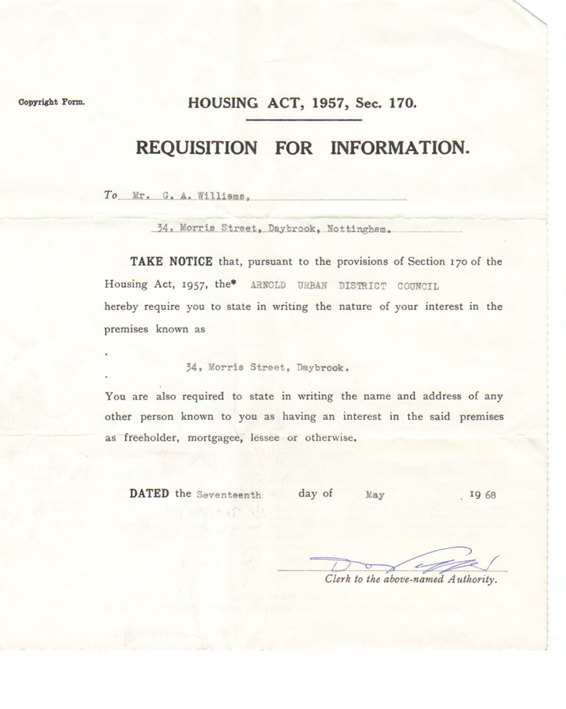
Our five years on the street ended in November 1971. The writing had been on the wall as early as 1968, when the council wrote to residents to confirm their relationship to their property (left). Morris Street and Salop Street, plus the houses at the bottom of the hill on Mansfield Road, were to be demolished. At the time I didn’t feel sad. Sadness was usurped by feelings of excitement at the prospect of moving to a new house, with my own bedroom, plus upstairs and downstairs toilets! On our final day, I walked to Roundwood Junior School as normal, accompanied by my new neighbour, Martin, whose family had moved into1 Keats Close soon after Brett’s had moved out. Instead of walking home to 34 Morris Street that evening, however, I ambled up the hill to our new house on Roundwood Road, just around the corner from my school, and, just like that, a new chapter had begun.
By the time of the 1972 Electoral Roll, only numbers 22 to 26 Morris Street were still inhabited. Shortly thereafter, I visited number 34 for the last time with a friend from my new housing estate. We were able to still get into the house through the front door, and I was able to show him the roadway in the bay window where I used to play with my toy cars.
A few months after our visit, the house, and the street, were gone. For a few years, the double street sign that pointed one way to Morris Street, and the other to Keats Close, lingered on, even though nothing was left of the houses on the older street. In time a new house was built on the site of number 34. However, this imposter became part of an extended Keats Close, and Morris Street faded into history, leaving behind only the ghosts of the people who used to live there.

Over one hundred years after his death, and despite the demise of Morris Street, the mark that Edwin ‘Neddy’ Morris’ had on the area has not disappeared completely. The name Salop Street was retained for an access road to a new Doctor’s Surgery and industrial units, just off the A60 Mansfield Road, at the lower end of where the original street would have stood. And in the centre of Daybrook, a century-and-a-half after his Morris Street plans were submitted, Edwin Street still proudly bears his name.

Appendix: Occupants of Morris Street.
| Year | Occupant(s) |
| 1885-1919 | Not able to confirm definitively – electoral rolls are only available from 1920 onwards. The census returns for 1891-1911 do not include house numbers. However, Edwin Morris was resident on Morris Street in 1891 and the census layout would indicate that he was living in either no. 34 or no.1 in that year. |
| 1920-1921 | George and Kate Foster. |
| 1922-1923 | George Foster only. |
| 1924-1925 | George and Emma Foster. |
| 1926-1928 | Alf Tolley, Lucy Tolley and Ernest Mellors. |
| 1929-1940 | Alf Tolley and Lucy Tolley. (NB: Alf Tolley was born on 29th October 1898 in Daybrook and was a Builders Labourer in 1939 at the time of National Registration. Lucy (nee Knighton) was a year younger and probably born in Redhill. They married in 1920 and shared No. 34 with their seven children – Dennis (aged 16), Leslie (13), Kenneth (12), Howard (8), Edna (4), Catherine (3) and Brenda (born the same year). |
| 1941-1944 | No Electoral Rolls due to Wartime. |
| 1945 | Ethel Bostock and Lillian Demmen. |
| 1946 | Ethel Bostock, Joseph and Elizabeth Tovey. |
| 1947–1948 | Ethel & Francis Bostock (indicating perhaps that Francis had recently returned from service in the war?), Joseph and Elizabeth Tovey. |
| 1949-1950 | Ethel & Francis Bostock, Boris and Nellie Kennard. |
| 1951 | Maria and Agnes Holben, Alice Hudson, Cuthbert Newton. |
| 1952-1961 | Bernard and Joan M. Bristow |
| 1962 | Joseph Swift |
| 1963-1965 | Joseph and June Swift |
| 1966-1971 | Geoff and Carol Williams |
Additional Sources and Acknowledgements:
- UK Census records 1851-1911
- UK Birth, Marriage & Death Indexes & Certificates.
- Image of Sir John Robinson courtesy the National Portrait Gallery (Creative Commons Licence).
- Thirteenth Census of the United States, 1910 (NARA microfilm publication T624, 1,178 rolls). – New York State, St. Lawrence County. [Ancestry.com].
- Morris Street Building Plans Ref: DDMI 263/1/227 – Held at Nottinghamshire Archives.
- Arnold Urban Authority Notice Ref: DC/A/1/64/5 – Held at Nottinghamshire Archives.
- Ordnance Survey Maps 1880s-1970s.
- Electoral Roll Data 1920 – 1972.
- National Registration Data 1939.
- Photographs from Nottinghamshire Central Library Collection/ North East Midland Photographic Record. Note that, where stated, some images were originally obtained from the www.picturethepast.org.uk website, there has been some subsequent development of this site and some photographs may now by available via www.picturenottingham.co.uk ,
- Various Internet Resources including the British Newspaper Archive.
 The Red Writer