Author Archives: redwriter64

Well-skilled to weave: The lace-making journey of Nicol Young.
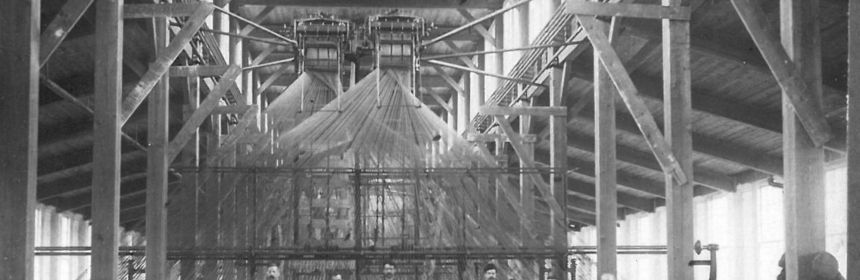
From Newmilns to Gouverneur, via Daybrook and Philadelphia – the story of the men and women who made Nottingham Lace in America.

It has the makings of a rather long-winded pub quiz question… 

What links the following places?

  • The valley of the River Irvine in Scotland
  • The city of Nottingham, England
  • The Nottinghamshire county towns of Beeston and Arnold
  • The city of Philadelphia PA
  • The American communities of:
    • Gouverneur, Kingston and Patchogue NY
    • Chester, Scranton and Wilkes-Barre PA
    • Pawtucket RI
    • Tariffville CT
    • Zion IL

It’s possible there may be other connections, of course, but my categoric answer is that this disparate list of places are linked by ‘Lace’. More specifically, all of these towns, villages and cities came to manufacture the product known to the world as Nottingham Lace. As told in this story, these communities are also connected by the hundreds of men and women who travelled thousands of miles around the world in the service of mass-producing this decorative textile.

As far as I can tell, the human stories of those migratory lace workers have largely gone unnoticed, but they were silent battalions who helped put ornate curtains at the windows, and picot-edged cloths on the tables of the Victorian and Edwardian world.

This is primarily the tale of just one of those men, a single foot soldier in the ranks of a world conquering army. I have chosen to tell it, specfically, because of a relatively obscure personal connection, one that will be explained as the narrative unfolds. However, this story also offers us the opportunity to delve into the many adventures of other individuals who shared similar journeys, and also to find out about long-lost industrial worlds that have left both a physical and a demographic mark on our own time.

Part One – A Journey begins.

On Wednesday 27th February 1907, nine days short of his thirty-fifth birthday, a Lace Maker called Nicol Young walked up the gangplank of United States Mail Steamer, the SS Noordland, at the port of Liverpool. The ship was moored at the Prince’s Landing Stage1 and she was looking her age, as smoke bellowed from her single black funnel. The funnel sat somewhat at odds with the ship’s four rigged masts that were throwbacks to the ‘old world’. First launched in 1883, the Noordland was destined to be taken out of service and scrapped the following year. Now, bearing the eagle insignia of the American Line, she was embarking upon one of her last transatlantic crossings; a two-week passage to Philadelphia, via the Irish port of Queenstown. As he felt the vibrations from the engine rattle through the steamer’s superstructure and imbibed the sights and sounds of the ship: the busy docks and the crowds of well-wishers waving them on their way, Nicol was, no doubt, experiencing both excitement and trepidation. Whether he had planned his trip meticulously, or he was leaving himself to fate, we don’t know… but it is likely that the story of his time in the United States didn’t, in the end, turn out to be one that he would have chosen to write for himself.

The SS Noordland in Red Star Line livery, before it was taken on by the American Line in 1901. (Public Domain/Wikipedia Commons)

Although he was a native of Scotland, with roots in the Irvine Valley, a region with a rich pedigree for weaving and, more recently, lace making; Nicol had actually travelled to Liverpool from Daybrook, a small suburb of the town of Arnold in Nottinghamshire, at the heart of the English Midlands.

Daybrook was the place he had called home for the last twenty-years or so. Arnold, incorporating Daybrook, also had a significant hosiery trade. Nicol’s father, George, a Lace Weaver himself, was the man who had brought the whole family to Nottinghamshire … moving south from the village of Newmilns, Ayrshire in the early 1880’s. At first, they had settled in the villages of Greasley and Kimberley, before moving on to Arnold. So, in a sense, Nicol was already a migrant, even before he had set foot on the ship.

Now, Nicol was just one man lost amongst hundreds of the Noordland’’s steerage passengers (the ship could accommodate up to five-hundred third-class travellers, alongside one-hundred-and-sixty in the second-class cabins)2. He was travelling alone, having left his wife of eight years, Mary Ann, back home in Daybrook… for now at least.

Part Two – The Golden Goose.

Like many of the steerage passengers undertaking the journey with him, Nicol was travelling for economic reasons. We don’t know exactly what he had in mind, of course, but it is likely he was just seeking modest financial betterment for him and Mary Ann. However, he was only human, so it’s possible that he could have been harbouring dreams of striking it lucky and make his fortune in, what many saw as, the land of opportunity across the Atlantic.

Nicol was a cotton lace maker, which essentially means that he operated the machinery that made the lace3. Nottingham Lace was famous world-wide and was especially renowned at that time for its lace curtains and tablecloths. Whilst it is true that, in those years, the lace industry in Nottinghamshire had not yet plunged into total decline (that would be precipitated in later years by the Great War), its position as a world leader was most definitely being challenged. Virtually all production was now mechanised, and foreign competition was starting to make a real impact on the market. By the turn of the century, one of those countries trying very hard to muscle in on Britain’s place at the head of the lacemaking pecking order, was America. 

Of course, it was not unusual for individuals and families to seek new horizons, even to emigrate, for the sake of economic stability; this had been happening for centuries. However, for non-native industries trying to establish themselves in new locations, immigration was a way to bring in the essential expertise and ready-trained labour necessary for them to hit the ground running. When it came to lace making at least, this population merry-go-round had, in the past, resulted in people moving largely between Britain and Europe… to Germany and France in particular4. Calais, for instance, had a thriving mechanised lace industry which had historically attracted migrants from Nottingham and vice versa.

In an interview in the Nottingham Post dated 28th August 2021, Dr. Josephine Tierney, from the University of Nottingham, a post-doctorate researcher on the topic, cited Nottingham families who had travelled to Patchogue, Long Island, in the United States, between the middle of the nineteenth century and the early twentieth century for this purpose. It worked the other way around too. Nottingham was, after all, the world leader in the manufacture and trading of lace, and there are records of American families emigrating to Nottingham to work in the industry there.

The Lace Mill at Patchogue, Long Island NY (Patchogue Medford Library)

As well as a growing lace trade, America had other attractions that would appeal to a young man of Nicol’s generation. The lure of American mythology had already begun to embed itself in the British psyche through literature and the media of the day. Buffalo Bill’s Wild West shows had been touring the UK since 1887 and had only recently finished a tour in 1906. The ‘Western’ movie was already established as a genre, in fact it is believe that the first movie of this type was actually made in Northern England in 18995.  It all added to the appeal of the New World for anyone thinking of trying their luck across the Atlantic Ocean

William F. “Buffalo Bill” Cody in 1911 – plus one of his Wild West Shows captured in Italy in 1890 (Public Domain)

The lure of the American mythology aside, there were a couple of very sensible reasons why Nicol had chosen to sail to Philadelphia. Firstly, for a lace maker, it appeared to be a good choice based on opportunity alone. The manufacture of textiles was the largest industry in the city, ahead of shipbuilding and the railroads. The textile industry also incorporated a growing lace making sector – one of the largest in the US.  

The Federal Government had been increasing tariffs on Nottingham Lace incrementally since the 1890s. At that time Nottingham had a virtual monopoly on provision of the machinery that produced lace curtains 6. However, the tariff changes had encouraged the birth of a home-grown lace industry, and, by 1907, there were several lace mills operating in Pennsylvania. This included two in Wilkes-Barre (the first founded in 1886), one in Scranton and three in Philadelphia itself (according to Dr. Tierney) – including the mill purchased by Joseph Bromley in 1894, located on the corner of North 4th Street and West Lehigh Avenue.

The Bromley Mill, also known as the Quaker Mill, on the corner of west Lehigh Avenue and North 4th Street, Philadelphia.
(Free Library of Philadelphia)

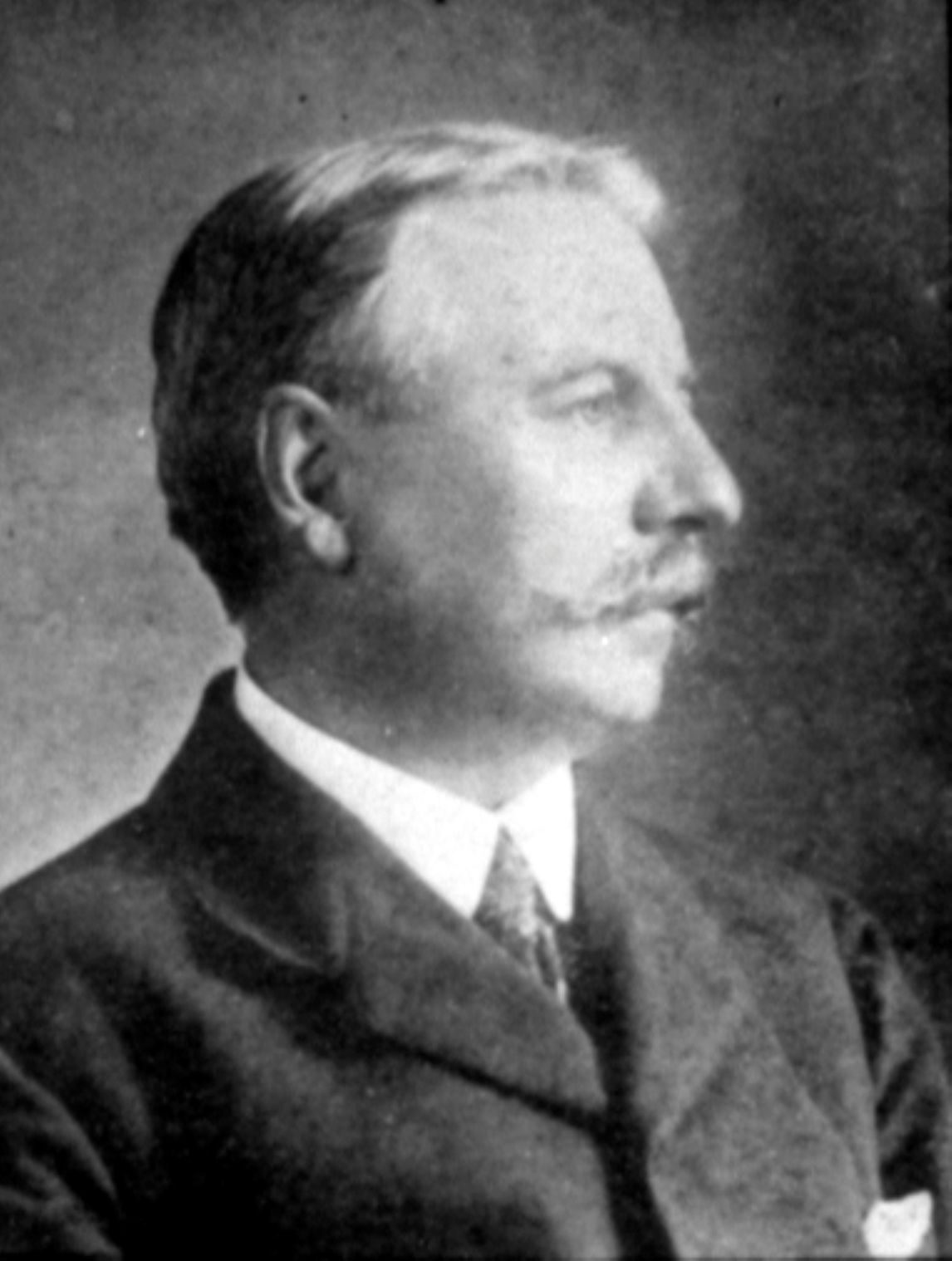
Bromley had obtained assistance in his venture from a Nottingham native called Sir Ernest Jardine (pictured left) 7. Jardine, who was later the MP for East Somerset, was an industrialist, whose company made and exported lace making equipment. Other Nottingham lace workers had already made the move there. Seasoned lace worker John Bowley emigrated from Nottingham to the US in 1893, taking his whole family with him 8. Bowley worked initially at the mill in Patchogue, Long Island, before relocating to the town of Chester, adjacent to Philadelphia. Here he was instrumental in starting up the Chester Lace Mill. So, it seems that there were both opportunities for employment in the lace or hosiery industry and long-standing Nottinghamshire connections in ‘Philly’ which Nicol might have been able to leverage if he needed to.

This Nottingham ‘connection’ also, most obviously, came in the form of the type of lace that many of these mills produced: Nottingham Lace. It was a brand that was known worldwide.

I think it’s time for a second pub quiz question then… “What was – or is –Nottingham Lace?”

The term Nottingham Lace entered the popular vocabulary towards the end of the eighteenth century, as entrepreneurs in and around Nottingham and Nottinghamshire sought ways to mechanise the production of ‘needle’ or ‘bobbin’ lace, which was largely a cottage industry during that period/ Lace-like fabrics had been around for thousands of years and it was probably introduced to Britain by Flemish immigrants. Nottingham, at the time, had a thriving hosiery industry making stockings using wooden frames. It was so successful that the number of workers engaged in producing stockings (sometimes whole families were involved) was exceeding the demand for stockings. Finding another way of utilising the frames, with modifications, to make lace, made sense to both alleviate the plight of the ‘stockingers’ and provide a ready-made skilled workforce. Following the invention of a frame adaption by John Rogers of Mansfield in 1786, the development of what were known as ‘point net’ machines took off, with new inventions appearing regularly well into the next century, which allowed for the production of finer, more intricate, patterns than those able to be produced by hand. This superior machine-made product was soon termed Nottingham Lace.9

It was originally called Nottingham Lace, therefore, because it was manufactured in Nottingham. So, could the term legitimately apply to lace manufactured in America, or anywhere else outside of Nottingham? Well, it would seem so… the term Nottingham Lace became synonymous with the type of product produced in Nottingham, rather than the geographical location where it was made. The Merriam-Webster Dictionary defines Nottingham Lace as “any of the various flat laces and nets machine-made originally at Nottingham, England and used for curtains, dresses, tablecloths”. Other definitions refer to the intricate designs and patterns including floral motifs and open spaces, which create a “light and airy effect”, or with scalloped or zig-zagged (picot) edges. Whatever it may have been in practice, identifying your product as Nottingham Lace in the early twentieth century gave it a certain cachet that was likely to make it even more desirable. Throughout the nineteenth century though, Nottingham remained at the centre of the mechanised lace-making universe.
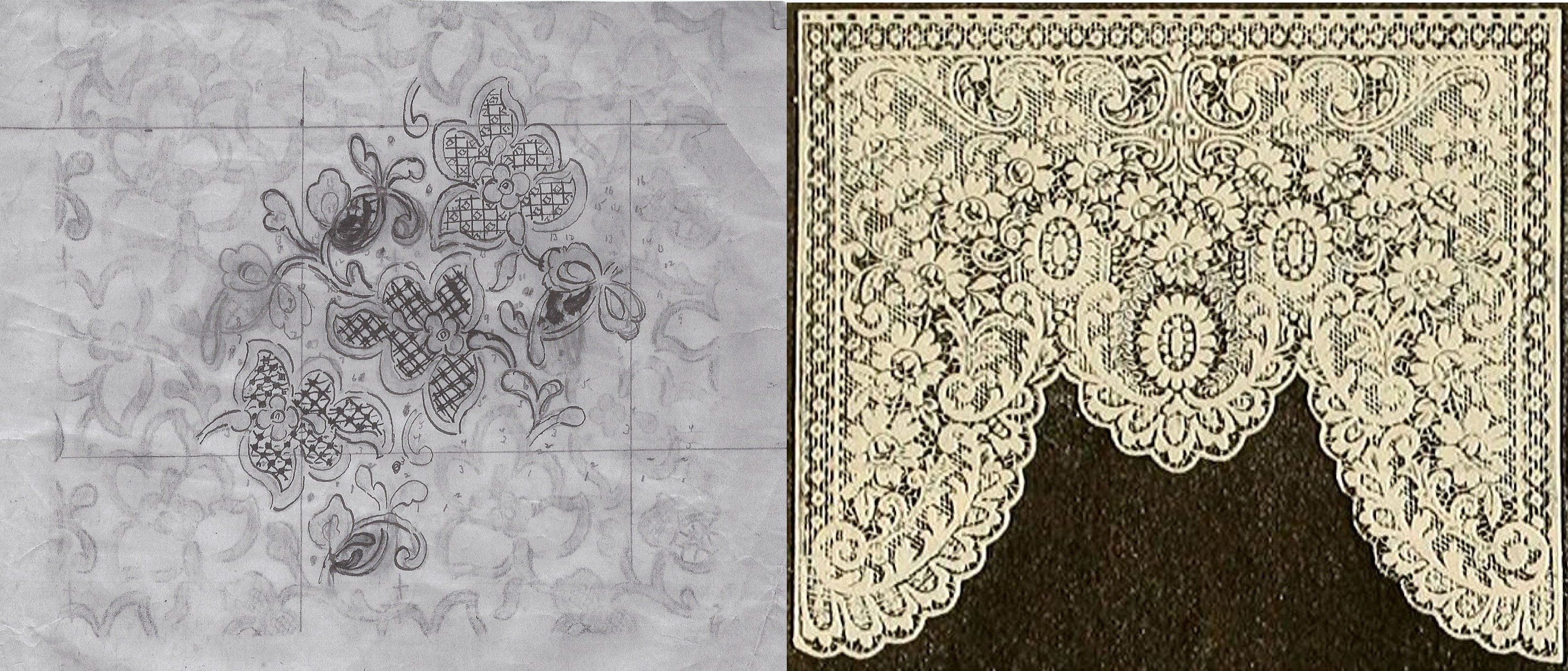
Left: Lace Design by a forbear of mine, Basil Robinson Westley, who worked in the lace trade in Nottingham, and himself emigrated to Calais around 1900. Right: Nottingham Lace Lambrequin Window Drape, 1912 (vintageephemera.blogspot.com).

Part Three – The Smiths, the Youngs and the Irvine Valley.

Whatever the employment opportunities that may have been waiting for him in Philadelphia as a skilled lace worker, Nicol also had another advantage over some of his fellow passengers: he had family already living in the city. Having someone close at hand who could help him get his bearings, and maybe even help with finding work must have been a great reassurance for him. The ship’s passenger list tells us that Nicol was travelling to join his cousin, Hugh Smith, who at that time was residing at 2133 West Somerset Street in the city. The house was a thirty-minute walk from the aforementioned Bromley mill. Before the year was out, Hugh had moved to 2917 North Marshall Street, which was even closer to the mill, only a ten-minute walk away.

Hugh Smith was related to Nicol through his mother, Sarah Young. He and Nicol’s father, George, were half-brothers. Hugh was also an émigré Lace Weaver. He had travelled to the US in 1906 from the village of Newmilns, Ayrshire, where he had been born in 1855. As previously referenced – Newmilns had also been the village where Nicol and his family were resident prior to their move to England in the 1880s. Hugh’s son, also called Nicol, was residing with him in Philadelphia at that time too, he’d been there since 1902, together with his wife Janet, and two young children –  a son, also called Hugh – and a new baby daughter, Mary (confusingly there are lots of people called Nicol, Hugh, Mary and Janet in this story – see chart below).

Chart showing relationships between Nicol Young and the Smith family.

It’s probably worth spending some time at this point to discuss the history and geography of the Irvine Valley area, because it will feature again in this story. The aforementioned village of Newmilns is located on the north bank of the River Irvine, in the parish of Loudoun. It is around seven miles from Kilmarnock, which is the largest town in the area. Newmilns is sandwiched between the settlements of Galston (where Nicol was born in 1872) and Darvel.
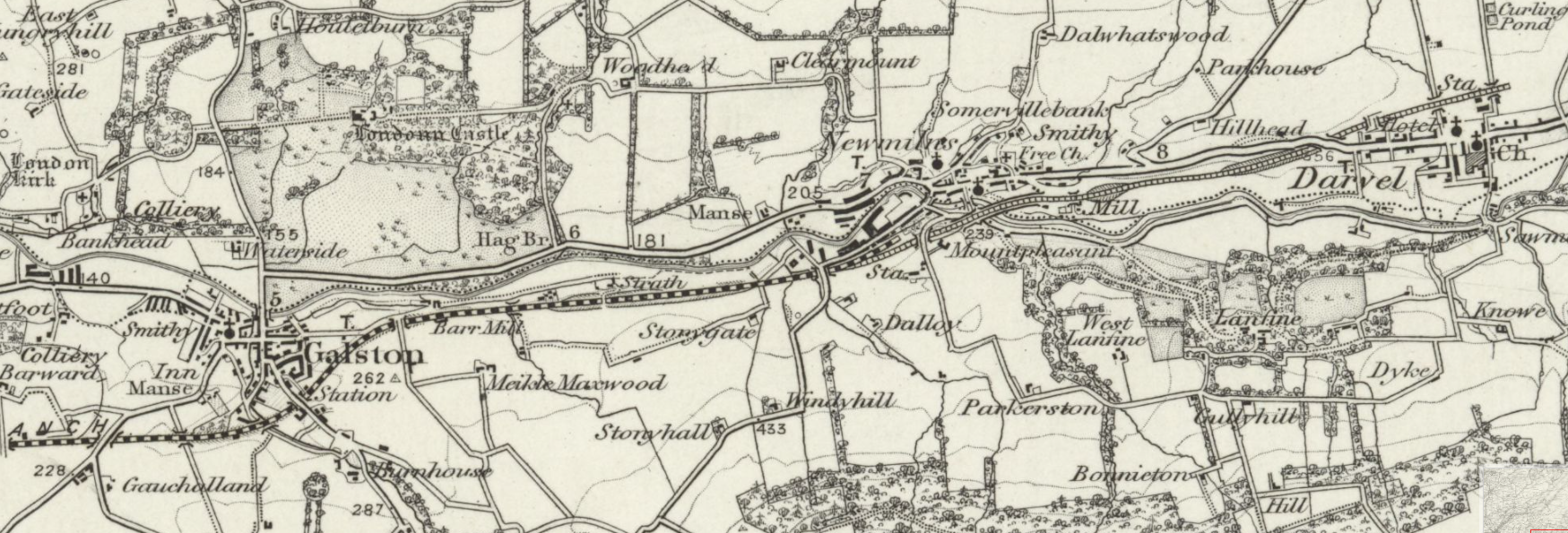
Segment of ordnance survey map dating from 1855-1857 and revised and re-published in 1897, showing Irvine Valley towns east of Kilmarnock – Galston, Newmilns and Darvel, plus Loudon parish. National Library of Scotland CC-BY (NLS)

I have already referred to the region’s weaving pedigree, which applied right across the villages and towns of the Irvine Valley. Historically, this had been built up by the area’s French Huguenot population. They had settled in Ayrshire after fleeing persecution in France at the end of the sixteenth century and had established weaving as the prominent trade in the valley. The industry boomed once Britain started to import cotton from the USA. As a result the population of the area, and urban expansion, grew in parallel with the prosperity of the towns.

However, this was a population in flux. For many years the Campbell family, who ran the Loudoun estate, had been taking advantage of demographic changes to grow the size of their farms in the area. Whilst this enabled them to employ more modern and profitable methods of farming, it also needed fewer tenants and less labour to work the land. This encouraged some families – from communities who had lived in the area for many decades – to look to Glasgow or even America for new opportunities. Pennsylvania was one of the top destinations for migrants to the new world from the Irvine Valley – meaning that there was already an immigrant cohort in Philadelphia, and nearby population centres, by the time that Nicol set sail. 10

1:2 model of a Jacquard Loom made in 1867 showing punch cards – Science Museum CC BY-NC-SA 4.0 Licence

To compound this trend, the introduction of the Jacquard power loom to the area in 1877 accelerated the automation of the weaving industry, resulting in increasing unemployment amongst weavers and a further decline in the population of the towns of the Irvine Valley. The Jacquard machine was considered by some to be one of the first examples of computer programming, using as it did punched cards to dictate which warps were raised at any given time. 11

To counterbalance this, Lace manufacture had been introduced to Newmilns from 1876, and it was to successfully establish itself during the next decade as more and more production was moved to the valley from the Nottingham area (some sources allege that this was an attempt by the lace companies to neuter the impact of Trade Union power12). Whilst this was good news for many Scottish hosiery workers, others, like Nicol’s father George had already decided that better opportunities lay elsewhere. For George, this meant taking his family not to Glasgow, nor abroad, but south to Nottinghamshire in the English Midlands: the home of the lace industry.

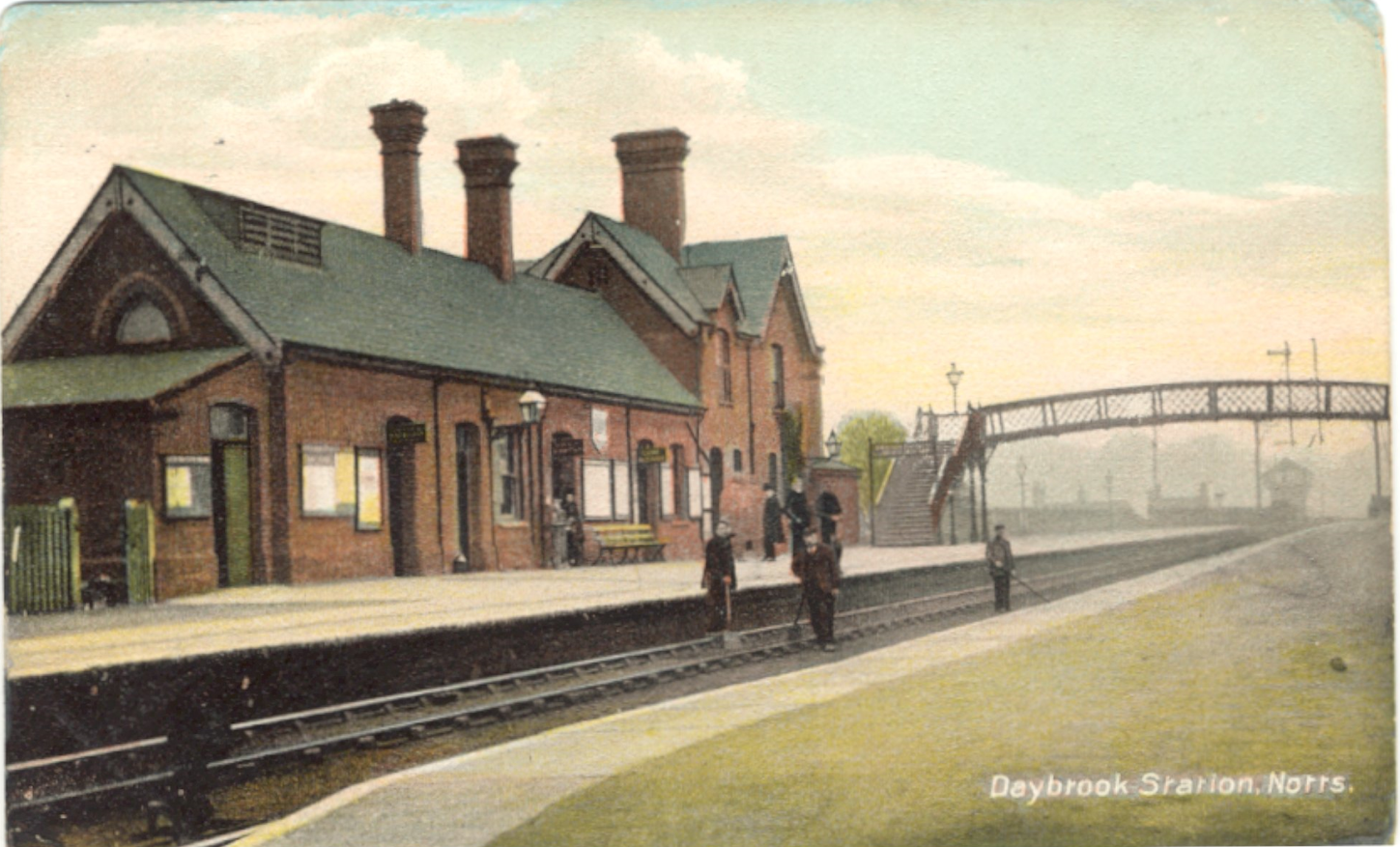
George and his family ended up in Arnold suburb of Daybrook. White’s Directory of Nottinghamshire records two lace manufacturers in Arnold as far back as 185313. Historically framework-knitters had formed a significant percentage of Arnold’s working population (including some of my own ancestors), so there was a ready workforce for this type of endeavour. As Daybrook expanded with the help of the Robinson family and the coming of the railway, in the latter part of the nineteenth century, this former tiny hamlet hosted the development of hosiery factories of its own14.

It is perhaps also worth noting that, at that time, the move of lace workers from Scotland to Arnold appears not to have been a commonplace occurrence, certainly not for weavers and lace makers, despite the town’s hosiery factories. Excluding the Youngs, the 1901 census records only eleven households with at least one member born in Scotland. Only one of these individuals had any connection to the hosiery trade (a ‘blouse maker’). The Youngs were the only lace makers amongst the Scottish émigrés listed in Arnold. By the time that Nicol felt that it was time to consider his own future, some 20 years after the family’s original move away from Scotland, it was America that beckoned.

Daybrook, a suburb of the Nottinghamshire town of Arnold, from the air – dated 1923.

Part Four – Philadelphia.

The Noordland”s crossing of the Atlantic was beset by strong winds and gales, at least for the first part of it’s journey, although the weather improved in the early part of March15. Whether he found his sea legs or not, Nicol arrived safely in the port of Philadelphia on 14th March 1907.

As he stepped into the streets of this vast industrial metropolis for the first time, after negotiating Customs at the Immigration Station (Pier Fifty-Three) on Washington Avenue, what he encountered would have probably been mind boggling in comparison to what he had known back in Britain, just in scale alone… let alone getting to grips with new-fangled ideas like hot-dog sellers on the streets and the extensive mix of nationalities in the city.

Pier 53 – Philadelphia Immigration Station on Washington Avenue (Photo Credit: Delaware River Waterfront Corporation)

Philadelphia was an immigrant city. Most of these migrants came from Ireland and Germany but, as we have seen, there was also a long-standing Scottish community. Philly’s population had rocketed from nearly eight-hundred-and-fifty thousand in 1880 to over a million by 1900 and twenty-thousand immigrants were still arriving each year 16. The confusion, noise and diversity within the Immigration Station after each vessel arrived can only be imagined. The station could accommodate a maximum capacity of fifteen-hundred people, and it’s eight inspectors could process three-hundred English speaking passengers per hour, but only one-hundred-and-fifty non-English speakers. Frederic M. Miller, in an essay called Philadelphia: Immigrant City, described the scene:

“The station naturally became one of the most colorful places in Philadelphia.  Inside, for example, was a part of the examination room called the ‘Altar.’  Since under some conditions single women were prevented from landing, many hurried unions were celebrated on the spot.  Outside, there was usually a crowd of entrepreneurs eager to charge the newcomers exorbitant rates for a variety of needed and unneeded services.”

Often these immigrants arrived with a job already secured, some of those worked to pay off their fare for the crossing. We don’t know if the case with Nicol, but the fact that Hugh and Nicol Smith were already in situ must have given him, at least, some hope that finding work wouldn’t be a problem. Other arrivals were taken in hand by their own communities. A Russian immigrant called Saul Kaplan arrived in Philadelphia aged 13 in 1890 and left a memoir describing his experiences 17. He found employment in a factory and was paid two dollars a week – and was also charged two dollars for his board! If there was a ‘Golden Goose’ in Philly, it would have to be worked hard for.

A blog in the US National Archives by Griffin Godoy describes the story of an Irish Immigrant to Philadelphia, a girl called Bridget Donaghy, who arrived in Philadelphia aged 16 in 1909, together with her 9-year- old sister18. They had been sent to the US by their family in Ireland, essentially to be raised there, in the hope that they could escape the ingrained poverty back home. The girls were taken under the wing of a distant relative. Godoy goes on to describe how different nationalities in the city looked after their own:

“Philadelphia became home to immigrants from all over Europe. Thousands of Germans, Italians, and Irish decided to make the “City of Brotherly Love” their community. They all dispersed and created their own city blocs. Most Italians flooded to South Philadelphia, whilst the Germans and Irish occupied neighborhoods in Kensington and Fishtown. Churches, markets, and housing were quickly built as immigrants acclimated to their new American life. As time progressed, urban “white flight” caused another dispersion in Philadelphia and many formerly Irish neighborhoods were transformed as the Irish population flooded to the south of Philadelphia in Delaware County.”

Segment of Philadelphia Street map showing part of Ward 33 – including the Bromley mill at the corner of Lehigh Avenue and North Fourth Street (the number 33 is stamped over the factory), and North Marshall Street (top left) with part of Somerset Street also shown (middle right). https://www.philageohistory.org/

It is tempting to believe that new arrivals with links to the Irvine Valley were also part of a close and supportive community, and there is some evidence to suggest that this may have been the case. On the 1900 census for Philadelphia, there were one-hundred-and-two men and women who stated that they were born in Scotland and were lace workers. Virtually all of them lived in either Ward Thirty-Three or Ward Nineteen of the city – right in the area that 2133 West Somerset Street ,2917 North Marshall Street and the Bromley mill were situated, in suburbs known as Fairhill, North Philadelphia, West Kensington and Allegheny (see above map segment).

A diptych showing Panoramas across Philadelphia’s Mill District. The date of this public domain photograph is unknown, but at first glance this could be any large industrial city in the UK. The image is taken from the tower of the Bromley mill. “From the tower of the Bromley Mill at Fourth & Lehigh Avenue there are more textile mills within the range of vision than can be found in any other city in the world…” (Quote reproduced from https://www.workshopoftheworld.com/kensington/kensington.html).

In the first few months following Nicol’s arrival, we can surmise that things went well, because Mary Ann followed him out from Arnold, arriving in Philadelphia on 30th June 1907 on the SS Friesland, an American Line sister ship of the Noordland. The Irvine Valley immigrant community was bolstered further on 14th October by the arrival – via Boston – of another of Hugh’s sons, Thomas Love Smith, and his wife Maggie. Prior to embarking from Glasgow on the SS Laurentian, they had been staying with Maggie’s family at the Angel Inn, Newmilns; their return to the US may be a further indication that there were jobs available for the newcomers. 19

Before too long, Thomas and Maggie, together with Nicol and Janet and their families, would go on to share another leg of their adventure with the Youngs but before then, a year after Thomas and Maggie’s arrival, events in Philadelphia took a sad turn. On 15th November 1908 Hugh Smith Senior died of Pneumonia, aged fifty-three years.  Phthisis (Pulmonary Tuberculosis) was stated on the death certificate as a likely contributory factor, so he probably had been ill for some time. He was buried at Greenmount Cemetery two days later.

The sadness of Hugh’s death was compounded by the fact that Maggie was pregnant with his grandchild. She gave birth to a son on 4th February 1909, who was also named, perhaps unsurprisingly, Hugh.

Things got worse the following month. On 24th March 1909 Nicol Young’s younger brother, George, died, back home in Daybrook, also as result of Pulmonary Tuberculosis. He was twenty-six years old. We don’t know, of course, how long it took for this news to reach Nicol. This was a time before the telephone was in common use, so urgent messages were sent via Telegraph. Whilst sending the message – even across the Atlantic – could be relatively instantaneous, there was still the human factor of getting to a telegraph station at one end and receiving delivery of the printed message, by hand, at the other. Things like time of day would also be a factor in this process. However, the news, when it came, would have been devastating. The fact that Nicol was so far away from home no doubt intensified his grief and, I’m speculating here, but I imagine that it may also have provoked some feelings of guilt too.

Thomas and Maggie’s new baby was baptised at the Gaston Presbyterian Church on 21st May 1909, a short walk from the house at 2917 North Marshall Street. By the time of the baptism, Mary Ann and Nicol Young were expecting a child too. What a rollercoaster of emotions they must have gone through in those weeks.
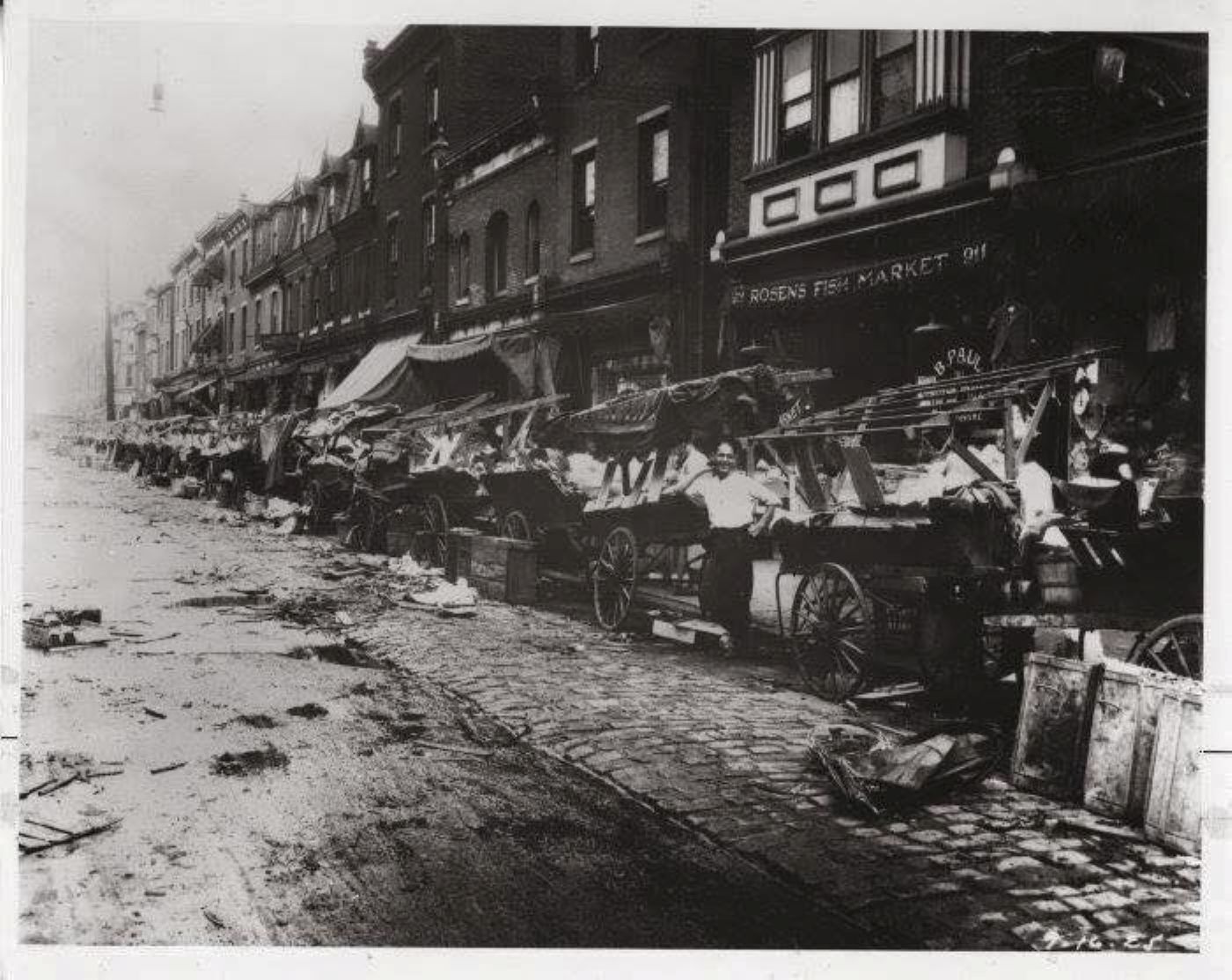
North Marshall Street, Philadelphia circa 1925 –
Elaine Ellison Collection, Historical Society of Pennsylvania (PhilaPlace)

There is nothing that focuses the mind like a new baby, or the imminent arrival of one. Finances immediately fall under the microscope and other things come into consideration too – like living in a hugely populous city, where disease was an ever-present threat (Hugh Smith Senior’s Tuberculosis diagnosis being a case in point – TB was the leading cause of death in Philadelphia at that time20) and where employment was never guaranteed. In addition, industrial unrest was always simmering under the surface in the so called ‘city of brotherly love’.  In the same month as baby Hugh’s baptism, violence scarred Philly’s streets, as the tram company brought in strike breakers over a dispute with the Motormen and Conductors Union. Trams, tracks and cabling were destroyed amidst claims of police brutality and many arrests21. Could these factors have played a part in Nicol and Mary Ann, together with their Smith cousins, taking the decision to move on again, and leave the the tainted air of the city behind? Or was the promise of increased financial rewards elsewhere that drove them… or maybe both factors together served to clinch the deal?

They weren’t alone in moving on. Of the one-hundred-and-two Scottish lace workers who had lived in Wards Nineteen and Thirty-three of the city in 1900, only twenty-four remained by the time of the 1910 census. An indication, perhaps, that the ‘golden goose’ now lay elsewhere. Things didn’t improve in Philadelphia and the industrial unrest that had been building up during 1909 was eventually to culminate in the fractious General Strike of 1910.

The three families chose to head up to the northern limits of New York State, to a place called Gouverneur, some three-hundred-and-forty miles away from Philadelphia, as the crow flies. It was a leap of faith, but then again, everything they had done up until this point had been one too.

Part Five – Gouverneur: “The Nottingham of America”.

The village of Gouverneur sits in north-west New York State, in the shadow of the picture-postcard pretty greenery of the Adirondack Mountains. It is located only thirty kilometres from the border with Ontario, Canada which dissects the St. Lawrence River. The river also gives its name to the administrative county that the village sits within. Then, as now, Gouverneur is served by the railway and, therefore, it is likely that the Smith and Young families travelled north by train. Today, if you travelled from Philadelphia to Gouverneur. it would be a minimum nine-hour trip, via New York City. In 1909 it would likely have taken longer, and you may have needed at least one stopover… in Syracuse perhaps?

The origins of Gouverneur can be traced back to 1787 when the New York State legislature sold parcels of land along the banks of the St. Lawrence River. Then it was no more than lines drawn on a map and given the name of ‘Cambray’. It wasn’t seriously settled until 1805. Gouverneur Morris, a United States Founding Father and former minister to France, subsequently purchased a significant volume of land in the area and the village was eventually renamed, not perhaps after Morris’s given name, but more likely after his Dutch-born mother’s maiden surname, which was also Gouverneur.

Panoramic view of Gouverneur, New York, in 1885. Eighteen years before the Lace Mill (Public Domain)

Up until the early part of the twentieth century, the village and wider town were mostly supported by industries that made use of the waters of the Oswegatchie River, which cuts through the village, to power lumber and talc mills. Mining of iron and pyrites, and quarrying, particularly of marble, also became more prominent as the 19th Century wore on. However, the reason that Nicol Young and his cousins headed here in 1909, was because of a new venture that had been unveiled some seven years beforehand.

The International Lace Company was constituted in Albany, New York in August 1902, partly in response to the favourable tariff position in the USA. The company’s major backers were Lesser Brothers of New York, who had previously specialised in importing Nottingham Lace. Now they were aiming to manufacture it on American soil. On the back of a prospectus issued by the new company, Gouverneur put itself forward as the perfect place to locate a factory. By October 1903 the factory had been built and production had commenced. The Ogdensburg Journal – which refers to Gouverneur as “The Nottingham of America” – described the scene in its issue dated 18th December 1903:

“The extent of the buildings would surprise many who have … not visited Gouverneur’s new industry. Occupying a commanding position on the west side of the Oswegatchie, they are a conspicuous feature of the place. Not until the visitor has gone over them, however, does he fully realise their extent. There are ten miles of water pipes in the building for heating and other purposes…

The offices in the front of the building are handsomely equipped. Here, as in other large factories, employees and visitors gain access to the mill. The long weaving shed… is a most interesting room. It is well lighted from sides to the top and here are spaces for thirty lace curtain looms. Six are in place, two more are on their way and seven more are to be imported within three months, making a total of fifteen which will be running in a short time.

A lace curtain loom is a lofty and complicated affair. High up among the skylights the patterns which are designed and made in a neighbouring department are inserted in the loom. The patterns control thousands of linen cords extending downward to the loom and multiply or drop threads as the weaving proceeds forming the pattern, the warp and woof being prepared and wound on spools, shuttles and cylinders in another department. Standing before the loom a person can see the flowers, figures and background of the curtains grow rapidly before his eyes.”

Gouverneur Lace Mill (Courtesy Gouverneur Museum)

The article claims that the Gouverneur lace mill was, at that time, the largest in the world. It goes on the say that, once the additional looms were installed, the mill expected to produce three to four-thousand pairs of “Nottingham Lace Curtains” per day, produce one million dollars’ worth of product per year and employ about three to four-hundred people. That workforce, it says, … will be drawn from the resident population. Some of the operatives, Swiss and English, who have learned the trade abroad, get big pay. Gouverneur people will be given the opportunity to learn, and the prosperity of many natives will date from the establishment of the lace mill.”

An original lace tablecloth, made at the Gouverneur mill in the first years of the twentieth century. (Courtesy Gouverneur Museum)

The optimistic outlook encapsulated in the article didn’t entirely come to fruition. By 1905 only ten looms were in situ and the number of employees was at the lower end of the numbers predicted. In 1907 the company filed for bankruptcy, blaming the high price of cotton, and the mill closed for business.22

Part Six – A new begining.

The mill was rescued from oblivion in 1908. A group of “Philadelphia capitalists” 23 purchased the plant at a public auction and put together a bold plan to treble production and increase the number of people employed at the factory. It is not totally clear from reports, but it was well-known that the Bromley company of Philadelphia had designs on the plant, and it is at least possible that they were involved in the consortium to resurrect it 24. If so, then it might also have been the case that the call was put out to its workers in Philadelphia to help them pull together the expertise they needed to enact the plan. This was perfect timing for Nicol, Thomas and Nicol and their families.

Early Twentieth century view of Main Street, Gouverneur. (No known restrictions).

We can’t be sure precisely which month they made the journey in, but there are clues that indicate that they probably travelled sometime between the Summer and Fall of 1909, this assumes that that the brothers and their cousin made the journey north either together, or within the same approximate time period. As a starting point – none of the three men were listed as employees of the lace factory in the Gouverneur village directory for 1907-1908.  We also know that Thomas and Maggie were in Philadelphia at the time of their son’s baptism on 21st May 1909 and that the latest possible date that Nicol Young was resident in Gouverneur is likely to have been from around mid-November 1909 25. Furthermore Nicol Smith’s wife, Janet, took their children back to Scotland to visit her mother in April 1907, returning to the US, via Canada, on 9th November 1909. Janet stated on the immigration papers that that she was heading to Gouverneur, so her husband must have been resident in the village at that point.  Whenever they arrived, it seems clear that they were seeking to take advantage of the wave of optimism brought about by the re-opening of the mill.

It probably wouldn’t have been a surprise for them to find that there was already a small community of Irvine Valley immigrants in Gouverneur. There were brothers James and Boswell Ross from Darvel, William and Mary Dykes from Newmilns and Kilmarnock respectively, plus the Dykes’ relation James Cox, who had also been resident in Darvel before sailing to the US in 1905. William Scott, another native of Newmilns, had been in America since 1899 and, like many of his colleagues, he had been based in Philadelphia prior to moving north. It’s entirely possible that the Youngs and the Smiths may have known some, or all, of these people prior to arriving in St. Lawrence County.

Women mending lace at the Gouverneur factory circa 1918 (Gouverneur Museum)

There were also a significant number of English lace workers in Gouverneur at that time, easily outnumbering the Scots. All the English lace workers were either from, or had connections to, Nottingham and Nottinghamshire. It is said that there were so many English people living in Gouverneur at the time that cricket leagues were formed in the area 26.  I have told the individual stories of Gouverneur’s English cohort of 1910 in more detail, in Part Ten of this history.

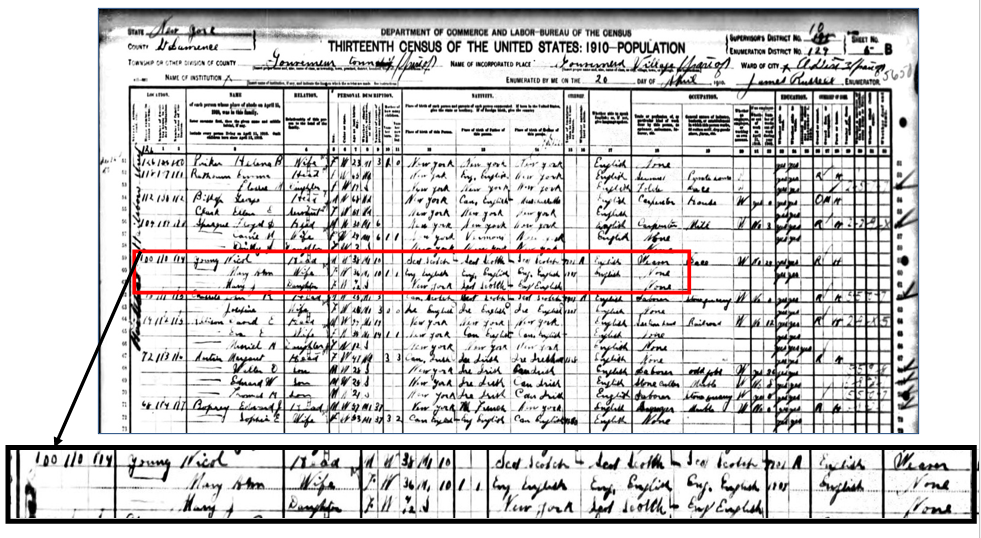
It is into this community that a daughter – Mary Janet Young – was born to Nicol and Mary Ann on 28th January 1910. It’s probable that she was born at 100 Hailesboro Street, which was the house the family were living in at the time of the 1910 census (taken on 15th April). In fact most of this community of lace workers lived on Hailesboro Street or Prospect Street, which were the two closest streets to the mill (the main entrance to the mill was via Prospect Street).
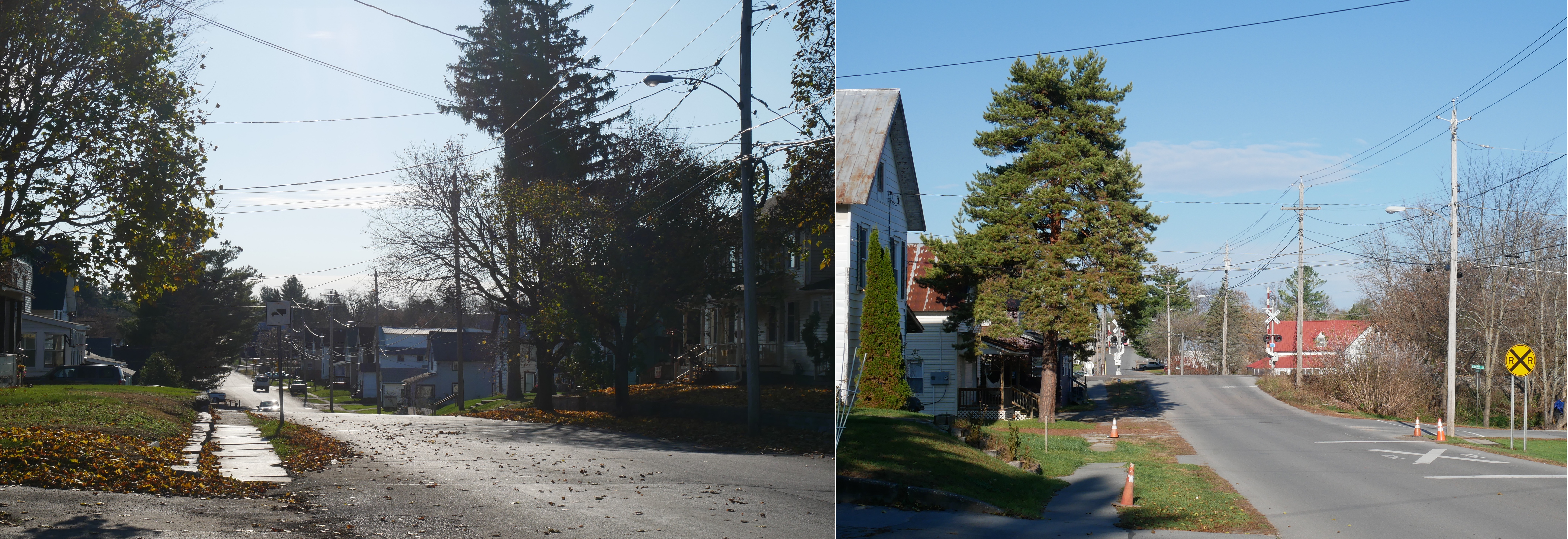
Hailesboro Street in November 2023. The right-hand image shows the railway crossing (the railway runs parallel to the factory site which is just off to the left). This is also close to the house where the Young family lived in 1910 and Mary Janet was born.

Mary Janet Young – known simply as ‘Janet’ in later life – is my personal connection to this story and the person who piqued my curiosity enough for me to want to research it and write it down. You can find out why that was in my piece on my childhood in Daybrook, Nottinghamshire.

For many of the Scottish and English lace workers in Gouverneur during this period there was enough work for them to be confident enough to plant roots in America. Nicol Smith was one such individual. By 1910 he had already submitted papers seeking naturalisation. Indeed, most of this group ended up staying in America.  Life wasn’t rosy for everyone, however.

Mill workers standing in front of a loom inside the Gouverneur mill – Circa 1910. (Gouverneur Museum)

A column on the 1910 census return records the numbers of “Weeks Without Work”. Where an individual had recorded a period of unemployment, with a few exceptions, it was generally in single figures. Nicol Smith, for example, records that he had been out of work for six weeks. For his brother Thomas, and for Nicol Young, that figure was significantly larger – twenty-four weeks in each case. Both men had young families to provide for, and the lack of income over such a period was clearly unsustainable. It’s clear that they must have relied on some form of community support in such circumstances just to get by.

It is easy to imagine how soul destroying that must have been. Nicol Young, with a baby to feed, must have known that his American dream had come to an end after less than three years. As a result, he and Mary Ann took the decision to return to England, leaving their cousins behind. Perhaps, the loss of his younger brother the year before had also focussed Nicol’s mind.  They managed to scrape together the fare for the journey home 27 and, a few weeks after Mary Janet’s first birthday, they embarked from New York City on Cunard’s RMS Mauretania. The Mauretania, alongside her sister ship Lusitania, were the current stars of transatlantic travel, able to make the crossing in five to seven days – the ship was a world away from the Noordland that Nicol had arrived on in 1907. There were strong winds and gales in the North Atlantic during this period and, to start with, it was very cold, although becoming milder as they approached their destination. They docked at Liverpool on 28th February 1911. 28

The Mauretania in 1907.(Public Domain)

Part Seven – The journey ends.

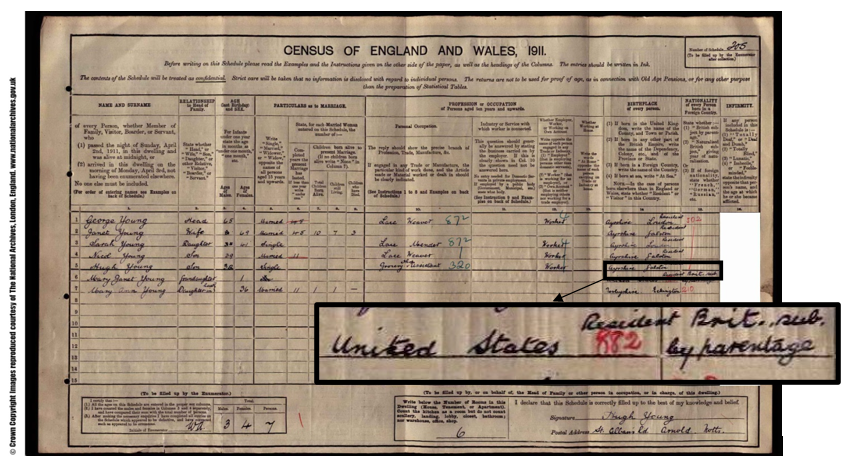
The Youngs had the (presumably) rare distinction of being recorded on both the 1910 American Census and the 1911 UK census. The latter was taken on 2nd April 1911. At that time they were resident at the home of Nicol’s parents, including a couple of his siblings (Sarah and Hugh), on St. Albans Road in Daybrook. It probably helped, space wise, that Nicol’s youngest brother, Matthew, had taken the opposite journey across the Atlantic, emigrating to Canada at about the same time.

Almost exactly three years later, on 17th April 1914, Nicol and Mary Ann added to their family with the birth of a son, who – not unsurprisingly for followers of this story – they named Hugh. At this time they were living at 37 Harcourt Road in the Forest Fields district of Nottingham. The house is only five or so minutes’ walk from the Birkin and Company Ltd. lace factory on Beech Avenue, so it is highly likely that Nicol worked there at this point. The company retained the factory until 2003. A description of the factory in its heyday, in many ways echoing the desccription of the Gouverneur mill in the Ogdensburg Journal, is available in an article from the Nottingham & Notts Illustrated magazine entitled “Up-to-Date” Commercial Sketches: Industries and Manufactures Illustrated and Reviewed dated 1898) 29:

“Entering from the “Forest” near the handsome Higher Grade School Board buildings, we are faced by a timekeeper’s office and some stabling to the left, beyond which is an old-fashioned, two-storied, ivy-clad house, once the residence of Mr. Richard Birkin, and now occupied by some of the firm’s employees. We believe Mr. R. Birkin still resided here at the period of his first mayoralty. Beyond the house is a second entrance to the works from Palm Street. Quitting the main entrance, we first arrive at the old factory, a substantial three-storey building, of which the ground floor is occupied as workshops for the punching or pattern-card making department of the “Levers” or fancy lace branch of the business, next to which are the winding and threading rooms, each fitted with the requisite up-to-date machinery. From here we pass to a large and well-lighted room, in which a number of boys and girls, known as threaders and bobbin pressers, are busily engaged; while in an adjacent apartment a staff of male hands is occupied in somewhat kindred labour. Crossing the yard, on the way to No. 1 factory, we approach a tall chimney stack with a turret clock displayed in its side and surrounded to about one-half its height by a winding stone staircase, with windows at frequent intervals…

Passing through to the open space in front of the engine-house, we come to the large modern four-storey building known as the New Factory, formerly occupied by the lace curtain machines, and which since their removal to Scotland has been utilised by Messrs. Birkin for the more modern part of their plant of fancy lace machinery. All the machines in this factory are of the latest type and construction, and on them are manufactured the very finest classes of goods capable of being produced by machinery. On the two floors there are twenty of such machines, each one of which, with its warp, represents a value of twelve hundred pounds. In ascending to the upper floor we note the substantial character of the walls and stone staircases and admire the lavatories and general sanitary arrangements provided on each floor for the comfort and convenience of the employees.”

The empty shell of the Guy Birkin lace factory in 2024.

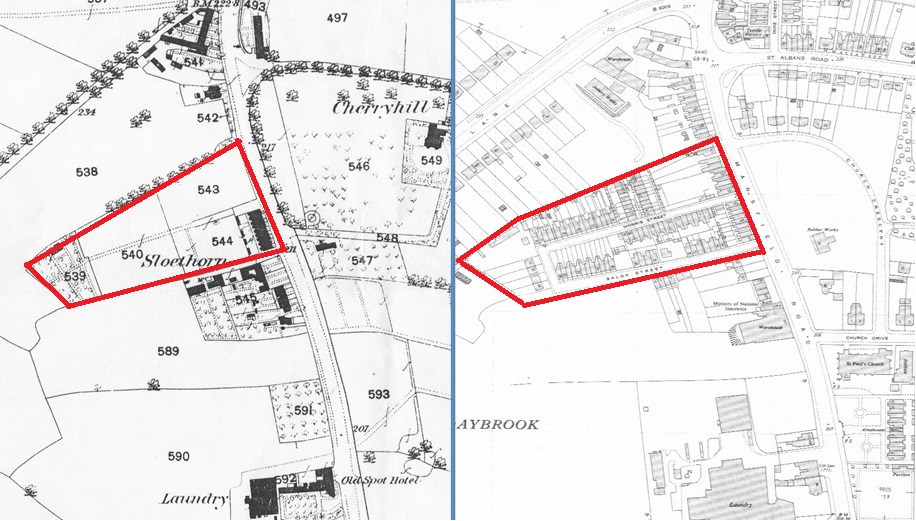
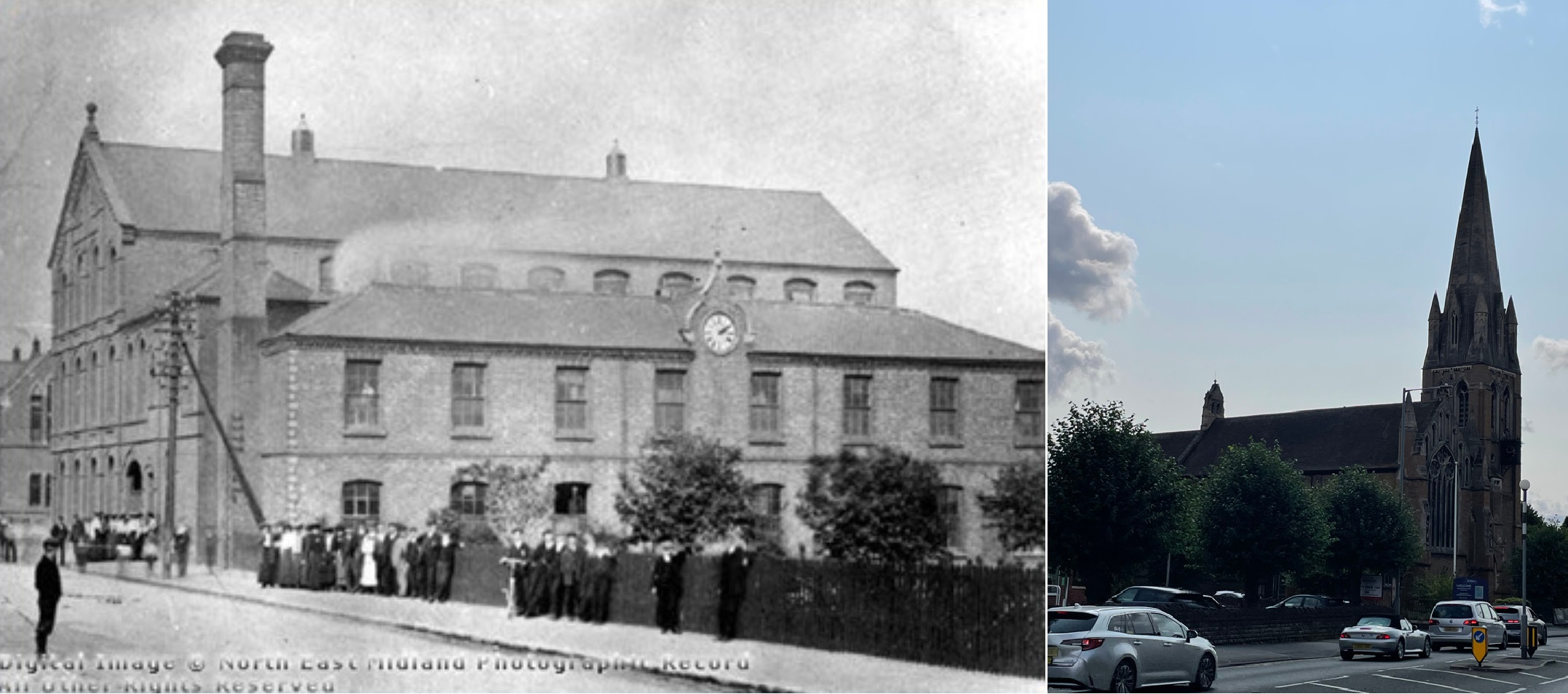
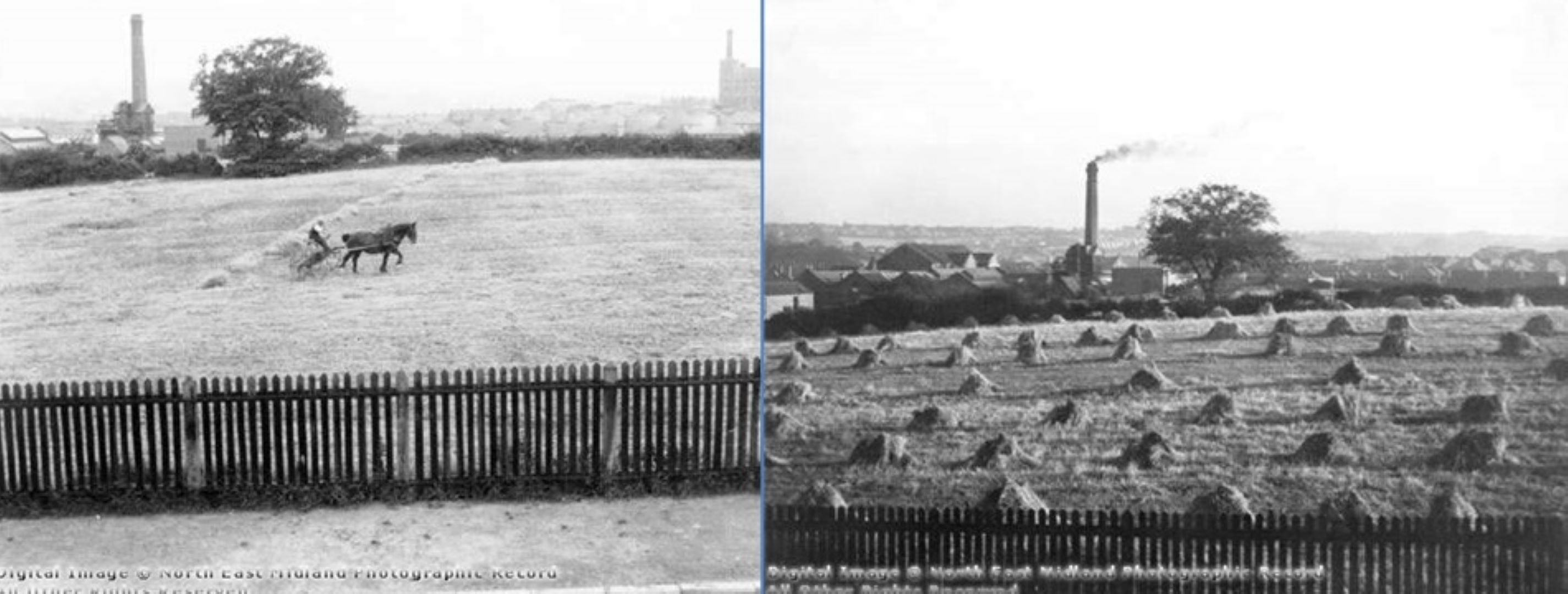
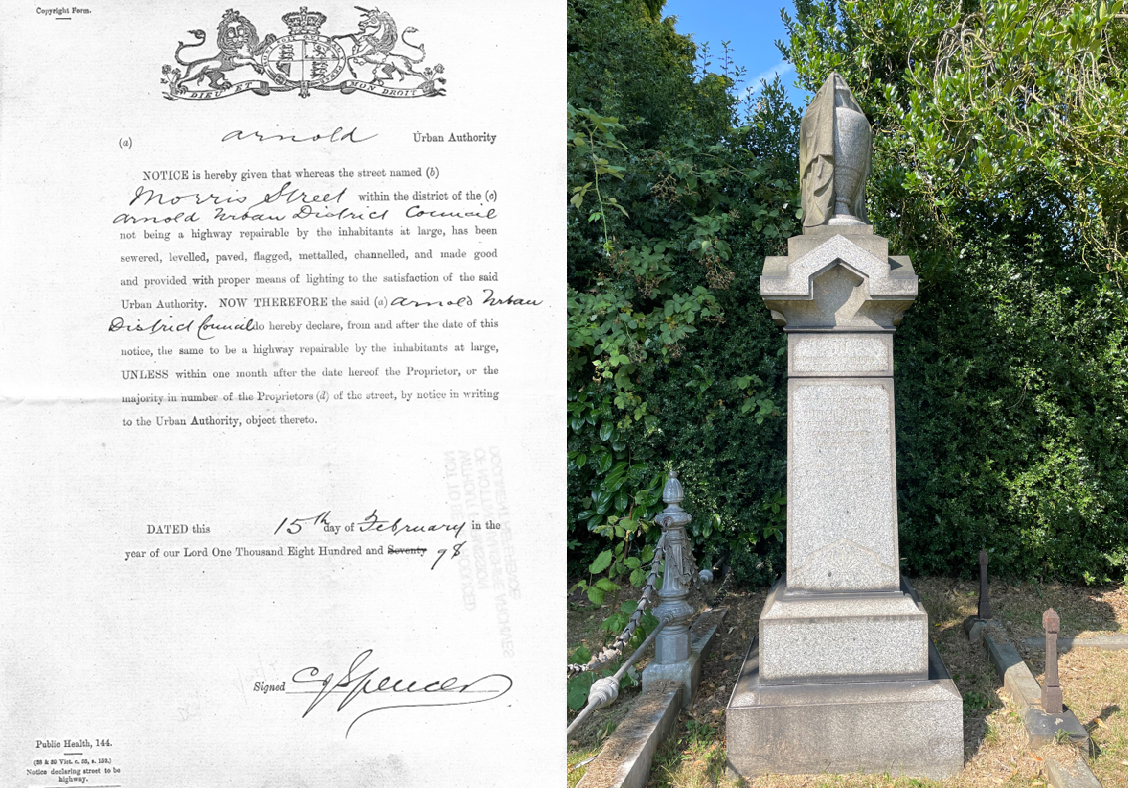
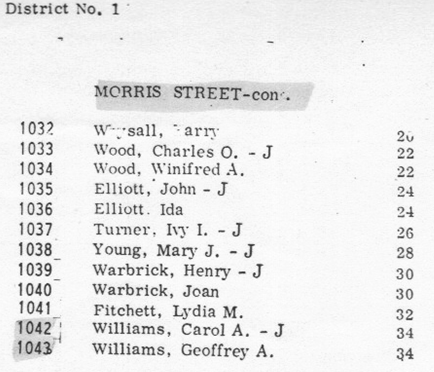
By 1921 the Young family was back in Daybrook and living at number 28 Morris Street, towards the top of a street that tumbled down a hill to the Mansfield Road. Nicol was working at W.H. Hurcombe and Company at this time. The company were located in a building known as ‘Jacoby’s Factory’, on Sherbrook Road. The company specialised in the manufacture of lace curtains. Nicol’s father, George, who was now retired, had also worked at Hurcombe’s, as did his sister, Sarah, who was employed there as a ‘Lace mender’.

Another view of Daybrook from 1923 showing ‘Jacoby’s Factory’ – where W.H. Hurcombe were based at this time, and where Nicol Young worked – at the very top left of the frame.

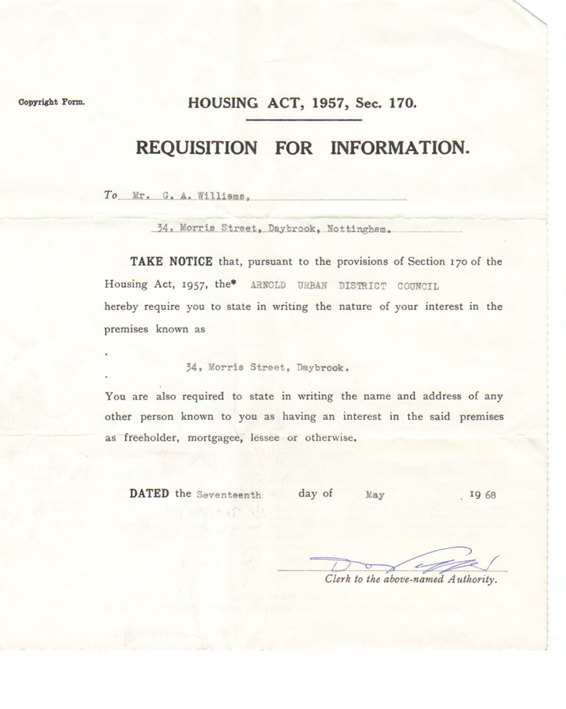
Nicol and Mary Ann lived at 28 Morris Street for the remainder of their lives. Their daughter, Mary Janet – who was known simply as ‘Janet’ – continued to live in the house until the local authority decided that the street should be demolished as part of an urban renewal scheme in the early 1970s. As a child I lived a couple of doors along from Janet, and I clearly remember her distinctive presence. Her relationship with the local children was, to put it mildly, often fractious. I hope that this piece goes some way to putting her and her family in context and that it offers a corrective to the image of her that we had as children back in those days.

Nicol died in the house on 14th March 1953 at the age of eighty-one years. Mary Ann followed him almost exactly seven years later, on 24th March 1960, aged eighty-five. Mary Janet, who was born over three-thousand miles away in Gouverneur, New York, died on 19 April 1973, aged just sixty-three years. At the time she was resident at Hillcrest Hospital in East Retford, a home for the elderly and a former workhouse. It was situated thirty miles away from her last family home on Morris Street. All three of them are buried together in Redhill Cemetery, a short walk from where Morris Street once stood. There is a small memorial vase on the grave which commemorates Nicol and Mary Ann, but it makes no mention that Mary Janet is also buried there.

Grave of Nicol, Mary Ann and Mary Janet Young at Redhill Cemetery near Nottingham

Part Eight – The decline of the lace industry.

The consensus amongst historians is that the 1914-18 war signalled the demise of the modern lace industry – certainly in the UK. The war disrupted production, with coal suppliers diverted to other industries better serving the war effort, meaning that lace factories couldn’t count on the power they needed to maintain production. On top of this, long-standing export markets, in countries such as Germany, were taken away at a stroke and the import of raw materials, such as cotton, were disrupted. The workforce was disrupted too, as key personnel went off to fight overseas.

This decline continued after the war, compounded by the imposition of international tariffs and changes in fashion. In the UK there was a short-lived boom when import duties were imposed on imported lace 30, but lace factories across the UK still closed their doors. Then there was a second war, bringing with it all of the disruption of the first. After the war, companies merged, diversified or just went out of business as the industry adjusted to the modern era.

In 1925 a representative of Messrs. Hayward, Limited, Court lacemakers, of New Bond Street, who had decided to shut down their business, summed up the impact of changes in fashion in an interview in the Manchester Guardian: “Women nowadays … want frocks that they can slip on over their heads, and instead of lace-trimmed lingerie they are wearing Milanese silk. The day of the great demand for lace passed with the full skirts, which could be trimmed with deep flounces of lace. I see no prospect of wide skirts coming back.” 31

In its prime the lace industry employed 25,000 people in Nottingham and was responsible for five-million pounds worth of exports.  By the1970s the industry in the city employed no more than 5,000 people. 32

The pressures of changes in fashion – which applied to the use of fancy lace curtains and tablecloths as well as clothing – took its toll in the USA too. Amidst a general depression in the US textile industry, the doors closed on the Gouverneur Lace Factory again in September 1928. The mill, however, true to form, bounced back again. In January 1936 the production of lace resumed under the auspices of the Bromley Lace Company. A couple of years later, a hosiery division opened in the factory, making silk hose, and many of the old lace factory hands were re-employed. However, war, again, intervened. The hosiery division closed in 1940 due to difficulties getting hold of silk fibre from Japan. The lace division did continue, making camouflage netting for the armed forces, but as the war was coming to an end, the inevitable happened, and the lace factory closed for good on 16th March 1944. Despite this, the building still stands and, most recently, has been used as a warehouse for a paper manufacturing company. 33

The Gouverneur Lace Factory building in November 2023.

In a magazine interview in November 1992, Shirley K. Tramontana, curator of a museum exhibition about Nottingham Lace manufacture in the US, stated that, at that time, the mill in Scranton, Pennsylvania was the only one still involved in its manufacture.34 The Scranton Mill, for a time the world leader in Nottingham Lace production, eventually closed for good in 2002.35

Lace is still made around the world, and it is still considered to be a luxury item. Production has adapted to cope with reduced demand and has taken advantage of new digital technologies 36 . Vast industrial complexes, fitted with intricate machinery and employing hundreds of people, are no longer required. As a consequence some of those old mills, like Jacoby’s factory in Daybrook, and the Seekonk mill in Pawtucket have been demolished or lie abandoned. However, others, like the Gouverneur factory, the Tariffville mill and the Zion Lace Industries facility have found alternative commercial uses. Several others, such as the Kingston, Scranton and Bromley/Quaker mills continue to serve their communities in other guises, re-purposed as residential or public spaces.
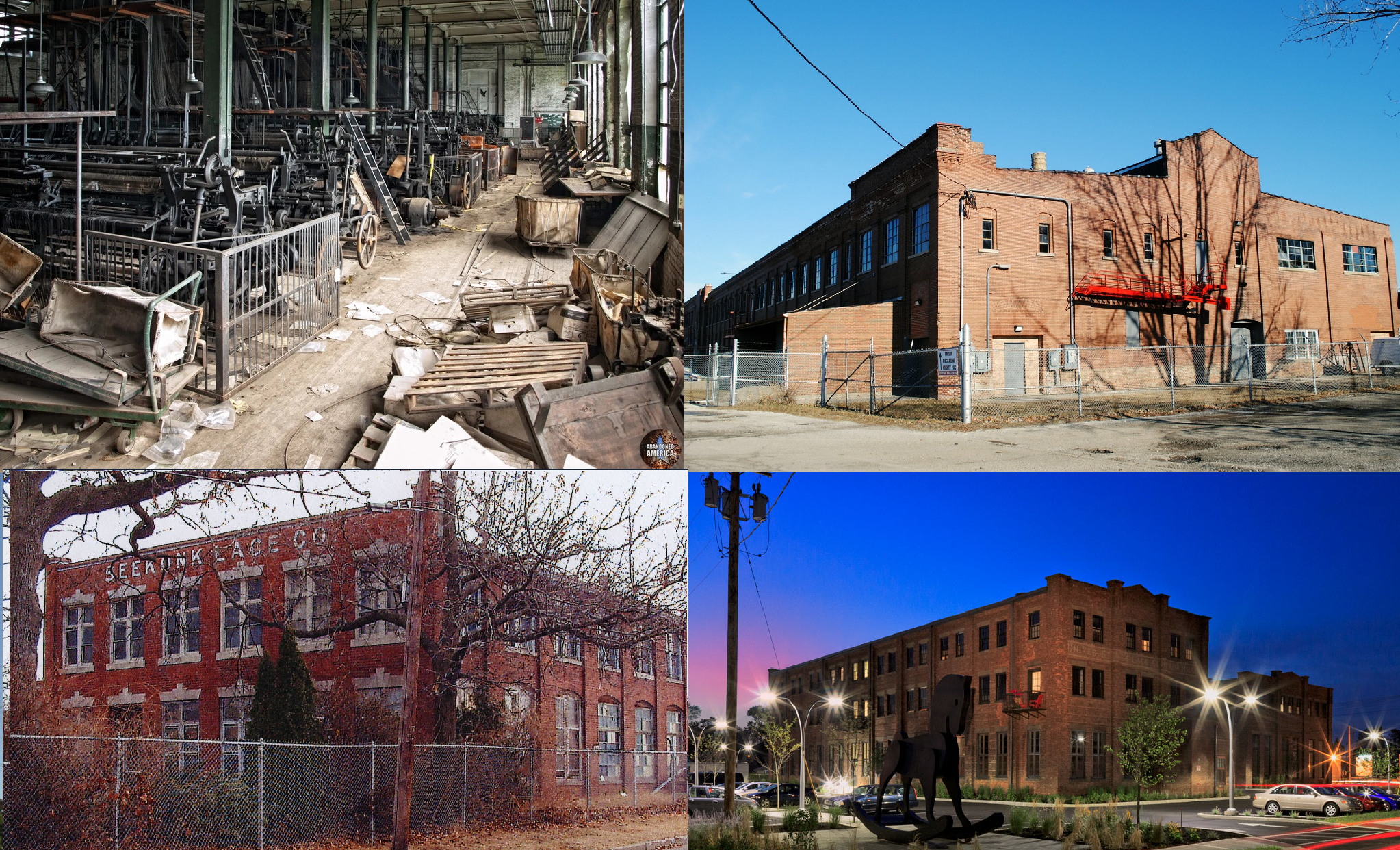
Top Left: Inside the abandoned Scranton Mill in 2004 © Matthew Christopher Photography LLC 2004-Present All rights reserved (Abandoned America). Top Right: The Zion Industries Mill, now a business park – © All rights reserved by Cragin Spring .
Bottom Left: The Seekonk Mill. Pawtucket, prior to demolition – courtesy Pawtucket Library Photostream. Bottom Right: The Kingston Lace Mill, which is now a housing complex for artists – Photo Courtesy RUPCO Inc.

Part Nine – The Irvine Valley Scots – class of Gouverneur 1910.

So, we have followed Nicol Young to the very end of his journey, but what became of the other Irvine Valley immigrants who, like Nicol, were plying their trade in the Gouverneur Lace Mill at the time of the 1910 census? And what happened to his cousins – Nicol and Thomas Love Smith – and their families, who he left behind there?
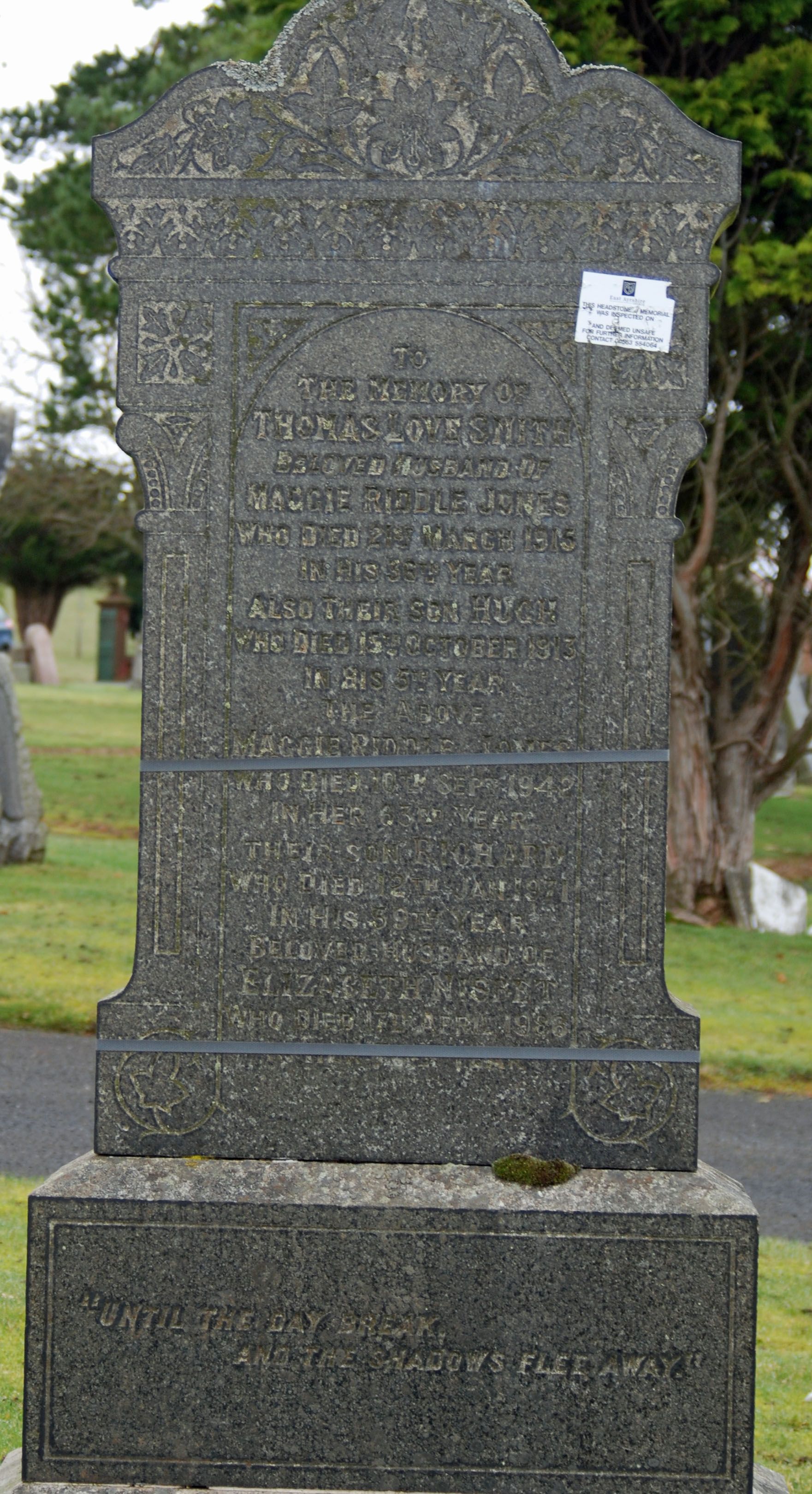
The lives of the brothers Nicol Smith and Thomas Love Smith, took very different paths. Both initially stayed behind in Gouverneur, and both added to their families there. John McKelvie Smith was born to Nicol and Janet on 10th November 1910, and Richard Smith was born to Thomas and Maggie on 7th May 1912. However, Thomas and Maggie took the decision to return to Scotland shortly after their second son’s birth. They departed from Portland, Maine and arrived back in Liverpool on the SS Scandinavian in December 1912. It wasn’t a happy homecoming.

Less than a year later, back in Newmilns, on 15th October 1913, their eldest son Hugh died of Meningitis aged just four years old. Thomas’ occupation was detailed as ‘Insurance Agent’ on the death certificate, perhaps indicating that he was struggling to find work in the lace trade. In early 1915 Thomas was committed to the Ayr District Asylum suffering from ‘Acute Mania’ (the manic phase of Bi-Polar disorder). He died on 21st March 1915 from exhaustion and broncho pneumonia, aged thirty-six years. Maggie lived on until her early sixties, dying on 10th September 1942. Their remaining son, Richard, died aged fifty-nine years on 12th January 1971. The whole family is commemorated on a memorial in Newmilns Cemetery. See right – Photo by Alice Stevenson (Dreameralilu) via Findagrave.com.

Nicol and Janet Smith, plus their three children became naturalised United States citizens on18th September 1912. At the time Nicol gave his address as Zion City, Illinois indicating that he was then employed by Zion Lace Industries, whose factory in the city was established in 1900. By 1920 the family had moved on again and were living in Pawtucket City, Providence County, Rhode Island, which possessed a lace mill run by the Seekonk Lace Company. By 1930 they had returned to live in Philadelphia, at 3031 North 4th Street (in Ward 33, close to where they had lived previously in the city). Nicol and Janet would see out there lives here. By then, it would seem that Nicol was struggling to find work in the lace industry and both he and son Hugh were running a Newspaper route (roughly the equivalent of a paper round in the UK). Son John, however, was a ‘helper’ in a Hosiery Mill and daughter Mary was a typist in an office. In 1936 Nicol and Janet made a final trip to back to Scotland. By 1940 Nicol was again recording his occupation as ‘Lace Weaver’, at the age of sixty-four and sons Hugh and John were now running the news dealership by themselves. 

Nicol died of cancer on 29th January 1947 aged seventy-one. Janet survived him by ten years, passing away at the house they had shared together at North 4th Street, just around the corner from the Bromley mill, on 4th April 1957, aged eighty-two years. Both were buried at Sunset Memorial Park, Bucks County, Pennsylvania.

With regard to their children – their son John eventually became a school administrator and died in Sun City, Arizona on 2nd May 1984 aged seventy-three years. Their daughter Mary married a Philadelphia Fireman in 1932 and raised two children in the city. Mary died on 12th September 1995 aged 88 years. At the time she was living in Warrington, a northern suburb of Philadelphia. Nicol and Janet’s eldest son, Hugh, born in Greenholm, on the opposite side of the River Irvine to Newmilns, in 1902, was working for the Philadelphia Post Office at the time of the1950 census. The obituary of his brother John in 1984 indicates that Hugh was still alive at that point, but I have been unable to trace what happened to him subsequently.

Of the other Irvine Valley Scots in Governeur in 1910…

Brothers James and Boswell Ross were natives of the Irvine Valley village of Darvel. At the time of the 1910 census they were both lodging with Thomas and Maggie Smith at 50 Hailesboro Street in Gouverneur. Both remained in the United States and saw out their final days in Gouverneur.

James (pictured left in a photograph from his passport application in 1919) was born on 11th October 1882 and naturalised as a US citizen in 1916. James had arrived in the US in 1906 and was listed as a Lace Factory employee as early as 1907-08. He married Jessie McCormack in Gouverneur in 1910. Jessie died in 1914 aged just thirty-nine. He married his second wife Faye in 1922 and became the father of a daughter, Betsey, the following year. He was still working at the mill in 1940. The only time he worked elsewhere was during the period 1928 to 1936, when production ceased at Gouverneur and James relocated temporarily to Scranton PA. James died in 1943, aged just 60. He is buried in the Riverside Cemetery in Gouverneur, alongside Faye, who died in 1987.
James’ younger brother, Boswell Ross (pictured right from a 1937 factory group photograph), was born on 9th July 1884 and arrived in the US a little later than James, in 1909. He soon began working at the lace mill.  Around the period 1928 to 1936, when production ceased at Gouverneur, he joined his brother in relocating to find work in the mill at Scranton, Pennsylvania. Other than that, Boswell remained resident in Gouverneur. During this time he made several return visits to Scotland. He died on 17th May 1963, a couple of months short of his seventy-ninth birthday. He too is buried in the Riverside cemetery at Gouverneur.
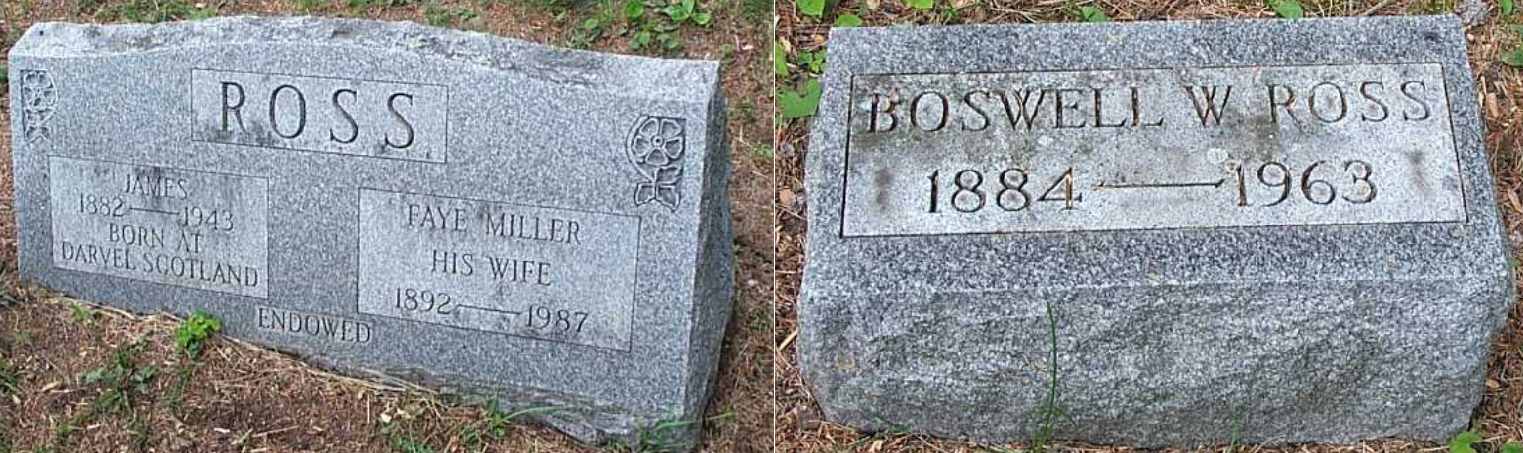
The graves of James and Boswell Ross at Riverside cemetery, Gouverneur (Photos: Anne Cady via findagrave.com)
Grave of William and Mary Dykes, Greenwood Cemetery, Phila.(Photo: Christina Mellor via findagrave.com)

William Dykes was born in Newmilns on 4th November 1879. He travelled to New York in 1901 and married his wife Mary Graham, who was also a Scot (from Kilmarnock), in Philadelphia in 1905. William and Mary were resident in Gouverneur by 1906, when their first child was born, although neither appear on the list of factory employees from 1907-08.  He was naturalised in Philadelphia in 1917 after moving back to the city sometime post 1913. They lived at 3110 North Wendle Street for the remainder of their lives and worked at the Bromley/Quaker mill. They raised six children, one of whom – Hugh – became a fireman in Philadelphia. William died in St. Joseph’s Hospital, Philadelphia on 8th December 1947 aged sixty-eight. Mary lived on until a month before her eightieth birthday, passing away on 3rd January 1963. They are buried in the Greenwood Cemetery, Philadelphia.

James Cox was born in Darvel on 3rd May 1882. He travelled across the Atlantic the on the SS Majestic, arriving in New York from Liverpool on 3rd December 1904. James was a cousin of William Dykes through his mother Jean Dykes, and it was William that James had arranged to make contact with, in Philadelphia, upon his arrival. James was also listed on the employee roster for the Gouverneur lace factory for 1907-08. Around 1912 he married a fellow Scot, Helen Dunsmuir, and they went on to have three children. James was naturalised as a US citizen at Canton NY in September 1919. After the first closure of the Gouverneur lace factory in 1928, James took his family to Scranton, Pennsylvania, where they were able to find work in the large lace factory there, and where they were to remain. Helen died on 20 August 1952 aged 63. James passed away from cancer at the Medical Centre in Scranton on 14th February 1963 aged 80 years. James and Helen are buried together in Dunmore Cemetery, Scranton.

William Scott was born on 6th March 1877 in Avondale, on the north bank of the River Irvine between Kilmarnock and Galston. At the time he left for America he was living in Newmilns. He travelled to New York City from Liverpool in July 1898 and met up with his brother David who was already living in Philadelphia. He married English widow Bertha Beckett in Philly in 1908. Bertha already had a daughter from her previous marriage, and they added two sons to the family, both of whom were born in Gouverneur. After their sojourn in Gouverneur, they returned to Philadelphia around 1918, where they lived initially at 2928 North Fairhill Street. At that time William was employed by the North American Lace Company at 8th Street and Allegheny, which was very close to their house. By 1920 they were living on North 8th Street (even closer to the factory) before moving to 5961 Bingham Street, where they were to remain until William’s death on 5th November 1956 at the age of seventy-nine years. Bertha lived on at the house until her death, aged eighty-seven, on 3rd July 1964. They now lie together in Lawnview Cemetery, Philadelphia.

Grave of William and Bertha Scott at Lawnview Cemetery, Philadelphia (Photo: Gail Kelly via findagrave.com)

Part Ten – Gouverneur’s English community of 1910.

I have previously referenced the fact that, alongside their American born lace worker colleagues, and the small Irvine Valley enclave employed at the Gouverneur lace factory, there was a significant English born (and evidently cricket-playing!) community living in the village. It is immediately striking that every single one of that community with an active lace making role in the factory in 1910, had strong connections with my home city of Nottingham, England or the wider county of Nottinghamshire. Nicol Young, of course, embodied the Scots, English and Nottinghamshire communities because he was part of them all, but the part that Nottingham played in embedding the lace industry in the United States, even for the comparatively short time that it existed, is made abundantly clear in these stories.

The other noteworthy aspect of these lives is that, apart from the odd fleeting visit, none of them returned to their homeland, choosing instead to put down their roots – to live and die – in the Unites States. The breadth of their different experiences and their individually unique stories, are, no doubt, resonant of immigrant stories generally, but lace making was clearly a transitory affair.  I like to think, though, that when they did come together in one place for the purpose of making lace, that they were a talented and professional community who supported each other through the good and bad times. Anyway… let’s meet them:

The crew of the International Lace Mill at Gouverneur, hosiery Division, in 1937. the photograph is reproduced from a newspaper clipping published in the Gouverneur Tribune Press, on 13th September 1972. The annotations shown here identifying participants in this story are my own, and are taken from the original list of names names provided.

Frederick Harry Goodyer was the Superintendent at the Gouverneur lace factory at the time of the 1910 census. He was born in Peckham, London on 18th April 1854, the son of a druggist. However, by 1871 the family had moved north to Nottingham and were living in the Hyson Green area of the town. By 1881 they had moved to the village of Attenborough and Frederick was employed as a Lace Warehouseman. He married Louisa Pace in Codsall, Staffordshire on 21st November 1883 and by 1891 they were settled in the Minster town of Southwell, Nottinghamshire, where Frederick, according to the census at least, was now the manager of a lace factory. The couple were back in the centre of Nottingham, living at 23 Clarendon Street by 1901, where Frederick was operating as a lace curtain salesman. This frequent changing of occupation was to be a feature of Frederick’s life.

Frederick and Louisa emigrated to America in 1903, arriving in New York City on the SS Teutonic on 30th January. At the time of the New York State census two years later, they were living in the city of Kingston, Ulster County, New York, with Frederick now a lowly labourer in the lace factory there. After their brief sojourn in Gouverneur in 1910 (where they lived on Austin Street), they were back in Kingston by 1920 where Frederick was now trying his hand at managing a boarding house. Whilst they stayed put in Kingston for another ten years at least, and where he became a naturalised citizen in 1923, Frederick clearly got bored easily… at the time of the1925 state census he was describing himself as a ‘farmer’. By 1930 he had reverted to being a salesman again – possibly hawking cleaning products (it’s difficult to read on the census entry).

Sometime before the 1940 census was taken, Louisa died. By then Frederick was living in the township of Rye, Westchester County, New York, apparently in a lodging house. He was eighty-six years old at that point and still describing himself on the census as a ‘Lace Manager’ in a ‘Lace Factory’, although presumably he had retired by then. Unfortunately, it is not clear from available records where Frederick saw out his final days.

Lace weaver James Hadfield was born on 14th December 1884 in Nottingham, the son of a shoemaker. At the time of his parents’ marriage in July 1884, James’ father John was living on Woolpack Lane, and his mother, Annie, on Goose gate. John emigrated to the US in 1888, and his family followed him out a year later. James was only four years old at the time. Like many lace making families making the journey to the US, they settled in Philadelphia, and, by 1900, they were living in Ward Thirty-Three at 339 East Indiana Avenue, not far from the Bromley mill. Around 1905 James made the journey to Gouverneur, where he married Grace Vaile on 23rd August 1906. Grace and James were to raise five children in Gouverneur, living for many years on Smith Street. He became a member of the local Masonic Lodge.

James was listed on the 1907-1908 roster of employees at the lace factory in Gouverneur and remained an employee of the factory for many years. A rare exception was during the 1928 to 1936 closedown, when, like others from the village, he relocated to Scranton PA. In 1930 he was resident at the same lodging house in Scranton as Irvine Valley Scot James Ross. He was to work in Scranton again after the final demise of the Gouverneur factory in 1944 and it was in Scranton, on 9th April 1961, that he passed away from heart failure at the age of seventy-six. Grace lived on until 1970. James and Grace are buried together in the Riverside Cemetery, Gouverneur (See Right – photo by Anne Cady via findagrave.com)

John Whyatt was born in March 1854, in Daybrook – the suburb of Arnold, Nottinghamshire that Nicol Young and his family (and indeed me!) later lived. He was baptised at St. Leodegarius Church, Basford near Nottingham on 10th April 1854. His father, also called John, was a ‘bleacher’ in the hosiery trade. John Jnr married Elizabeth Allen Christian at St. Andrew’s Church Nottingham on 26th June 1880. By this time he was employed as a ‘Warehouseman’. In 1881 they lived at 3 Cranmer Terrace, in the St. Anns area of the town. John travelled to the United States in 1889, arriving in New York City from Liverpool on the SS Alaska on 23 September of that year. Elizabeth followed soon afterwards.
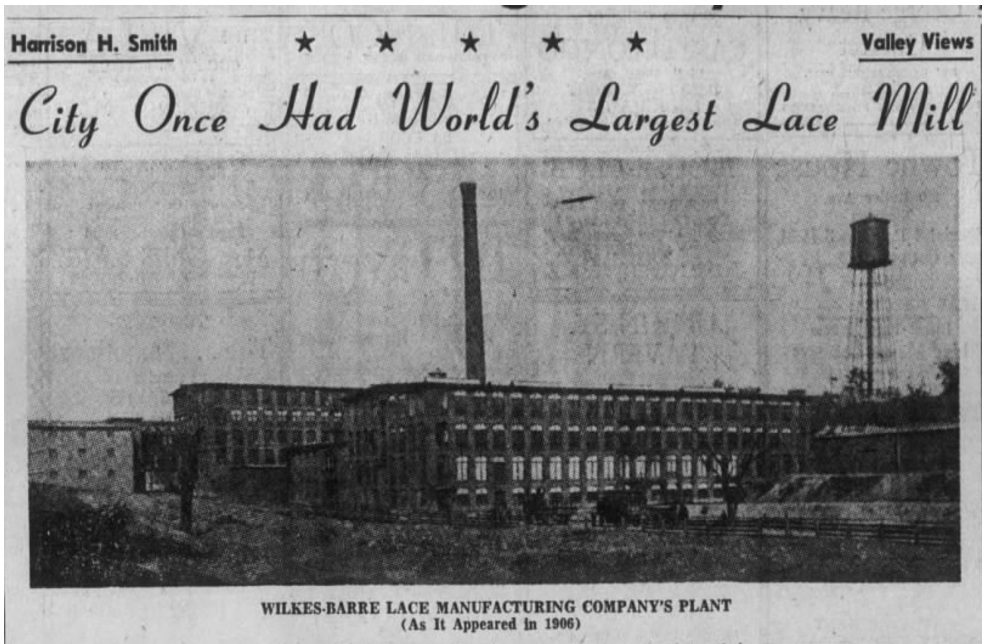
Wilkes-Barre Lace Mill in 1906.
Photograph taken from an article in the Wiles-Barre Times Leader, The Evening News dated 19th December 1970.
Grave of John Whyatt,
Gouverneur Riverside Cemetery
(Photo: Anne Cady, via findagrave.com)

In 1900 the couple were resident in Wilkes-Barre, Luzerne County, PA. John was employed as a Weaver, at the Lace Mill there (see above). Despite not being shown in the roster of employees working at the Gouverneur factory in 1907-1908, John was resident there by the time of the 1910 census, which lists him as being a foreman at the lace mill. By 1915, however, the state census shows John and Elizabeth running a Boarding House at 36 William Street. They remained in Gouverneur, running their boarding house at 68 Clinton Street until 1931, in which year they both passed away – Elizabeth on 11th March and John on 12th August. They are buried in the Riverside Cemetery.

Allen Straw was born on 19th December 1870 in the town of Ilkeston on the Nottinghamshire and Derbyshire border. His father, Samuel, was a stone miner, but by the age of twenty, Allen was working in the lace industry. He married Louisa Severn at Ilkeston on 13th February 1892. Louisa already had a daughter prior to their marriage and another four children, three girls and one boy, had arrived prior to them leaving for America. In 1901 they were resident in Cossall, Nottinghamshire and Allen’s occupation on the census was listed as ‘Lace Curtain Maker’.

Allen set off for America from Liverpool in the early summer of 1903. Louisa and the children followed three months later. Once they had disembarked at New York City, they headed straight for Gouverneur, making them one of the earliest of the 1910 cohort in our story to have made the journey there. Allen and daughter Mary Jane (known as Jennie) were listed on the roster of employees at the Gouverneur factory for 1907-08. In 1907 another daughter, Margaret, was born.

Photo: Grave Recorder via findagrave.com.

By 1913, however, the family had moved on again. In this year they are listed in the town directory for Zion City, Lake County, Illinois, for the first time, residing at 3002 Elizabeth Avenue. The city of Zion was only founded in 1900 and had a strict evangelical religious ethic. Amongst the business ventures that grew out of this was Zion Lace Industries with a large factory located on Deborah Avenue (a fifteen- minute walk from the Straw’s House).  By 1946 they had retired to the neighbouring township of Waukegan, and it was here that Allen Straw died on 19 September 1946, aged seventy-five years. Louisa passed away on 28th April 1949 in her seventy-eighth year. They are buried together at Mount Olivet Memorial Park, Zion.

Artists impression of the Zion Lace Industries mill at Zion, Lake County, Illinois circa 1898. (https://www.1898revenues.blogspot.com/ Article ‘John Alexander Dowie’s Zion Lace Industries dated 4th October 2014)

Lace mill machinist and fitter, Edwin Sidney Roberts was born at 47 William Street, Radford, Nottingham on 15th July 1877. His father, Samuel, was also a machine fitter in a lace factory. By 1881 the family had moved to the St. Ann’s area of the town. Here they initially lived just off Peas Hill Road, which had two lace factories dominating its skyline, according to the 1881 Ordnance Survey map of the area. Edwin lived at 9 Lilac Street at the time of his marriage to Flora Jane Cleary, at Emmanuel Church, St. Anns, on 1st November 1902 37.

The following year Edwin set sail for America, arriving in New York City from Liverpool on 19th November 1903. The passenger manifest suggests that Edwin is meeting someone in the city, possibly going by the name of M C Thomson (it’s not very legible), with an address at 511 Broadway. By the time that Flora followed him across the Atlantic in February 1904, with baby daughter Hilda Florence in tow (born in St. Ann’s on 4th February 1903), Edwin was staying at the Grove Hotel … in Gouverneur. Oddly, given that we know Edwin was resident in Gouverneur from around 1903, and that he was listed as a machinist working at the lace mill on the 1905 state census and the 1910 federal census, he doesn’t appear on the roster of factory staff for 1907-1908.

Kingston Lace Mill circa 1950s (Bob Haines Collection/https://www.RUPCO.org)

Flora gave birth to three sons during their time in Governeur – George Samuel on 9th September 1905, Sidney in April 1912 and Edwin Frederick on 4th April 1921. According to the census’s that took place between 1915 and 1925, Edwin was the lace mill superintendent during those years. When the Gouverneur mill closed in 1928, the family relocated to Kingston, Ulster County, New York. Here Edwin was employed at the United States Lace Curtain Mills which was founded in 1903 at 165 Cornell Street, at the junction with South Manor Avenue (the Roberts family lived on or around North Manor Avenue). The mill was part of the Scranton lace empire. Edwin died in Kingston on 24th August 1933 aged just fifty-six years. Latterly Flora lived with daughter Hilda (by then a teacher), and son Edwin Frederick (a Post office manager) in Floral Park village, Hampstead, Nassau County, New York. Flora died on 29th January 1944 in her sixty-third year. Edwin and Flora are buried, together with their son George (died 1973), at Wiltwyck Cemetery, Kingston, New York (See below – Photo: Donna Lamerson via findagrave.com).

Lace weaver Samuel Towlson (left) was born in Beeston, Nottinghamshire on 2nd March 1880. His father William was a lace maker in the town. Beeston had a rich tradition of hosiery manufacture going back to at least the very early nineteenth century and, in 1871, the Wilkinson family opened the Anglo-Scotia mills on Wollaton Road, which signalled the arrival of power-driven factories to the town38. David Hallam’s 2014 blog post on lace making in Beeston covers the history in studious detail and puts the Wilkinson family (who we shall meet again later in this story) in context39.

At the time of the 1891census the family were living at 24 Willoughby Street in a household that also included fellow 1910 Gouverneur weaver Ernest Hardy (see below). The Towlson family (including Ernest Hardy but minus their father William, who was already in the US) arrived in New York City from Liverpool on 28th March 1892, bound for Connecticut. They were heading there because William Towlson’s Beeston employer, the aforementioned Wilkinson family, had purchased real estate in Tariffville, Hartford County for the purpose of manufacturing lace. Several key workers – including William – were shipped out from Beeston to supervise the production of lace curtains at the site. In Tariffville, on 28th July 1894 another child, Harold Percival, was born to William and his wife Maria. Unfortunately, William died on 12th February 1895 and the family began to go their separate ways.

By 1905 Samuel Towlson was resident in Gouverneur after recently marrying local girl Nina May Campbell, on 19th April 1905. With a couple of exceptions he was to see out his life there. It seems odd then that his name doesn’t appear on the 1907-08 roster of factory employees.  Together, Samuel and Nina raised two sons, Earl (born 4th April 1906) and Harold (born 17th June 1908). Sadly Nina died, in her forty-first year, on 1st March 1925. Samuel wasn’t a widower for long, however, and on 7th May 1927 he married Pearl Adele Campbell (nee Forsythe) also in Gouverneur.

In 1928, following the first closure of the lace factory, and like many of his colleagues, Samuel took his family to Wilkes-Barre in Pennsylvania in pursuit of work. It would seem  that he returned to Gouverneur for a spell in 1931. He is quoted in a news-piece in the Gouverneur Tribune Press 40 regarding a letter received from motor manufacturer Henry Ford enquiring about one of the old looms in the now idle lace factory. Samuel is described as “recently returned here from Pennsylvania where he has been engaged in the lace business.”

In the article Samuel talks about the history of the loom:

The loom referred to by Mr. Ford… is evidently the loom that came to this country in 1888 from England. That was the first loom to come here. At first it was installed in a mill at Derby, Connecticut, and later in another place in Connecticut 41. My father worked on the loom before me and when the local mill was running, I also operated it. The loom was sent here [i.e. to Gouverneur] in 1908 and installed in the local mill. It is a 300-inch machine and was not used as extensively as other looms. Mr Ford must be trying to purchase the loom solely on the fact that it is the first one to come to America and not on the strength that it is the first mechanical lace weaving loom to be manufactured, for the latter piece of machinery was made in 1874 and is now located at Wilkes-Barre, Pennsylvania.”

The 1940 census infers that the family had relocated again, this time to Kingston, Ulster County, New York by 1935. However, the re-opening of the factory brought them back to Gouverneur for the final time and he is shown on the above 1937 photograph of mill workers at Gouverneur. By 1940, the Towlsons were resident at 55 Prospect Street.

Pearl Towlson died on 8th October 1955 aged sixty-seven years. Typically, Samuel moved quickly to find another wife and he married Percie Kinney (nee Laforty) in Gouverneur on 20th October 1956, almost exactly one year since Pearl’s death. Percie died on 5th August 1967 aged eighty-three. She shares a grave at the Riverside Cemetery with Samuel, who died in Gouverneur on 19 March 1972 aged ninety-two. Samuel’s grave is shown right. (Photo: Anne Cady via findagrave.com)

Lace Weaver Ernest Henry Hardy was born on 13th May 1883 in Long Eaton on the Derbyshire/Nottinghamshire border. By 1891 he was living in Beeston, Nottinghamshire, at 24 Willoughby Street, in the same household as fellow future Gouverneur weaver Samuel Towlson. It appears that he was related to Samuel’s mother Maria, whose maiden name was Hardy (although the exact relationship is not clear from the sources). Ernest travelled to America with the Towlson family (listed on the passenger manifest as “Master E. Toulson”). They arrived in New York City, from Liverpool, on 28th March 1892. The party moved on to Connecticut – to Tariffville, where a new lace factory was being established (see the entry for Samuel Toulson above). Members of the family seem to have gone their separate ways, however, after the death of patriarch William Towlson in 1895.  Ernest was naturalised as an American citizen in Simsbury, Connecticut on 22nd September 1904 and his next appearance in the records is his marriage to widow Emily McFetrich (nee Campbell), a native of Gloucestershire, England, in Manhattan on 28th April 1909.

Their appearance in Gouverneur the following year was fleeting. They resided at 271 West Main Street where they had taken in Irvine Valley Scot James Cox as a lodger. As early as 1911, according to city directories of the time, they had moved on to Wilkes-Barre, Pennsylvania, where their son, Walter Arthur, was born on 20th September 1914. By 1920 they had moved on again, this time to Philadelphia, and they were ensconced at 225 East Lippincott Street in Ward Thirty-Three, before moving on to 1021 East Shelmire Street, where Ernest died on 2nd August 1924 of Chronic Nephritis, aged forty-one years. Emily lived on at East Shelmire, where she died aged seventy-three on 28th September 1950.

Lace Weaver Thomas Higgins was born on 18th August 1867 in Newthorpe, Nottinghamshire. His father – also called Thomas – was a miner, and the family lived at ‘Skegby Bridge’ near Mansfield at the time of the 1871 census. By 1881, however, Thomas’ mother, Louisa, had moved the family to Radford in Nottingham and was describing herself on the census as widowed (note that I am unable to find any record of Thomas’ father’s death).

It was whilst in Nottingham that Thomas began working in the lace industry… the 1881 census records him being employed as a ‘Lace Dresser.’  On 5th April 1890, Thomas married Annie Marshall at Hyson Green church, Nottingham.  Between March 1891 and January 1902 Annie gave birth to four children – Thomas Marshall, Elsie Lucile, Philip Frank and John William.  The 1901 census records Thomas’ occupation as ‘Lace Curtain Maker.’

The family emigrated to America in 1903 and by 1905 were resident on West Main Street in Gouverneur. Thomas is listed on the roster of weavers at the mill for 1907-08, with his son, Thomas Marshall, also shown (detailed under ‘Other Help’). By 1910, daughter Elsie was also working at the mill and Philip and John followed them into the mill in subsequent years.
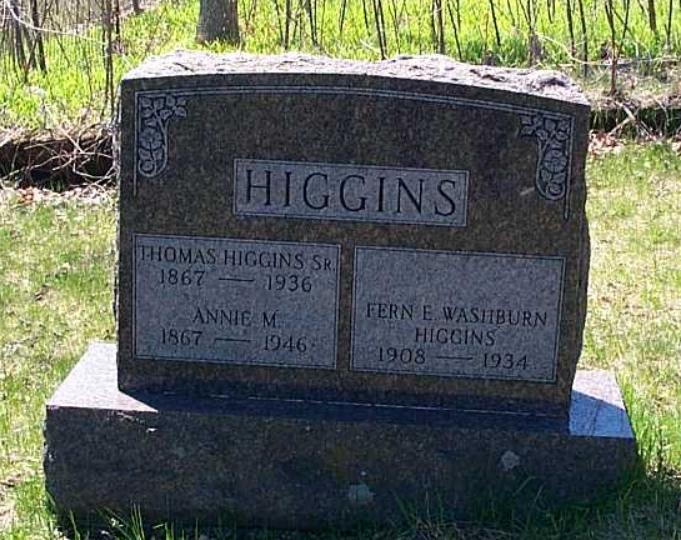
The Higgins grave in Pieces Corner cemetery. (Photo: Anne Cady via findagrave.com).

Although Thomas and Annie appear on the federal and states census’ for 1905, 1910, 1920 and 1930 and are shown as living in Gouverneur, there is no entry for them for 1915. This could be explained by the fact that Thomas’s naturalisation was ratified at Waukegan, Illinois on 3rd April 1914. Waukegan is a township adjacent to Zion – and so it is likely that, for a short time at least, Thomas sought employment at the factory run by Zion Lace Industries there. Thomas died in 1936 in his sixty-ninth year and is buried in Pieces Corner Cemetery, Macomb, St. Lawrence County, New York. Annie moved to Philadelphia to live with son Philip, and she died there, aged seventy-nine, on 29th January 1946. She was buried with Thomas at the Pieces Corner Cemetery.

Of his Gouverneur lace-making children: Thomas Marshall Higgins married twice and eventually put down his roots in Scranton, Pennsylvania, working in the lace factory there. He died on 27th January 1956 aged sixty-four, barely a month short of his planned retirement date. He is buried in Gouverneur. Elsie married cheesemaker Ivon Hull in Canton in 1917. They lived in Canton, Harrisville and Gouverneur at various times. Elsie died in nearby Watertown, Jefferson County, New York on 11th June 1982, aged eighty-eight years. Philip moved to Philadelphia and lived at 3301 North Sixth Street in Ward Thirty-Three, in the heart of the city’s mill district. He died on 14th February 1962 aged sixty-four. John broke away from lacemaking and became a bus driver, eventually moving to Syracuse, New York. He died there on 17th July 1962 aged sixty-two years.

Where the Irvine Valley lace-makers in Gouverneur had the Smith brothers and the Ross brothers amongst their number, the English community had the James brothers:

Francis (Frank) Wilkinson – Photo: © David Hallam 1914 – http://www.beeston-notts.co.uk/industry_lace.shtml

Charles Wilkinson James and George James were both born on Meal Court, off St. James Street, Nottingham – Charles on 14th March 1856 and George on 5th November 1857. Their father, John Joseph James, was also a lace maker. Their mother, Charlotte, was a member of the Wilkinson lace making family of Beeston – her brother Frank was a leading presence in the industry locally, so lace was in very much in their pedigree. Uncle Frank Wilkinson was also the driving force behind the resurrection of the lace factory at Tariffville, Connecticut, USA, which has already featured in this story, so much so that it was known locally as the ‘Wilkinson’ mill.

Lace weaver Charles married Elizabeth Leavers (or Leivers) on 4th November 1875 at St. Thomas Church in Nottingham. He was, according to the marriage entry, living on Mount Street at the time. Soon afterwards they moved to Beeston, where six children were born to them:  Lily (1876), Florence (1878), John Edward (1880), Mabel (1883), Mary Elizabeth (1885) and Rosie (1890) 42.

The family made the move to the United States in 1892 – with Charles and Elizabeth travelling out first. The children followed on SS Servia, which left Liverpool for New York on 4th March 1892, arriving twelve days later43, under the care of a mysterious ‘Matron’ called Mary James. Things don’t seem to have gone to plan at first.

Eight years after their arrival in America, the 1900 federal census shows Elizabeth, Mabel and Florence living in Chester, Pennsylvania at 3021 West 3rd Street. By then Florence is already a widow at the age of 23. The lace mill in Chester was a prominent employer in the town, and it had Nottingham connections, so it is easy to imagine that Charles may have worked there. However, on census night the indications are that Charles was being held in Connecticut State Prison44, in the town of Wethersfield. I am unable to find any record of what Charles’ offence might have been. However, as we already know, the Wilkinson family did have a strong connection to Connecticut through their ownership of the Tariffville lace mill. In addition their daughter Rosie (by then going by the name of Mae), had been adopted by a family living in Hartford, Connecticut. Of course, we don’t know the background to why the James’ youngest child was, in effect, given away. It may have been an extreme indicator that the family were struggling financially. Whatever the reason, the hope is that it was done in the best interests of their daughter, who was only ten years old in 1900. Son John Edward is recorded on the census working as a lace weaver at the mill in Wilkes-Barre, Pennsylvania at this time, but there is no confirmed trace of their eldest daughter Lily in the records at all, after their arrival in the US. So, at this point in the summer of 1900, the family has scattered and, outwardly at least, appeared to be in a desperate position.

Despite this obvious low point, the James family (minus Lily but including Mae) were reunited once more by 1905, where the the New York state census shows them residing on Hailesboro Street, adjacent to the lace factory, in Gouverneur. Charles’ brother, George was also living with them (this is just prior to George’s wife, Maria, joining him in the US).

Charles’ daughter Mary Elizabeth James aged 56. Photo 1941 from Naturalisation papers.

Things were about to get a little stranger though. Charles and Elizabeth’s daughter, Florence, had married again in 1897 and, by the time of the 1910 federal census, she was living in Suffield Town, Hartford, Connecticut. Both Elizabeth and Mary Elizabeth were residing with her. There is clearly nothing strange about that on the face of it. By 1920, however, whilst Mary Elizabeth had stayed behind in Hartford to pursue a career in nursing, Elizabeth had followed Florence and her family to their new home in the mid-west town of Pueblo, Colorado. Elizabeth was to reside there for the rest of her life. Meanwhile, Charles stayed behind in Gouverneur, and he remained there until the factory stopped production in the late 1920’s. All that time, he was lodging at 74 William Street, at the home of Martha Derby and, clearly incorrectly, was describing himself as ‘widowed’ on the 1910, 1915 and 1920 census returns!

As the lace factory ground to a halt in 1928, Charles sought to be closer to his family and, by the time of the 1930 census he had travelled to Colorado too, to the household of his daughter Florence and a reunion with Elizabeth. He was on the move again by 1935 though, travelling to Manchester, Connecticut, to live at the home of another daughter, Mabel. He was residing there too (giving his occupation as ‘retired’) in 1940. By then he was a widower: Elizabeth had died on 1st October 1936 aged eighty-one years.
Charles seemingly, at the advanced age of eighty, made a further appearance at the Gouverneur factory in 1937 (right), if the accuracy of the group crew photograph from the Gouverneur Tribune Press is to be believed. But even he was not indestructible and Charles died on 14th October 1947, at the grand old age of ninety-one. He and is buried with Elizabeth and daughter Florence (who died in 1969, also in her 91st year) at Mountain View Cemetery in Pueblo, Colorado.

In around 1871 Lace Curtain Maker George James may have been apprenticed directly to Frank Wilkinson. This is speculated by David Hallam in his blogpost about Lace Making in Beeston, Nottinghamshire from the Exploring Beeston’s History website45 , but, even if that was the case, this doesn’t seem to have materialised into anything concrete.

George married Louisa Mellors on 5th May 1879 at Beeston, Nottinghamshire. They had two children, John Joseph (1880) and Lottie Georgina Louisa (1882) and were residing in Chilwell at the time of John’s birth. They later moved to Beeston. However, on 30th December 1888 Louisa died of Tuberculosis at Arnold, Nottinghamshire (although the death certificate states that their home address at that time was ‘Bellvue’ Cottages, Borrowash, Derbyshire – the Wilkinson family also had a factory at Borrowash).

George soon remarried, to Maria Hooley, in Spondon, Derbyshire, on 10th March 1889. They were resident in Draycott, Derbyshire, with George’s children, at the time of the 1891 census and had moved back to Beeston by 1901. However, they were soon making a more long-distance move.

George set sail from Liverpool on 15th October 1904 on the SS Umbria, arriving in New York on 23rd October. He had arranged to meet his nephew, his brother Charles’ son John Edward, at Wilkes-Barre, Pennsylvania (we know that John Edward was in Wilkes-Barre at the time of the 1900 US census). Plans changed, however, and both George and John Edward had found their way to Gouverneur by the time of the New York State census taken on 1st June 1905, where they resided with Charles and his family on Hailesboro Street.

Whilst George’s children from his first marriage stayed behind in England, Maria made the journey out to join him in 1907, and the two of them were living at 10 Hailesboro Street by 1910. It was to be a brief reunion – Maria died on 14th November 1912, two days short of her forty-seventh birthday, in Ogdensburg – possibly at the County Hospital which was located there. George remained in Gouverneur, at least until 1915, at which point he was lodging on West Main Street. By 1920, however, and presumably because work became more difficult to pick up at the Gouverneur factory, he had made the move to Philadelphia.

His lodgings at 3116 North Wendle Street, Philadelphia were only six doors away from William Dykes and family, who were in Gouverneur during the same period as George. By 1927 George was in desperate straits both financially and health wise. His last address in Philadelphia was the ‘Home for the Indigent’. He was resident there at the time of his admission to the General Hospital on 10th May 1927 – in reality, the ‘Home for the Indigent’ was part of the same complex of buildings as the hospital, located in the former Blockley Alms Houses.  George died there on 27th July 1927 aged sixty-nine, from cancer. The informant named on the death certificate was his nephew, John Edward James, who had moved to Philadelphia prior to 1910 and was then working in the Bromley factory.

John Gray was a lace curtain ‘reader’, a specialist job that entailed interpreting the pattern cards which outline the design that is to be produced. John also fulfilled the role of ‘Pattern Maker’ at various times.  He was born on 16th March 1869, in Burford, Shropshire, where his Nottinghamshire-born father, James, was a Coachman at Burford House and later a gardener. His mother, Mary, was a native of Attenborough, Nottinghamshire and the family – including nine children in total – had made the move to the nearby hamlet of Chilwell by the time of the 1881 UK Census. Mary died in 1888, and in 1891 James, John and his sisters Martha and Kate were living at 13 Gladstone Street in Beeston, Nottinghamshire. John’s father James died later that year – leaving he and his siblings orphaned.

John Gray married Elizabeth Mary Beardsley at Beeston on 2nd February 1893. It was an eventful month, and they only had a couple of weeks together, before John travelled to Liverpool to board Cunard’s SS Etruria on18th February. His destination was New York, where he arrived on 26th February. Once in the US he headed for Hartford, Connecticut, where he became part of the initial influx of workers for the Tariffville lace mill, alongside several other colleagues from Beeston, in the employ of the Wilkinson family’s International Lace Products Company. Elizabeth followed him out, also on the SS Etruria, in November 1893, alongside John’s sister, Martha Emma. Two of his other sisters, Sarah and Kate, followed them out in January 1895. Tragedy struck, however, on Christmas Eve 1895, when Martha Emma died in Tariffville, after a ‘long illness’ aged just twenty-one.

Former mill building at Tariffville, Connecticut. (Photographs: Left – https://historicbuildingsct.com/tariffville-mill-1868/, Right: Jerry Dougherty from https://connecticuthistory.org/towns-page/simsbury/

Once in Connecticut John became a naturalised citizen (in either 1897 or 1902 according to conflicting census entries). In 1908 John and Elizabeth made the move to Gouverneur, and they remained there for the rest of their lives. On the 1925 state census John was describing his occupation as ‘Foreman Reader’. After the shut down of the factory in 1928, John chose not to do as many of his colleagues did and try his luck at other lace mills around the North-Eastern US. Instead he set up a grocer’s shop at his home at 50 Austin Street!

John Gray died in his home on 25th November 1931 aged sixty-two. Elizabeth lived on in Gouverneur until 25th February 1951, when she died in her eighty-second year.  Mysteriously, because there don’t appear to be any family connections to the area, they were buried together ninety miles away, in St. John’s Anglican Church Cemetery, South March, near Ottawa, Ontario, Canada. Of his remaining sisters who travelled out to the US with him, Sarah married John A. Lindeman and died in Hartford, Connecticut on 20th September 1936, aged sixty-nine; Kate married Thomas Convey in 1907 and settled in Tariffville. She died there on 3rd October 1971 aged ninety-five years.

There was one other Englishman employed by the lace factory at the time of the 1910 census, although he was not a lace worker as such, his contribution to the operation of the lace factory should not be overlooked. His name was William ‘Perry’ Woodman, and his job title was ‘Engineer.’ In fact William had been resident in Gouverneur before the lace mill was built and he was to be found working as an engineer for the local Marble Company in 1900.

William was born in North Lew, near Okehampton, Devon, England on 2nd September 1848. His father John was a farmer who evidently had ‘abandoned’ his family by 1851. The census of that year records the words “Under Relief. Husband left” against his mother Mary’s name. At this time they were living in the delightfully named Bog Town area of North Lew. It may be significant that elder son Henry had also disappeared from the household at this time too.

Appearances were deceptive, however, and the whole family were reunited in the United States of America, probably in 1855 or 1856 based on dates in census entries. A likely explanation is that John and Henry headed out to the US first, sometime before 1851, and, once they had established themselves and procured somewhere to live, and to farm, they brought the rest of the family across the Atlantic. By 1860 the whole family were living on a small farm in Niagara, New York. They had relocated to Polkton, Ottawa County, Michigan by the mid-1870s.  It was here that William married local girl Ida Fox on 28th May 1876. By then William was describing himself as a ‘farmer’ like his father and brother. William and Ida raised a family of five children in Michigan, before moving to Gouverneur by 1900. William died on 4th October 1912 and is buried in the Riverside Cemetery in Gouverneur, next to Ida, who died in 1940.
Photo: Anne Cady via findagrave.com.

Finally, there was one other English-born resident of Gouverneur shown on the 1910 federal census. Her name was Edith Farley. Unlike the rest of her English counterparts, Edith didn’t work at the lace factory – although her American born husband, John Edward, did at the time of the 1910 census, having some sort of stock control role at the mill.

Edith was born Edith Sparks in Chelsea, London, on 19th June 1880. Her father, Thomas, was a Butcher. At the time of her sister Louisa’s birth in December 1882, the family were living on the King’s Road in Chelsea. On 24th September 1891, Thomas, Edith, her mother Harriett, and younger sister Louisa boarded the ship Numidian for a voyage across the Atlantic to Canada. They arrived in Quebec on 7th October. The next time we encounter Edith is on the US federal census for 1900, where she is recorded as working at an ‘Attendant’ at St. Lawrence State Hospital and living in the small nearby town of Lisbon, NY. She is also listed in the town directory for Ogdensburg, where the hospital was situated, in the same year.
Photo: Anne Cady via findagrave.com

She married John Edward Farley on 4th September 1901 in Gouverneur and they are recorded on state and federal census’s as living in the village between 1905 and 1915, predominantly at 116 Johnstown.  In 1910 Edith’s occupation is described as ‘Nurse’, but that is the only time that she has any employment listed. By the time of the 1920 federal census they had relocated to the small forest community of Edwards, where John worked as an electrician, and later stock controller, in the local Zinc Mine. By this time they had also raised five children. On 2nd August 1932 Edith died, aged just fifty-two years. She was buried at the Riverside Cemetery in Gouverneur alongside John (who died in 1955) and three of her children.

Coda.

The 1910 United States Federal Census is a snapshot in time. In our case, it records a fleeting moment in history, in one village in the northern part of New York State. Despite this transience in time, the census tells us a great deal. Together with a wealth of other historical documents, it opens the door into the personal stories of the men and women whose expertise built the lace industry in America. It gives them a name. It records their journeys, as they travelled the waters of the Atlantic and the roads and railways of northeastern USA, in pursuit of a better life.

Lace manufacture in the USA was an enterprise that burned brightly and then flickered out; its demise hastened by wars, “progress” and the changing tastes of the modern world. However, in developing the industry, the people in this story risked everything they had known. Often those risks paid off; sometimes – starkly – they didn’t.

I chose the 1910 census as a focus because our principal player, Nicol Young, features on it. Whilst he was representative of the Scottish, English and Nottinghamshire lace making communities, he wasn’t – in the end – representative of the Gouverneur lace factory workforce of 1910. For very good reasons Nicol gave up on his dream and went home. Out of the members of the three communities mentioned above that established themselves in Gouverneur by 1910, only his cousin Thomas joined him back in Britain, a couple of years later.

Everyone else mentioned in this story stayed. Whilst the Gouverneur lace factory shut its doors, the bodies of the men and women who worked there in 1910, and stayed behind, now lie permanently in the earth of Gouverneur, Macomb, Philadelphia, Zion, Scranton, Kingston, Pueblo and Ottawa. Many of those places have been changed forever by the fact that they once had a lace factory in their midst. The descendants of the Scots and English lacemakers are now fully-fledged Americans, and they have almost certainly spread their reach well beyond those cities, towns and villages into the rest of the country. I like to hope though, that they still carry the torch of the dreams of their ancestors… dreams which took them across the cold, grey waters of the Atlantic and into the unknown, over a century ago.

Notes.

  1. https://www.ggarchives.com/OceanTravel/Brochures/AmLine-1907-Philadelphia-LiverpoolServices.html ↩︎
  2. http://www.redstarline.eu/noordland.html ↩︎
  3. More insight into how Nottingham lace was manufactured during this era can be found at Nottinghamshire history > Nottingham & Notts Illustrated : “Up-to-Date” Commercial Sketches (1898) (nottshistory.org.uk). The United States Tariff report also provides a detailed breakdown of the processes involved (see note 4). A video of a lace machine in operation is available at https://youtu.be/ozq7xGLpAVM ↩︎
  4. ‘The emigration of British lacemakers to continental Europe (1816-1860s)’ – published online by Cambridge University press 14 May 1019. ↩︎
  5. World’s first Western movie ‘filmed in Blackburn’ – BBC News 31st October 2019 ↩︎
  6. Laces and Lace Articles, part 1 United States Tariff Commission, Report no. 83 – dated 1934. ↩︎
  7. Workshop of the World blog pages: https://www.workshopoftheworld.com/kensington/quaker_lace.html ↩︎
  8. Old Chester, PA: Biographical Sketches: Edward “Ed” L. Bowley, Jr. ↩︎
  9. ‘The Story of Nottingham Lace’ – guide to the ‘The Lace Hall’, written by Graham Black and Michael Eaton – 1988. ↩︎
  10. Scots Among the Yankees: The Settlement of Craftsbury East Hill’ by Bruce P. Shields. (Vermont History Vol.64 No.3 Summer 1996. Scots_Among_the_Yankees_vol64.pdf Pp 177-179 ↩︎
  11. https://www.scienceandindustrymuseum.org.uk/objects-and-stories/jacquard-loom ↩︎
  12. Laces and Lace Articles, part 1 United States Tariff Commission, Report no. 83 -Section VI – ‘Foreign Production’, Page 54 – dated 1934; also Nottinghamshire history > Nottingham & Notts Illustrated : “Up-to-Date” Commercial Sketches (1898) (nottshistory.org.uk). ↩︎
  13. White’s Directory of Nottinghamshire 1853 – ‘Broxtow Hundred – South Division’ Page 327. ↩︎
  14. The Illustrated History of Nottingham’s Suburbs” by Geoffrey Oldfield (first published in 2003) – DB Publishing. Pp: 117-119. ↩︎
  15. American Meteorological Review – February & March 1907: https://journals.ametsoc.org/view/journals/mwre/35/2/1520-0493_1907_35_57_naw_2_0_co_2.pdf and https://journals.ametsoc.org/view/journals/mwre/35/3/1520-0493-35_3_130.pdf ↩︎
  16. Phila Ellis Island plus Wikipedia entry entitled Demographics of Philadelphia – Wikipedia – quoting Campbell Gibson ‘Population of 100 largest cities and other urban places in the United States: 1790 to 1990’ (United States Bureau of the Census). ↩︎
  17. hiddencityphila.org/2018/03/brooms-buttons-busking-memoir-of-a-young-russian-immigrant-in-philadelphia/ ↩︎
  18. https://education.blogs.archives.gov/2021/07/01/irish-immigrant-bridget-donaghy/ ↩︎
  19. The 1910 census hints that both Thomas and Maggie had made previous trips to America. It seems that Thomas may have sailed there in 1901and was there when his brother Nicol arrived in 1902. The census also suggests that Maggie made the same trip, initially in 1904 – which feels unlikely given that the couple were married in April of that year, in Newmilns. I have not been able to find any evidence of Maggie’s previous journey. ↩︎
  20. Life and Death in Philadelphia’s Black Belt: A Tale of an Urban Tuberculosis Campaign, 1900–1930 – PMC ↩︎
  21. Foner, Philip S. The General Strike in Philadelphia—1910 Ch 6 of History of the labor movement in the United States, Vol. 5: The AFL in the Progressive Era 1910 – 1915. International Publishers Co. ISBN 0-7178-0562-X↩︎
  22. Watertown Daily Times – article ‘History of Lace Mill, on again, Off again.” by James R. Donnelly, Dated 19th October 1983. The piece incorporates an interview with former lace mill employee Grace LaDuke. ↩︎
  23. Northern Tribune Press, Wednesday January 22nd, 1908. Page 6 Columns 1,2,3. ↩︎
  24. Ogdensburg Journal, Tuesday September 24th, 1907 – Page 4 ↩︎
  25. The 1910 federal census was taken on 15th April 1910. In it, Nicol Young states that he has had no employment for twenty-four weeks. ↩︎
  26. Gouverneur Tribune Press Inc. “County Focus” – Volume 2, No. 15 – Friday November 6th, 1992. –  Page 6. ↩︎
  27. According to https://www.business-of-migration.com the average 3rd Class Fare to cross the Atlantic in 1911 was around $35 (approx. £7). This was also, precisely the amount that RMS Titanic steerage passengers were charged the following year. ↩︎
  28. Liverpool Weather forecasts from newspapers for period 24th February to 28th February available at: https://www.britishnewspaperarchive.co.uk/ ↩︎
  29. Nottingham & Notts Illustrated entitled “Up-to-Date” Commercial Sketches: Industries and Manufactures Illustrated and Reviewed (Robinson, Son & Co. dated 1898) – reproduced at Nottinghamshire history > Nottingham & Notts Illustrated : “Up-to-Date” Commercial Sketches (1898) (nottshistory.org.uk). ↩︎
  30. Nottingham – Settlement to City’ by Duncan Gray, The Amethyst Press, New Edition Publ. 1983. Pp102-13. ↩︎
  31. Interview reproduced in The Guardian on 25th March 2020 –
    Changing times bring decline of lace – fashion archive, 1925 | Fashion | The Guardian ↩︎
  32. Article in the Nottingham Post dated 28th August 2021 – How Nottingham’s world-famous lace industry made the city a global trading centre – Nottinghamshire Live (nottinghampost.com) ↩︎
  33. Article entitled ‘Gouverneur Lace – a piece of the past is museum exhibit’ included in County Focus by Gouverneur Tribune Press Inc. – Volume 2, No. 15, dated Friday November 1992. ↩︎
  34. Article entitled ‘Gouverneur Lace – a piece of the past is museum exhibit’ included in County Focus by Gouverneur Tribune Press Inc. – Volume 2, No. 15, dated Friday November 1992. ↩︎ ↩︎
  35. https://www.abandonedamerica.us/scranton-lace-factory ↩︎
  36. The Story of Nottingham Lace’ – guide to the ‘The Lace Hall’, written by Graham Black and Michael Eaton – 1988. ↩︎
  37. My great-grandmother, Polly Harriman, lived just a couple of doors down from Edwin, at number 7 Lilac Street, in January 1902 -This was at the time of her marriage to my great-grandfather, John Henry Williams – so my forbears and Edwin Roberts’ family may well have known each other. ↩︎
  38. ‘The Illustrated History of Nottingham’s Suburbs” by Geoffrey Oldfield (first published in 2003) – DB Publishing. Page 125. ↩︎
  39. http://www.beeston-notts.co.uk/industry_lace.shtml ↩︎
  40. Gouverneur Tribune Press edition dated 12th August 1931, page 3 column 2. ↩︎
  41. “Another place in Connecticut” presumably refers to the Tariffville mill. ↩︎
  42. By the time of the 1900 census Rosie had been adopted by factory Inspector Samuel E. Doane and his wife, Elizabeth. Her name had also been changed to ‘Mae’ (although its not clear whether this happened before or after the adoption – it may be significant that she is simply listed as an ‘Infant’ on her emigration papers in 1892, with the name ‘Elizabeth’ crossed out). At the time of her marriage to Henry Mott, in Hartford CT in1909, she was known as Mae Doane. Subsequently, her name was shown as Mae James Mott or Mae James Doane Mott, or combinations thereof. One slightly odd quirk is that, although Rosie/Mae was born on 21st June 1890, In Beeston, Nottinghamshire – and her sister Mary Elizabeth was born on 27th April1885 (and so was nearly five years older than her younger sibling) – the women appear to have almost ‘swapped’ birth years. At Mae’s death on the 30th May 1974, in Houston, Texas (where she had moved in 1970 to be with her daughter after the death of Henry Mott, and her sister, Mary Elizabeth who lived nearby in Hartford), her death certificate showed her date of birth as 21st June 1886, making her eighty-three years old at the time, and not eighty-seven as was reported. Conversely, in her naturalisation papers, Mary Elizabeth gave her date of birth as 27th April 1990, and not 1885, thus knocking five years off her age. However, this was mitigated by the newspaper obituary at the time of her death at St. Francis’ Hospital, Hartford CT, in October1970, which gave her age, correctly, as eighty-five years. Mary Elizabeth lodged with Mae and clearly kept in touch, so it would be interesting to know if this was a subterfuge that they had deliberately cooked up together! ↩︎
  43. Mabel’s naturalisation paper corroborate UK passenger lists which show a departure from Liverpool on 4th March 1892. She also states that they arrive din New York on 16th March. ↩︎
  44. Quite apart form the fact that Charles is not shown living with the family on 1st June 1900 (the date of the census) a man fitting Charles description in every respect, including date and place of birth, date of marriage and occupation, is shown as being held in Connecticut State Prison, in the town of Wethersfield, Connecticut on census night. ↩︎
  45. David Hallam hypothesises, in his 2014 blog post on the Beeston Lace Making industry, that George appears as an apprentice on the 1871 census in the Wilkinson household at http://www.beeston-notts.co.uk/industry_lace.shtml – his explanation is as follows, ” The entry for the family in the 1871 Census (Piece 3554 Folio 75 – New Chilwell, Notts) is particularly curious, being either a misunderstanding by the enumerator or deliberately misleading information provided by the family. The head of household is recorded as ‘Elizabeth Stephenson’, Unmarried, 36, Silk Woollen Manufacturer, b. Plumtree, Nottinghamshire. Her two sons, recorded as Francis and Herbert d’ L Stephenson, aged 2 and 7 months respectively, are both recorded as born in Chilwell.
    Amongst several residents described as ‘Assistant in Warehouse’ is a ‘James Wilkinson’, aged 36, b. Hucknall, Nottinghamshire. This latter individual seems to be almost certainly Francis as all details fit, other that his forename. It is possible that ‘Francis’ written on the household schedule (not now, of course, available) was transcribed as ‘James’ by the enumerator when writing his summary schedule. No alternative entry has been found”.  ↩︎

Acknowledgments.

Huge thanks to Joe Laurenza at https://www.gouverneurmuseum.org for giving up his time to show me around the amazing museum at Gouverneur NY, and for providing so much of my invaluable source material.

The title “Well-skilled to weave…” is taken from ‘The Lace Maker’ by James Francis Hollings (1835).

Other resources that I have used in telling this story (not necessarily credited in the footnotes) are:

The House that Neddy Built: Remembering Morris Street and Daybrook.

After a few months sojourn at Twycross Road, the time eventually came for us to move back into a home of our own. And so it was that, by the Autumn of 1966, we were ensconced at 34 Morris Street, in the tiny community of Daybrook, near to the sprawling town of Arnold. It is this house that gave me my first memories of ‘home’. After (at that time) around 85 years of its existence, we were the last family ever to live there and, maybe partly because of this, it is still a place that evokes for me a level of nostalgia not triggered by anywhere else. Many of my child-level memories of Morris Street are still crystal-clear pictures that have not faded, in the well over five decades since we parted company.

Morris Street circa 1960s. [Nottingham Central Library Collection].
Morris Street circa late 1960s (Nottingham Central Library Collection).

Morris Street was built on a hill rising up from the Mansfield Road (originally the Nottingham to Mansfield Turnpike, now more commonly known as the A60). If you walked up it from the direction of the Mansfield Road, you would find number 34 right at the crest of the hill, on the right-hand side, the first building of a red-bricked terrace which stared out onto the back yards of Salop Street. Salop Street was effectively our sister street and ran parallel to Morris Street. Halfway down the hill there was a gap, which used to be occupied by a separate terrace (unsurprisingly named Morris’ Terrace) that once sprouted off at right angles from the street. At the bottom of the hill on our side of the street stood our ‘corner shop’ (which was actually number 155 Mansfield Road – the building on the right in the picture above). On the opposite side of the road to our house, below the back yards of the Salop Street houses, the buildings became three storeys high and spilled down the lower part of the hill in pairs, towards a motor mechanics garage, which stood on the opposite corner to the shop at 153 Mansfield Road.

Morris Street resided, for postal purposes at least, within the community of Daybrook, which was by then part of Arnold’s suburban sprawl. In reality, however, Morris Street and Salop Street (plus the modern Keats Close that was by then appended to the two older streets) were in a kind of world of their own, neither really parts of Arnold, nor at the centre of Daybrook. They were situated just as close to the area known as Redhill and, at the time they were built, the land behind them, on the Oxclose Lane side, formed part of the Bestwood Park Country Estate belonging to the Dukes of St. Albans.

Morris Street looking down towards the Mansfield Road
(Original photograph courtesy of North East Midland Photographic record http://www.picturethepast.org.uk)

A further reason for this identity crisis was because the land which was destined to be occupied by Morris Street and Salop Street, including their gardens and yards, together with the houses fronting onto the Mansfield Road, was once known as ‘Sloethorn’. It was described as such on ordnance survey maps as late as 1881. This is particularly significant to me, because my Great Great Grandmother, Emma Oscroft, was born in ‘Sloethorn’ on 22nd February 1874 (this was ten years before Morris Street was built, so she probably came into the world at one of the dwellings on the Mansfield Road, or one of the farm buildings standing near to where Salop Street was built). At the time I lived there, however, I had no idea at all that I was potentially treading upon ancestral ground.

The same area highlighted in old OS maps… as Sloethorn in 1881 (left) and the location for Morris Street & Salop Street in the 1950s (right). Oxclose Lane can be seen in the top left of both maps and Daybrook Laundry at the bottom.

Daybrook ‘proper’ was dominated by a number of buildings that were the legacy of the Robinson family. Sir John Robinson (1839-1929) started a brewery on the Mansfield Road in the 1870’s, utilising water from a nearby spring, and which he eventually named the ‘Home Brewery Co.’ after his family residence – ‘Home Farm’ – which stood just off Oxclose Lane, at approximately where Queen’s Bower Road runs now.

Left – The modern 1930s revamp of the Home Brewery buildings complete with the neon sign which flashed green and yellow in the evening (Original photograph courtesy North East Midland Photographic record http://www.picturethepast.org.uk).
Right – the founder and chairman of the company Sir John Robinson in a portrait by ‘Spy’ from Vanity Fair dated 1911. By this time Sir John was the owner and squire of Worksop Manor.

A new brewery building was built on the site in the 1930s (pictured above). It’s bright green and yellow neon sign, which flashed the words ‘Home Ales’, followed by ‘Home of the Best Ales’, was a landmark I always looked for from the back seat of our Renault Dolphin, or Ford Popular 100E, when returning home from family trips out. If, as a special treat, we stopped off at the fish and chip shop on the corner of Sherbrook Road, my dad would park the car on Mansfield Road in full view of the brewery’s flashing sign and I was fascinated by it. 34 Morris Street stood half a mile from the brewery and the aromas of malt and hops often hung heavily in the air.

Sir John, together with his brother Samuel, later founded the Daybrook Laundry, which stood just across the road from the brewery. This was, in effect, a massive laundry ‘factory’. The old laundry buildings were replaced in the 1930s with the modern art deco edifice that still stood at the time I lived in Daybrook. In fact the building stood until 2008-2010 during which time it was demolished to make way for a value supermarket. In addition to its industrial business, it also had a small domestic dry-cleaning outlet on the site (in the old reception building), to which my mum occasionally took clothes to be cleaned with me in tow. The laundry’s steaming chimneys were visible from our house. For years, the very word ‘laundry’ was synonymous in my young mind with this place.

The 1930s art deco Daybrook Laundry buildings which still stood at the time we lived on Morris Street. I visited the old reception building often as a child with my mum. The chimney was visible from our home.
(Original photograph courtesy North East Midland Photographic record http://www.picturethepast.org.uk)

Just before the turn of the century, on land next to the brewery, Sir John built a row of elaborate alms houses in memory of his son, John Stanford Robinson, who had died in 1896. Equally elaborate (for such a small parish) was the neo-gothic St. Pauls Church, built next to the alms houses on land donated by Sir John and partly funded by Sir Charles Seeley, another local magnate. The building was constructed between 1892 and 1896. My sister was baptised there in 1967.

Left – I & R Morley’s lace factory (Original photograph courtesy North East Midland Photographic record http://www.picturethepast.org.uk) and – Right – St. Paul’s Church.

Daybrook also boasted a number of Hosiery and Lace mills. I & R Morley’s knitwear factory stood next to the brewery in Daybrook Square and ceased to trade around the time that we moved into Morris Street, after exactly one hundred years of business. The expansion of Daybrook’s industry and trade in the 1870s and 1880s no doubt encouraged demand for new houses to be built close by. For this new population, therefore, the building of Morris Street was opportune.

When the street was first erected, it was built alongside oat fields and allotments, but these had long since gone by the mid-1960s. In their place, a post-war council estate had consumed the farmland, as Daybrook housed more and more families, and not just those engaged in local industries. In between Salop Street and the newer houses, just one of the old fields remained. It had become an unkempt open space where the children played, and where a communal bonfire was built every November 5th. I clearly remember the feelings of terror as I hid behind my dad, clinging onto him for dear life, as the noisy fireworks crackled into the air on ‘bonfire night’.

Two images showing the ‘Oat field’ adjacent to Morris Street and Salop Street. By the mid 1960s this was a grassy open space where the local children played. The chimney of the Daybrook Laundry is visible at the rear left of both images. (Original photograph courtesy North East Midland Photographic record http://www.picturethepast.org.uk)

The roads on the new council estate were named after poets (taking their cue from a slightly older thoroughfare, Byron Street, which ran from Mansfield Road up to Oxclose Lane). As a result, Morris and Salop Streets’ close neighbours were Shelley Road, Wordsworth Road, Browning Close and Coleridge Crescent. The newer, funkier, Keats Close was a more recent addition and was almost an extension of Morris Street itself (number 1 Keats Close was next door to our number 34). I recall having a discussion (although I can’t remember with whom) about whether or not the ‘Morris’ in Morris Street was also a poet – perhaps it was even named after the artist and occasional poet, William Morris? This speculation couldn’t have been further from the truth. The street was actually named after the man who built it; and his name was Edwin Morris.

An aerial view dating from 1927 showing Morris Street and Salop Street at the top of the frame, with number 34 marked. The ‘oat field’ is at the centre of the image and the spire of St. Pauls’ Church can be seen towards the bottom of the frame. Part of the Daybrook Laundry complex can just be seen at the extreme left, behind the ‘Old Spot’ hotel. The hotel is still standing and has been recently renamed ‘The Cooper’s Brook’. (Nottingham Central Library Collection)

Morris was, like his father before him, a bricklayer by trade. He was born in Shrewsbury on 15th December 1844 and lived there for at least the first twenty-five years of his life. Soon after that, however, he was on the move; both geographically and in terms of his own ambition.

By 1881 Morris was living in Monks Coppenhall, Cheshire (now part of Crewe). By then he was the father of two sons and was married to his second wife, Miriam. Sometime between April 1881 and the summer of 1884 the Morris family made the move to Nottinghamshire. On 12th August 1884 he submitted a copy of plans to the Arnold Local Board of Planning, for “Four houses at Daybrook for Mr. Morris”. The four houses were the first ones to be built on a “New Road – 24 feet wide”, which ran down to the Mansfield Turnpike Road. The plans were drafted by Arthur Marshall, an architect and surveyor based in Nottingham, and they were signed by Edwin Morris himself. The “New Road” was to become Morris Street, and the four houses in question were those eventually numbered 34 to 28.

The house that I remember from my childhood is easily identifiable from those original plans for number 34. It shows a ground level parlour accessible via the front door, with a fireplace and a bay window facing out into the street. This became our play-room, and my dad built a road system for me, painted onto a unit that had been built into the space underneath the bay window. Here I played with my Batmobile’, fire engine and other toy cars (plus, my favourite, a shiny green Interceptor from the TV series ‘UFO’ which fired little red missiles). The other main ground floor room shown on the 1884 plans (shown above) was a kitchen, also with a fireplace, and a small window overlooking the yard. When we lived in the house, this room was our ‘living room’. I recall looking out of this window near to Christmas one year as snow floated down in large flakes and settled heavily on the yard; this is an image that still comes to mind whenever I hear the song ‘White Christmas’. Beyond the ‘kitchen’ there was a scullery, complete with a large sink. This room became our kitchen. Also built into the house at ground level, but only accessible from outside, was a coal store.

The stairs, situated between the kitchen and parlour, led up to the first floor where there were two bedrooms. The one at the front of the house became my Mum and Dad’s bedroom, the one to the rear I eventually shared with my sister. It was here also that I suffered through a bout of measles, where I was puzzled by the sight of my dad wearing a toupee as he put us to bed one night, and where I clearly recall dreaming that a large tiger was prowling around my bed.

Beyond the ‘back bedroom’, a further room was accessible down a couple of steps. This room had been converted into a bathroom by the time of our arrival, but there was no indoor plumbing in 1884. Instead, the yard and a small garden at the rear of the house came complete with four ‘closets, two on each side of a block. In between them was an ‘ash pit’, which also acted as a cesspit. From the plans it was clear that this block was designed to be shared between all four houses. These ‘closets’ or ‘privvies’ were obsolete during the time we lived in the house and were, by then, used for storage. We kept our lawnmower in one of them.

With my mum and sister in the back garden, the red-bricked wall looming over us, circa 1969.

The back yard was one of my favourite playgrounds and, amongst the many memories associated with it, are ones of endless summer days, with the old lady next door standing by her fence… and of a cat called Oliver. One day a group of kittens appeared in the yard. We put out milk for them, and my Aunty Merry eventually gave one of them a home (she named it Oliver, no doubt after the popular musical of the time, and he lived well into the 1980s). Once the remaining houses had been built, access to the rear of our house was via a narrow alley between numbers 28 and 26. I used to love running down the alley, with its black-tiled floor, because of the echoing sound it used to make. The end of the garden was marked by a high red-bricked wall. Whilst playing in the garden on one occasion, I heard a voice from the top of the wall, and then, to my surprise and excitement, a face appeared. The face belonged to a boy called Alistair who lived in one of the ‘big houses’ on Oxclose Lane. He lowered down a basket of apples from his lofty perch. To this day, I have no idea how he got up there!

All of the main rooms in the house had fireplaces in them. One year I was given a toy fort for Christmas. I remember the keen pang of disappointment upon discovering that there were no soldiers included with it. When I questioned my Mum and Dad about this they looked confused and told me that they had very definitely asked Santa Claus for some soldiers to go with my fort. They suggested that the soldiers might have got stuck in the chimney when Santa delivered the presents, so we checked all of the fireplaces. Sure enough, to my great delight, a bag of toy soldiers was found stuck in one of the chimney spaces!

Edwin Morris’s signature as it appears on the plans for his new houses dated 19th August 1884.

Morris’s plans for his new houses have an approval date of 12th January 1885, so we can assume that construction probably started during that year. An early public sale of houses on the street took place at an auction at the nearby White Hart Inn on 6th September 1886. The sale consisted of 5 lots, 3 of which concerned the sale of 16 houses on Morris Street, plus a further 7 on a new street which was later named Salop Street, after the county of Morris’ birth (Salop is an ancient abbreviation for Shropshire). He went on to build houses on other streets in the area, including one that he rather narcissistically named Edwin Street.

Morris prospered from his property development. In 1891 he was himself living on Morris Street, possibly even in number 34 itself. By 1901 he occupied a larger house in central Daybrook, close to the Old Spot pub. By 1911 he lived at the grandly titled Salisbury Farm, just off Byron Street, behind what is now Coronation Buildings. At this time he was also serving as a Conservative member on the Arnold Urban District Council. Councillor Morris was well known locally and Arnold historian Bill Spick refers to him in one of his books of reminiscences as ‘Neddy’ Morris. Spick remembers him living at the farm towards the end of his life. He evidently still owned houses on Morris Street, and 11 of them were sold off in March 1920, alongside some of his other properties on Edwin Street, Byron Street and Sherbrook Road. Morris died at Salisbury Farm on 5th June 1923, aged 78 years. He is buried, alongside Miriam (who died in 1912) at Redhill Cemetery.

(Left) Council declaration of Morris Street’s completion in 1898. (Right) Grave of Edwin and Miriam Morris in Redhill cemetery.

During the time we lived on Morris Street, several of our neighbours could claim an unbroken connection back to the first families who lived on the street during Neddy Morris’ time. In 1967 Edith Broadhead and her husband Joseph lived at 11 Morris Street; this could well have been the very same house that her grandparents (Joseph and Kate Terry) lived in 1891. In fact families with the surname Terry and Armson were still living on the street in 1967, just as they were in 1891. Another example of this continuity over time was that, in total, six of the families who were living on the street in 1901 were still there at the time of National Registration in 1939. Nine of the families living there in 1939 were still there in 1967.

Between 1901 and 1939 the main occupations of men living on the street were in hosiery or lace, coal mining, the building trade or brewing. In 1901 agriculture and the railway also featured prominently as occupations; until the reorganisation of the railway in the 1960’s Daybrook had its own railway station. The closure of both Morley’s factory and the Railway Station, however, signalled the beginning of the end for Daybrook’s ‘heyday’. In recent years both the brewery and the laundry – the two centres of the Robinson’s empire – have also closed down and the latter demolished.

The railway station at Daybrook. From here you could catch a train into Nottingham or to Derbyshire. The station closed permanently on 1st June 1964. A retail park now occupies the site. Courtesy http://www.picturethepast.org.uk.

The boundaries of my childhood universe, with Morris Street at the centre of it, were clearly defined. The Cecil Hall, a community building on Byron Street linked to St. Pauls Church, where I attended ‘play group’ and where Mum worked for a while, was situated towards the southern edge of this world. Cecil Hall’s place in my life was eventually superseded in 1969 when I started at St. Albans’ Infant School on Sherbrook Road and, latterly, by Roundwood Junior School, across the other side of Oxclose Lane, where I attended form 1971. I walked home the half a mile from St. Albans’s Infants on my own, which would be a rare occurrence for a five or six-year-old these days. This did give me a certain amount of freedom; once I was made to take home a piece of ‘art’ I’d made in class (a large flower made out of scrunched up tissue paper). I hated it so much, that I ran up onto the footbridge over Oxclose Lane and threw it back onto the school field! On another occasion I stopped mid journey to talk to the Herring sisters, who were school friends, outside the Cecil Hall. I must have been there quite a while because my Mum came to look for me… I could hear her shouting my name from the top of Wordsworth Road… and she was understandably none too happy that I hadn’t gone straight home. I can remember being very conscientious about crossing roads, however, this possibly stems from a visit to infant school by ‘Bertie the Belisha Beacon’ and, consequently, the phrase, “look left, look right, look left again” was never far from my mind.

The ‘other side’ of Oxclose Lane marked the northern boundary of my world. Here we might walk up Gladehill Road, and Mosswood Crescent, en route to my Grandparents, a thirty-minute stroll away. Or we might just visit Mace, to go shopping. Mace was the closest thing we had to a Supermarket. I was fascinated that the name above the door of the shop, presumably that of the manager, was ‘A. Williams’. While visiting Mace, we might also pop into see Steve the Grocer, or into Mr. Probert’s Newsagents, or Mum might buy some wool from a shop run by a lady who had her grey hair styled in a ‘bun’. Often we went to the shops which stood further east, on the ‘Arnold side’ of Mansfield Road, opposite the junction with Oxclose Lane. Here we would be served by the always cheerful Les, at Dewhurst’s Butchers, or I would get my hair cut at Rex Weston’s barbers shop.

The Shops on Mansfield Road, at the junction with Oxclose Lane. Dewhurst’s, where Les the butcher worked and Rex Weston’s barber shop were located here. The sign for the White Hart Inn can just be seen on the left behind the traffic lights. This photo probably dates from the late 1970s or early 1980s. (Original photograph courtesy of North East Midland Photographic record http://www.picturethepast.org.uk)

Close to these shops was our doctor’s surgery which was on the corner of St. Albans Road and Mansfield Road, where the scary (to me at least) Doctor Kendrick, who had the deepest voice I’ve ever heard, looked after our health. My favourite place, however, was probably Bexon’s sweetshop, which stood in Coronation Buildings, on Mansfield Road opposite the brewery and occupying the south-eastern edge of my world. It was run by two ladies of advancing years and housed a mind-boggling treasury of sweets, which they would pour out from large jars, in order to measure the precise amount required on an old-fashioned set of scales.

Coronation Buildings – opposite the Home Brewery – on Mansfield Road where Bexon’s sweetshop stood.

Alongside the buildings, the people who inhabited my world at that time also feature strongly in my memories. The other children I played with during those endless summers included Brett and his brother Clive, who lived at 1 Keats Close, with their parents Keith and Wendy. When they moved to Oxford, in around 1970, I remember waving at their car as they drove away for the last time.

Me (on the right) and my friend Brett pictured outside number 34 Morris Street, just before his family moved to Oxford. Note the double street sign, shared with Keats Close.

At the top end of Keats Close, lived Mark – another of my friends. I was sent round to play with him when he had German measles, in the hope that I would catch it too (I didn’t). I also recall us both digging a very large hole in his garden with the aim of tunnelling through to Bombay, for reasons that are now lost in the mists of time! Mark’s dad, Tom, was a Policeman and when my Mum badly cut her finger whilst slicing an orange, it was Tom who drove us to the hospital. Then there was Paula, who lived in the last house on Salop Street, who was a school friend and a regular on the birthday party circuit; and a dark-haired girl called Lynne who lived across the ‘oat field’ in Browning Close. Lynne, and her sister and brother, have a starring role in another one of those memories that is burned into my brain. It is a remembrance of one of those endless blazing hot summer days that only seem to exist in our childhood. Myself, Lynne and her siblings are running around the ‘oat field’, before marching over to our house, through the echoing alley, in strict military formation. We break formation in our back-garden, playing with a push-along wooden trolley and then line up to jump through the gap between its handles, each of us taking a turn. We repeat this this over and over until my dad calls us over and hands us cooling lemon drinks from the kitchen, made with PLJ and sugar.

Not all was sweetness and light, however. In time honoured tradition there was a local ‘bully’. He liked to throw punches at me, and once pushed me into a hedge on Shelley Road when I was on the way home from infant school. He also used to turn up at the front door of the house and demand that I give him my best toys. In fairness, he must have mellowed with age, because later, at junior school, I got on very well with him and we used to go swimming together.

Amongst the other cast of characters who passed through Morris Street’s stage on a regular basis was the rent man, on his motorised scooter, the insurance man, and the ‘rag and bone’ man. I remember walking up the hill behind his cart, as he rang a bell and shouted “rag and bone” on his way up the street.

Occasionally, I was asked to go down to the corner shop. Once I was sent on my own to fetch some potatoes. I was provided with a handful of old pennies for this purpose. I can still recall the bell ringing when I entered the shop, and the dusty wooden floor. The shop was dimly lit, and there was a split counter with provisions stacked up on high shelves behind it. Some things, like potatoes, were deposited in sacks in front of the counter. The old man who ran the shop had snow white hair. He must have been Douglas Trusswell, who lived in the shop with his wife Grace from the late 1950’s until the early 1970’s. The previous owners were called Gretton, and I have this niggling feeling at the back of my mind that we referred to the shop as ‘Gretton’s’. When I asked for the potatoes, Mr. Trusswell asked me sternly (or so it seemed to me) whether I wanted “reds or whites”. I can clearly remember being completely confused by the question and not knowing the answer. I still don’t recall which sort of potatoes I ended up with!

Of all of our Morris Street neighbours, there are two who stand out in my mind more clearly than the rest. At 32 Morris Street, the house adjoining ours, lived Mrs. Fitchett. I called her ‘the old lady,’ and she did indeed present the archetypal image of just that, grey-haired with a shawl around her shoulders and always sporting a kindly smile. I can recall her standing, smiling benevolently, at the low wooden fence that separated her part of the yard from ours and offering to fetch me a piece of cake. She had a son called Sam, a jovial sort of chap, who used to visit her on a regular basis. However, I was slightly bemused that someone’s son could look as old as he did.

Electoral Roll excerpt 1967.

Mrs. Fitchett was actually born Lydia Maud Woodhouse, in Shepherds Bush, London, on 18th February 1887. Her father was a bricklayer, and they had moved to Nottingham (Carrington) by 1901. She married Joseph Fitchett in 1907 and they set up home in Bulwell, where they brought up their two sons, William born in 1908 and Sam in 1910. It’s not clear what happened to Joseph… it’s possible that he died in one of the wars… but Lydia moved into 32 Morris Street in 1945. Apart from a couple of years in the late 1940s, when Sam and his wife Lily lived with her, she lived in the house on her own for over twenty years. Mrs. Fitchett outlived Morris Street and died in 1978 aged 91. Sam died a little later in the same year aged 67.

I also considered the sole occupant of number 28 to be an ‘old lady’. However, she wasn’t the benign smiling old lady personified by Mrs. Fitchett, instead she appeared to us kids as a dour and humourless figure. Reclusive and drably dressed, usually with a hairnet in place and not a smile to be seen; we knew her as ‘Janet’. I must confess to some feelings of guilt, with regard to Janet. She didn’t have the best of relationships with the children around Morris Street, and in turn they called her names and treated her with great disrespect. I know that, at the very least, I never stood up for her point of view (my defence is that I was only seven years old when we moved away from the street, but it is a poor excuse).

My moment of shame, which has lived with me all of my life, is that I witnessed other children pushing ‘dog dirt’ through her letter box and that I never did anything to stop them, nor did I even remonstrate against them. Afterwards she came to the door and mumbled something, presumably a rebuke, before shutting herself away again. Now, having lost the naivety of my childhood, I know how wretched she must have felt, and I can’t even begin to understand how alone and hurt she must have been. If only, I keep thinking, she had engaged with the children in a more positive way, and even given them an insight into her life story… because she did have one hell of a story to tell. Instead she cut a lonely and frustrated figure. How different it all could have been.

‘Janet’ was born Mary Janet Young on 28th January 1910. The first revelation, therefore, is that at that time and by today’s standards she wasn’t an ‘old lady’ at all when I lived on Morris Street. Her father, Nicol, was a lace worker, who was born in Galston, Ayrshire, in 1872. He and his family later moved to nearby Newmilns, which was also a lace making town. It was a family trade with Nicol’s father, George, employed as a lace weaver and some of his siblings fulfilling other roles in the industry. By the mid-1880s the whole family had moved to Arnold, where Nicol married Mary Ann Rockley in 1899. By 1901 they were living on Church Drive. However, Mary Janet, their first child, was not born in Arnold, or even in the United Kingdom. The second revelation comes from the 1911 census, which gives her place of birth as ‘United States’.

1911 Census Return for the Young family showing Mary Janet’s birthplace as the U.S.A.

Mary Janet was actually born in Gouverneur Village in St. Lawrence County, New York State. Gouverneur stands close to the Canadian border, on the Oswegatchie River (a tributary of the St. Lawrence River), not far from the edge of the Adirondack mountains. Although the local economy was historically largely reliant on the production of talc and marble, in 1902 the village opened their very own lace mill. Because they were starting lace production production from scratch, they would have required skilled workers and Nicol Young would have fitted the bill perfectly. Nottingham, of course, was the world leader in the trade, and the type of lace that the Gouverneur mill specialised in was, you’ve guessed it… Nottingham Lace.

The Young family as recorded on the USA Census in Gouverneur Village on the night of 20th April 1910 when Mary Janet was only four months old .

Nicol and Mary Ann travelled out, initially to Philadelphia, in separate journeys, in 1907. The Young family hold the (presumably) rare distinction of appearing on both the United States Census for 1910 (on 20th April ) and the U.K. Census for 1911 (on 2nd April). However, it would seem that neither Nicol nor the lace business prospered in Gouverneur. The USA census shows that Nicol had suffered a significant period of unemployment during his stay in Gouverneur. The mill itself ceased lace production in 1928. The Young family chose to return to the UK, embarking from New York on the S.S. Mauretania and arriving back in Liverpool on 28th February 1911.

The Young’s moved into 28 Morris Street in around 1920. Mary Janet became a ‘Hosiery Winder’ but remained a spinster for the rest of her life. Nichol Young died in 1953, and his wife Mary Ann lived until1960, leaving Mary Janet the sole occupant of the house. In 1973, shortly after she was forced to leave her home of fifty plus years, prior its demolition, Mary Janet died aged 63 years. The family are buried together in Redhill Cemetery.

Click here to read more about the Young family in America, and how men and women from Nottingham helped build the lace industry in the United States.

The most significant event during our residence on Morris Street was the birth of my sister, in early 1967. My memories of this day are still clear. I recall being at the top of the stairs, trying to get into the back bedroom, but whoever was in there wouldn’t let me in and I couldn’t understand why. Instead, I was taken to the house next door, where I spent the time playing at Batman and Robin with Brett and Clive. I have only a few memories of my sister as a baby. I remember her christening at St. Pauls Church, and our holiday in Robin Hoods Bay later that year. I also remember having our photograph taken on the settee in the living room, the professional photographer who took the picture asking me to smile, and to “watch the birdie”. I am also told that I bit her on one occasion (possibly to find out what she was made of).

There were other events that happened on and around Morris Street that also left an indelible imprint on my young mind. One day I was sitting in the back seat of my dad’s car, directly outside our house and all on my own. I watched as a milk float trundled up the hill. The driver was talking to a woman on the pavement who was walking in the same direction. His mind clearly wasn’t on the road and he proceeded to drive into my dad’s car. I was, understandably, distraught, but my grandparents were miraculously on hand, and it was nothing that a tube of ‘Smarties’ couldn’t make better.

One day my Dad took me for a haircut in Daybrook…not at Rex’s, my usual barber of choice, but at another establishment located in Coronation Buildings. My dad asked the barber to give me a ‘crew cut’. He duly obliged by cutting off all of my hair! I hated it, and I became overly sensitive to any comment made about it; so much so that when an ice cream man – parked up outside our house – called me a ‘skin head’, I ran off in tears!

Our five years on the street ended in November 1971. The writing had been on the wall as early as 1968, when the council wrote to residents to confirm their relationship to their property (left). Morris Street and Salop Street, plus the houses at the bottom of the hill on Mansfield Road, were to be demolished. At the time I didn’t feel sad. Sadness was usurped by feelings of excitement at the prospect of moving to a new house, with my own bedroom, plus upstairs and downstairs toilets! On our final day, I walked to Roundwood Junior School as normal, accompanied by my new neighbour, Martin, whose family had moved into1 Keats Close soon after Brett’s had moved out. Instead of walking home to 34 Morris Street that evening, however, I ambled up the hill to our new house on Roundwood Road, just around the corner from my school, and, just like that, a new chapter had begun.

By the time of the 1972 Electoral Roll, only numbers 22 to 26 Morris Street were still inhabited. Shortly thereafter, I visited number 34 for the last time with a friend from my new housing estate. We were able to still get into the house through the front door, and I was able to show him the roadway in the bay window where I used to play with my toy cars.

A few months after our visit, the house, and the street, were gone. For a few years, the double street sign that pointed one way to Morris Street, and the other to Keats Close, lingered on, even though nothing was left of the houses on the older street. In time a new house was built on the site of number 34. However, this imposter became part of an extended Keats Close, and Morris Street faded into history, leaving behind only the ghosts of the people who used to live there.

Houses on Salop Street being demolished in the early 1970’s. (Original photograph courtesy of North East Midland Photographic record http://www.picturethepast.org.uk)

Over one hundred years after his death, and despite the demise of Morris Street, the mark that Edwin ‘Neddy’ Morris’ had on the area has not disappeared completely. The name Salop Street was retained for an access road to a new Doctor’s Surgery and industrial units, just off the A60 Mansfield Road, at the lower end of where the original street would have stood. And in the centre of Daybrook, a century-and-a-half after his Morris Street plans were submitted, Edwin Street still proudly bears his name.

Left – Salop street in 1967 (Original photograph courtesy of North East Midland Photographic record http://www.picturethepast.org.uk) and – Right– today.
View from the ‘Oat Field’ in 2024. A children’s playground stands in the open space where we used to play. Some things remain constant, however and St.Paul’s Church and the Home Brewery building are still visible today, as they were when we lived at Morris Street. The white roof which can be seen just to the right of the Home Brewery Building roughly marks the spot where the Daybrook Laundry stood.

Appendix: Occupants of Morris Street.

YearOccupant(s)
1885-1919Not able to confirm definitively – electoral rolls are only available from 1920 onwards. The census returns for 1891-1911 do not include house numbers. However, Edwin Morris was resident on Morris Street in 1891 and the census layout would indicate that he was living in either no. 34 or no.1 in that year.
1920-1921George and Kate Foster.
1922-1923George Foster only.
1924-1925George and Emma Foster.
1926-1928Alf Tolley, Lucy Tolley and Ernest Mellors.
1929-1940Alf Tolley and Lucy Tolley. (NB: Alf Tolley was born on 29th October 1898 in Daybrook and was a Builders Labourer in 1939 at the time of National Registration. Lucy (nee Knighton) was a year younger and probably born in Redhill. They married in 1920 and shared No. 34 with their seven children – Dennis (aged 16), Leslie (13), Kenneth (12), Howard (8), Edna (4), Catherine (3) and Brenda (born the same year).
1941-1944No Electoral Rolls due to Wartime.
1945Ethel Bostock and Lillian Demmen.
1946Ethel Bostock, Joseph and Elizabeth Tovey.
1947–1948Ethel & Francis Bostock (indicating perhaps that Francis had recently returned from service in the war?), Joseph and Elizabeth Tovey.
1949-1950Ethel & Francis Bostock, Boris and Nellie Kennard.
1951Maria and Agnes Holben, Alice Hudson, Cuthbert Newton.
1952-1961Bernard and Joan M. Bristow
1962Joseph Swift
1963-1965Joseph and June Swift
1966-1971Geoff and Carol Williams

Additional Sources and Acknowledgements:

  • UK Census records 1851-1911
  • UK Birth, Marriage & Death Indexes & Certificates.
  • Image of Sir John Robinson courtesy the National Portrait Gallery (Creative Commons Licence).
  • Thirteenth Census of the United States, 1910 (NARA microfilm publication T624, 1,178 rolls). – New York State, St. Lawrence County. [Ancestry.com].
  • Morris Street Building Plans Ref: DDMI 263/1/227 – Held at Nottinghamshire Archives.
  • Arnold Urban Authority Notice Ref: DC/A/1/64/5 – Held at Nottinghamshire Archives.
  • Ordnance Survey Maps 1880s-1970s.
  • Electoral Roll Data 1920 – 1972.
  • National Registration Data 1939.
  • Photographs from Nottinghamshire Central Library Collection/ North East Midland Photographic Record. Note that, where stated, some images were originally obtained from the www.picturethepast.org.uk website, there has been some subsequent development of this site and some photographs may now by available via www.picturenottingham.co.uk ,
  • Various Internet Resources including the British Newspaper Archive.

The Old Lady by the River.

In homage to a special lady’s 120th birthday, I’ve shared my article which first appeared in Issue Three of the wonderful ‘Bandy & Shinty’ fanzine @ https://bandyandshinty.wordpress.com many thanks to Dave and Co. for their permission to re-publish it here.


Well, hello… it’s good to see you again. What have you got in store for me today, I wonder?

Each time I set eyes on you, as I step onto Lady Bay Bridge, my heart beats just that little bit faster. Now, that might be down to my apprehension about what is to come, but there is no doubting your beauty and majesty all the same. The sight of you under floodlights, the twinkling Trent lapping at your feet, boats dancing in your shadow – all this stirs the blood like nothing else. I can see it too in the eyes of others walking over the footbridge, their conversations tailing off as they are drawn by your magnetic pull. It can only be that lingering, tantalising, tingle-making promise of good times to come that does this. Good times? We’ve shared many of them over the years, so we know what they feel like don’t we? After all, we go back a long way, you and I?

Now, let’s see… when did we first meet? I reckon it was the summer of ‘69. I was five. You were seventy-one, but I’m happy to brush the age difference under the carpet if you are. I was perched upon my Dad’s shoulders, in your old East Stand, transfixed by the colours shimmering in the sunlight. It was a beautiful scene; your emerald green grass decorated by dots of red, white and sky-blue. Nottingham Forest versus West Ham United, world cup winning stars an’ all. It was the first of many portraits of you that are now permanently etched into the gallery in my memory. I think we won that day, or at least that is the impression I have now, meaning that ours must have been a starred relationship from the start.

It’s funny… I don’t remember the noise of the crowd back then. I say ‘It’s funny’, because no one can roar like you do. You give me goosebumps like no other and you can leave my ears ringing for hours afterwards.

The ‘old’ first division passed me by if truth be told. I was too young to know any different. Instead, you were the theatre where my first clear football memories consist of solid supporting actors like Tommy Jackson, Miah Dennehy and George Lyall, plying their trade in the old second division. To the tune of ‘Robin Hood, Robin Hood, riding through the glen’, they set the stage for ‘Sammy’ Chapman, ‘Bomber’ Bowyer and the great Duncan McKenzie, who topped the bill.

That FA Cup match against Man City sealed the deal. McKenzie’s overhead kick was a masterpiece painted on your canvas, a beam of sunlight providing the spotlight for his acrobatics at the Bridgford End. I remember that moment, together with the preceding intake of breath and the subsequent release of elation, just as clearly as the moment it happened. It’s the same with the eponymous mist, as it poured in waves over your main stand in a match against Southampton, and the moment that I leaned against your low white wall in the East Stand, holding my frozen breath, as David Jones blasted in an FA Cup equaliser against Spurs in the last game BC (Before Clough). You atmospheric old thing, you.

It was largely from the wide-open spaces of your Bridgford End that I witnessed the miracle years. You were often bursting at the seams, so popular were you; both a palace and a temple to the genius of you know who. We had a stool, my Dad and I, hand-painted red and white with the Forest logo on it. It fitted snugly onto your concrete steps. At first it was me who stood upon it under the open skies, but, in time – as I grew, it became my Dad’s perch. From it we witnessed greatness together; Robbo’s stardust glittering along the wing, Barrett’s dream goal against Liverpool, the rumble in the mud against Cologne… I could go on.

We grew up together too, you and I, our lives organically entwined… family, you could say. You fed and entertained me. I brought my girlfriends to meet you. Alas, they were never as taken with your charms as I was. Once, I thought that a pulsating New Year’s Day game against Liverpool might have done the trick. Phil Starbuck’s goal equalised in dying minutes by that rotten spoilsport Ian Rush. Result aside, how could anyone not enjoy a battle royal like that? Unfortunately, I had forgotten about the impact of your roofless stand, the driving rain and wind-chilled, below-freezing, temperatures. My wife-to-be, soaked, shivering and blue to her bones, politely informed me that she didn’t want to meet you again. Nothing would keep me away from you though.

Things turned full circle, however, and, when he was five, I introduced my son to you. I bet you were as amused as I was as he held his tiny hands over his ears for the entire game, such was the tumult of noise you created. What a game to start with though – PVH in his pomp and a 5-2 thrashing of Charlton Athletic. He still comes to pay his respects to you by the way, my son. It’s in the blood you see. Three generations; my Dad, me and my son have paid homage to you and now we have a brick (well more of a tile really) with our names on it, stuck to your wall at the Trent End. We were always part of you and now that is true in the physical sense too… and I also have my very own piece of your real estate – a seat in the Trent End and a square foot of concrete to call my own.

In our forty-nine years together, we’ve shared promotions, relegations, sadness and joy, optimism and uncertainty. You’ve aged well, old girl, probably better than I have, with your sexy curvy additions and hi-tech adornments. Although, I think it’s not too impolite to say that you still probably need a lick of paint and an application of filler here and there… but don’t we all? There have been many rumours of your demise during that time, but they turned out to be greatly exaggerated and you’ve outlasted your predecessors. You are a stubborn old lady.

The fare served up on your stage now isn’t as thrilling as it once was, and the atmosphere has been a little corrupted of late, yet you keep luring me back. It has got to be more than the taste of your Balti pies that does this, even if you do still conjure up the odd, rare, spine-tingling moment. Some might say it’s habit… or simply my need to wallow in the glow of those once-in-a-lifetime golden memories. I tell myself that the good times could happen again… but I am keenly aware of what they say about ‘hope’ and what it does to you in the end. It could be that, like a marriage, we have just been together for too long now to consider divorce. Maybe, it’s all of these things.

The Old Lady, still wowing them at night.

No… I think I know what it is that keeps drawing me back into your temptress arms. It’s the knowledge that when the good things happen upon your stage, they feel so goodso euphoric, that it makes me feel good about myself too. More precisely, you … my beautiful old lady by the river… make me feel good about myself. When that happens, it transcends the all bad stuff.

I know this, because we’ve shared many of those moments over the years, so we know what they feel like don’t we? After all, we go back a long way, you and I… xxx

The Green Green Grass of Home. (Attrib: Gary MCafferty)

“7-3 to the Russians”: Exploring Poland’s wartime legacy.

I have written, a few times now, about my love of those places to which you can pin a distinct and vivid moment from the past. It doesn’t have to be a world-changing or momentous event, as long as the place where it happened still, in some way, carries evocative resonances of that moment in time. When this happens, it helps to bring that past alive. Sometimes such a response might be emotionally ambiguous, even sobering, but standing in a spot where such events took place often makes them easier to understand.

I was expecting a few moments like this during a recent trip to Poland. After all it is a country with a rich and troubled evolution, one that has been forged, shaped and tempered by its geographical position, squeezed as it is between the granite blocks of those two arch-history-making machines: Germany and Russia. I wasn’t to be disappointed. We began our trip in the Polish capital, Warsaw.

Warsaw: The National Stadium on the shore of the Vistula.

Warsaw: The National Stadium on the far shore of the Vistula.

Today Warsaw positively demands to be viewed as a modern city. You can see that in the spaceship-like National Stadium which commands the shore of the River Vistula, from where it performs an evening light-show that is visible for miles across the city. You see it too in the shimmering sky-scrapers, with futuristic shapes to rival London and New York. They rise from the financial district, at the edge of streets which once housed the ghetto. In truth, however much they try, even these 21st century marvels struggle to divert your senses from that past for long. It is a past that is cemented deep into Warsaw’s streets and buildings.

It is made visible too in the colossal fortifications which rise up along the shore of the Vistula. They tell of battles fought long before the 20th century’s great conflicts. I remark to our taxi driver that Poland seems to have spent a lot of time at war with its neighbours.

“Yes, the score is currently 7-3 to the Russians I think,” he chuckles.

The Palace of Culture and Science.

The Palace of Culture and Science.

Other streets echo with the music of Chopin, in the place where he spent his formative years. Elsewhere, the architectural power-statement that is the Palace of Culture and Science is a brazen relic of the years that Warsaw spent under the Soviet yoke. Originally dedicated to Joseph Stalin, it is still (for now) Poland’s tallest building and it seems to photo-bomb every view we see beyond the old town.

But it is the reminders of just one period of the city’s history – the years 1939 to 1945 – which dominate here, and for good reason. Whilst other cities have built over their past, Warsaw spent decades after the war reconstructing it, piece by fractured piece. The old market square, the castle and many of the palaces which line the streets of the beautiful old town, were re-assembled from the pieces of rubble that remained. The scale of the devastation wrought in those years is made clear by a 3D simulation that you can view in the Uprising Museum. Think of the scenes of decimation we see on the streets of Syria – broadcast on our TV news channels today; then imagine something worse.  Whole areas of this historic city were razed to dust.

day-2-palac-raczynskich-bullet-holes

Bullet scarred walls at the Pałac Raczyńskich.

Even despite the rebuilding, some of the physical wounds of conflict remained – like the pockmarked walls of the Pałac Raczyńskich, where 50 men were shot in a street execution in January 1944. The building was later used as a hospital during the uprising. After the battle the Germans murdered the 430 remaining patients, afterwards dousing their bodies with petrol and burning them. There are both scars and ghosts in this place.

day-3-warsaw-old-town-night-panarama-copy

The Old Town at night.

The Uprising Museum seems like a good place to start our first full day exploring wartime Warsaw. It is a sprawling, rambling space – spread over three floors of an old industrial building. It tells the story of the uprising of the summer of 1944 largely through the words of those who took part in it, on all sides, and it is chock full of static displays, film and video. We allotted a couple of hours, but it was so jam-packed with exhibits that I’m not sure that a couple of days would have done it justice. It was congested with visitors too (entry was free on the day we visited) and the enormous volume of detail on show was overwhelming. However, the scale of sacrifice that the Varsovians made during those weeks, both to themselves and their city, is made horrifically stark and appallingly clear. When you leave the exhibition and your eyes have adjusted to the shock of the daylight, you encounter a long granite wall spanning the whole length of one end of the museum grounds. It is full of the names of 200,000 or so men, women and children who gave their lives in what was almost certainly, in the end, a futile cause. This makes physical the scale of the sacrifice and, as much as anything else, sets the uprising – and those images and testimonies exhibited inside the building – in context.

Uprising Museum: Memorial Wall.

Uprising Museum: Memorial Wall.

Uprising memorial to the "Nalecz" 1st Storm Battalion of the 'Home' Army.

Uprising memorial to the “Nalecz” 1st Storm Battalion of the ‘Home’ Army.

Modern Poles seem to have mixed feelings about the sacrifice their forbears made. Their pride is evident in the many memorials – ranging in size from poignantly tiny to gloriously huge – dotted throughout the city. They have even commemorated a sewer manhole cover in recognition of the part the underground tunnels played in the rebellion. And yet they also recognise the folly of an enterprise that was doomed to failure from the start without Allied support. As the bloody drama unfolded, the Red Army watched from the far bank of the Vistula, grinning with satisfaction, as their current and future foes decimated each other.

Ghetto boundary marker.

Ghetto boundary marker.

After leaving the Uprising Museum, our party of four went in search of that other comprehension-defying human tragedy that played out on the streets of this great city during that war: the ghetto.

A short walk from the museum we turn into Chłodla, the street which divided the ghetto and over which a bridge was built to allow the Aryan inhabitants of the City to go about their business without contact with their Jewish neighbours. The bridge is long gone, but the cobbles and tramlines which still survive are immediately redolent of that time, running below the modern buildings which overlook them. The ghetto area itself is identified by memorial plaques and by a marker set into the pavement which traces the line of the boundary wall.

Nożyk Synagogue.

Nożyk Synagogue.

Within this boundary, and thanks to one of many helpful locals (and his dog), we find the Nożyk Synagogue, the only survivor of the 400 pre-war Jewish places of worship left in Warsaw. The man also directs us to where we can find a section of the original ghetto wall. It has been left standing as a memorial to the people who perished there.

Everywhere in Warsaw the various stages of its history intermingle. To get to the ghetto wall we must buzz one of the inhabitants of a modern apartment block.  It’s a case of closing your eyes and choosing one of the buttons on the intercom. We choose number 14. After a moment of suspense as we wonder if the person answering had understood our English, they click the front door open without complaint and we funnel through to the back yard where the wall stands. It is overlooked by modern high-rises and the ubiquitous Palace of Culture and Science. A Jewish man wearing a Kippah skullcap joins us and says a prayer. We step back to give him space, knowing that his remembrance is likely to be personal.

Ghetto wall.

Ghetto wall.

I find it difficult to categorise what our visit symbolises. Remembrance? Yes… to a degree, but not to the extent of the Jewish man standing before us. Commemoration? Perhaps… but the commemoration of what exactly? Wanting to understand the unimaginable… wanting to know? Certainly. I have wrestled with these feelings before, on a visit to Auschwitz a couple of years ago. As we leave, we discover that we can access the other side of the wall too, through a yard belonging to the business next door. This time we don’t have to go through the flats to do this.

Pawliak Prison.

Pawliak Prison.

As we move deeper into the streets of the ghetto we arrive at the site of the old Gestapo headquarters – the Pawliak Prison. This place chilled the hearts of Varsovians. Executions were daily occurrences here. The skeleton of an old tree in the courtyard is preserved as a ghostly reminder of what happened in this spot. Its trunk is thickly overlaid with plaques marking the names of those who perished here. Behind it memorial headstones line the boundary wall. As dusk begins to descend it is a grim place to be, even today.

By now it’s too late for us to tour the prison museum and, as the light ebbs away, we decide instead to walk the path of remembrance which loops around the heart of the old ghetto. From here over 300,000 of the 350,000 pre-war population of Warsaw Jews, the largest in Europe, were transported to Treblinka and other death camps. Sobering though the story is, as you cross the wide empty streets that are today lined with bland and unremarkable modern buildings, it’s hard to link this place directly with those grisly events.

Ghetto Remembrance Walk.

Ghetto Remembrance Walk.

Miła 18 Memorial

Miła 18 Memorial

The most moving place is the Miła 18 memorial. It marks the site of the bunker where the final few desperate survivors of the ghetto resistance made their futile last stand. Fifty-one of them died here and they lay here still, their names inscribed on a memorial stone. You feel it in this place… the sadness, the death, the futility. It feels haunted. Maybe that is because it is enclosed in its own space, away from the street? Maybe it is because of the eerie backdrop of a darkening purple-red sky? Maybe it is because it is a grave?

The remembrance walk ends at the brand new POLIN museum, which tells the story of the Jews in Poland and at another of the huge monuments that the Poles do so well.

Miła 18 memorial grave mound.

Miła 18 memorial grave mound.

On the second full day of our trip we leave Warsaw behind and are driven north along endless, straight, Russian-built roads. We cut through the industrial edge of the city and its remote suburbs, over the wide Vistula and into countryside which, surprisingly, resembles a British rural landscape at times. We pass pillboxes hidden in the woods and village memorials (one of them is an old tank) and arrive in East Prussia and the glinting Polish Lake District. The houses here are more rustic, some built of wood, others with thatched roofs. The names of the villages, too, betray their troubled history. Some of them are Polish, others are German, some have both Polish and German names. A few have Lithuanian names. We are two hours from the Lithuanian border and an hour from the Russian enclave of Kaliningrad Oblast. In amongst all of this we drive past a Tesco superstore.

Four hours into our journey we arrive at our destination, the town of Kętrzyn. It used to be known under the German name of Rastenburg and, according to our driver, some still choose to call it that. It hides a secret in the woods – the Wolf’s Lair.

The Wolf’s Lair is sometimes referred to as Hitler’s bunker in East Prussia. It’s actually a collection of around thirty ‘bunkers’ and other buildings which formed his eastern HQ. It lurks amongst the Görlitz forest, empty and silent apart from the rustling trees, populated only with a few tourists and the odd hooded crow or scuttling squirrel, but it teems with ghosts. Hitler spent around 800 days here during the war, more than he spent at any other single place. It was here that he oversaw his ultimately disastrous Russian campaign; it was here that the most famous attempt on his life was made.

Claus von Stauffenberg (Public Domain).

Claus von Stauffenberg (Public Domain).

The bomb planted by Colonel Claus von Stauffenberg was detonated, not in one of the large bunkers, but in a barracks buildings used for conferences. It lies close to the entrance to the complex. Today its ruined remains contain only a memorial to Stauffenberg and the 5,000 suspected conspirators who were executed in the wake of the failed plot. Standing here, even though you are familiar with the story, the hackles rise on your back with the thought of what might have been. Those questions resurface. What if the conference had been held in one of the large bunkers instead – where the thick double-layer of would have magnified the blast? What if Stauffenberg had put his case down in another place? What if it hadn’t been moved? What if he’d deployed his second bomb? What if it had succeeded? Would it have made a difference anyway?

day-3-wolfs-lair-3-von-stauffenberg-assassination-attempt-barracks

Stauffenberg Memorial at the place were the assassination attempt took place.

Martin Bormann's bunker.

Martin Bormann’s bunker.

The whole site now contains only ruined remains. The retreating Germans blew it up in January 1945, a few days before the Russian Army rolled into the forest. Our enthusiastic guide takes us to each building. The larger bunkers have a two to four-metre thick concrete inner shell and a four to five metre outer shell. Inside Hermann Göring’s bunker or Stauffenberg co-conspirator General Erich Fellgiebel’s teleprinter exchange, the structures are, more or less, intact. We are taken through dark, narrow, tunnels into the damp and dripping blackness within. They are oppressive spaces, booby-trapped now with rusty iron rods which protrude from the shattered concrete. It’s almost impossible to believe that some form of daily life existed here, that ordinary people did ordinary things.

Hitler’s bunker, by contrast, has been literally blown apart, one wall stands upright, but the others and the roof too, lie on their side – making it even more difficult to imagine or sense the history that was made here; and yet the past does haunt this place.

day-3-wolfs-lair-hitlers-bunker-2

Hitler’s bunker.

It also haunts the garages and the mess halls and kitchen, the smashed tea room so loved by Hitler, and the ‘house’ that Göring used adjacent to his bunker. It’s easier to imagine ‘Lilli Marlene’ or ‘The Horst Wessel Song’ echoing around these spaces, as it is to conjure up the sounds of the throbbing engines of swastika decorated armoured vehicles in the garages. There is a poignancy too in the threads of telegraph wires left rusting in the tree-tops, garrotting their hosts, causing the bark to grow like bulbous tumours around them. How many thousands of messages – maybe even orders direct from the Führer, that impacted millions of lives… that caused the deaths hundreds of thousands of people, pulsed through these same wires, I wonder?

Inside Hitler's bunker.

Inside Hitler’s bunker.

Ladder inside Goering's bunker.

Ladder inside Goering’s bunker.

That feeling of unease comes over me again. Is it right to be a tourist in a place like this? I mean, there will be visitors who come here with less benign intentions than me. The sort of people who might see this as a shrine perhaps? But then I realise that this is a castle… isn’t it? Not some crumbling medieval fortress for sure, but no different in the grand scheme of things. It is part citadel, part palace and was ruled by a mad King. Bad things happened here and evil people walked on its pathways and through its tunnels; but so did men and women with better intentions and with ideals that I hope I might have shared, if I were in their shoes. If so, then there is no difference between it and any other place where history was made, other than, perhaps, the depth of the darkness that shrouded it. Now only the shadows of that darkness remain.

Goering's bunker.

Goering’s bunker.

Shattered gun emplacement.

Shattered gun emplacement.

We can and should learn from these places. Learn, that is, of the nuanced shades of light and darkness surrounding even the worst regimes in history; of the good that can still penetrate the darkest places; of how history can be altered in any number of ways in just one split second; of how that altered history can be wrought by sheer luck or chance and of how, in the end, everything becomes shattered and overgrown.

With the sun lowering in the sky, we set off on the road for our four-hour return journey back to Warsaw. As we do so, we pass by a twisted metal post which is almost hidden by the grass at the roadside. Our driver points it out and explains that it was the post upon which once rested the security barrier, next to the guard house, at the entrance to the complex. I wonder whether this was the same barrier that Stauffenberg negotiated his way through on 20 July 1944, as the impact of his explosion was still reverberating through the camp. It makes me think about the courage it must have taken to do what he did. Our exit is quieter. Whereas Stauffenberg might have been nervously pondering his fate as he headed for his plane back to Berlin, we simply head off to the Tesco store in search of a sandwich.

day-3-warsaw-uprising-memorial-2

The uprising memorial in Warsaw.

Additional Sources:

The Holocaust Research Project at http://www.holocaustresearchproject.org

The Jewish Virtual Library at http://www.jewishvirtuallibrary.org

The Jewish Historical Institute at http://www.jhi.pl/en/institute

The Warsaw Uprising of 1944: The History of the Polish Resistance’s Failed Attempt to Liberate Poland’s Capital from Nazi Germany – by Charles River Editors

Wolfsschanze Tourist Guide by Czeslaw Puciato (1997)

Hidden in plain sight: The revelation of St. Nics.

OK then, I admit it, I felt sorry for you at first. That doesn’t mean I feel guilty though, because I think it shows that I care. After all, I had spent most of my lifetime not even noticing you.

I hope you don’t feel too hurt? I’d better explain: At first glance you appear to have been banished you see, exiled beyond the drab back-walls of the Broad Marsh Shopping Centre, from where you are bound to look out across Maid Marian Way. Didn’t they once call it the ‘ugliest street in Europe’? And… if that view isn’t unsightly enough, then you have that dull modern rectory and a monstrous 1970s concrete multi-storey car park for company too. It doesn’t get greyer than that, does it?

014cd663d2d8dd0156660737004c74f54a9c78767e

St. Nics… where are you?

01077a4321729e4daeda755ac4a32a9d77461c907c

St. Nics – Lost on the ‘ugly’ street.

I thought that you seemed lost in the greyness, at first, as if you had accidentally wandered out of the city centre and hadn’t yet found your way back. Your demeanour was that of a loner… coyly standing on the edge of a world that had passed you by. It must gall you, mustn’t it, that your ancient counterparts, St. Mary’s and St. Peter’s, have bagged Nottingham’s prime spots?  If the mantra ‘Location, location, location’ is important for a church, then there is no doubt that you’ve drawn the short straw. By the way, do you mind if I call you ‘St. Nics’ from now on, rather than ‘St. Nicholas’, it sounds more… well, ‘chummy’.

0178ccd7bdd4af2dba28bc7492d0516511bdd1144c

Of course, it wasn’t just your location that caused me to pity you; it was your bricks too. I know they mark you out as unique, but who on Earth built a church out of bricks back then? They do make you look a little unloved, like you have been hastily thrown together by cowboy church builders as an afterthought. Those builders didn’t push the boat out, did they? You’ve got no spire pointing heavenward, nor have you the haughty grandeur of your stone-built neighbours. Nobody opted for high-church ‘shock and awe’ with you, that’s for sure. I’ve even been told that, since you were built, a few of your more decorative features have… how do I put this… fallen off.

15746769437_88d3a92281_k

Now your garb is distinctly minimalist. It makes you seem almost diffident … shrunk into the shadows, quietly puritan perhaps? You’ve got a nice clock I’ll give you that. I love that gothic diamond-shaped face of black and gold, ornately proclaiming that ‘It is time to seek the Lord’; but it turns out that even your best feature was probably a hand-me-down from the old Nottingham Exchange building, which used to stand in slab square. You see… even your time is told by second-hand hands… it all fits the down-on-your-luck image, don’t you agree, St. Nics?

My interest in you has been kindled because I walk past you most days, now, on my way into work. You always draw my attention, even as I fight back against your magnetic pull, whilst I amble down the hill between Hounds Gate and Castle Boulevard. Your presence bugs me, to be honest. This is not for religious reasons, most decidedly not – I don’t do religion, but I do feel like I have some particular connections with you. For instance, my Grandmother was born in a Beerhouse room on Fink Hill Street back in 1922. The street is long gone, but it’s ghostly imprint is still marked out at the bottom end of Maid Marian Way. She was born on a Sunday and the bells that rang out to herald her emergence into the world would have been yours.

Do you remember Fink Hill Street? In those days it was just one of that tangled maze of streets which had stood since medieval times in the shadow of the Castle. Their evocative names were echoes of long lost history and spoke of colours and perfumes that probably hadn’t existed for years: Rosemary Lane, Walnut Tree Lane, Gilliflower Hill, Jessamine Cottages, Paddock Street, Mortimer Street and Isabella Street. You know that though, don’t you? You marshalled these unruly companions, standing tall above them in old photographs like the sensible older brother. Now you are all that’s left.

ntgm001595-c1895

St. Nics circa 1895 – NTGM001595 (St Nicholas’ Church Walk, Nottingham) courtesy Thoroton Society of Nottinghamshire and www.picturethepast.org.uk

Going even further back in time, you played a role in the life of my more ancient ancestors too. They lived near to the wood-yards, where they also worked, within earshot of the bustling canal wharves. The area was, strictly speaking, ‘extra-parochial’ but they chose you, St. Nics, as the baptism venue of choice.  You may remember William and Betsy Wesley? They were baptised within your walls in 1838 and 1840 respectively. They were siblings of my Great Great Grandfather John Wesley. Twenty odd years later, they set sail from Gravesend on a ship called ‘Ironsides’, their spouses in tow, bound for a new life in New Zealand. A couple of years after their arrival, Betsy and her husband moved to Australia.  It all turned sour for her there, in an alcoholic and litigious downward spiral that ended with her bloody self-inflicted death at the age of 36. William, on the other hand, stayed on in Auckland, a respected foreman of works on the New Zealand railways. He lived a long and contented life, dying at the age of 82.

ntgm009550-sid-gardner-1890s

Above: A sketch of St. Nics Circa 1890s, viewed from St. Nicholas Street – NTGM009550 (St Nicholas’s Church, Nottingham) courtesy Nottingham City Council and http://www.picturethepast.org.uk

Maybe you don’t remember William and Betsy, after all they were but two of thousands, probably hundreds of thousands, of screaming infants who took their first dip in the waters of your font. I often wonder, as I walk past, what other latent life stories might have passed through your doors. I bet, if you could unravel them, you’d have some tales to tell – of joy and sorrow; of ‘derring do’ and treachery; of workhouses and palaces; and of war, and peacetime, in a garden town that became black with industry and then became a modern city.

01a42ff48192db6d8cd0b580201319e723bbb1294c

Grave of Abel Collin.

Back in the days when the Church was everything, I bet you were the beating heart of the community around you… hatches, matches and dispatches and all that stuff. I found out that Abel Collin, the charity guy, was buried in your tiny graveyard in 1705. Like you, his charity is still looking after Nottingham folk today. Abel’s grave stands amongst the faded and timeworn stones commemorating many more of your congregation who, like the rest of us, have left less of a trace on history.

You see – you can’t fool me completely. I know that, behind that unassuming exterior, you have a colourful past too. I’ve looked you up, in J. Holland Walker’s history from the Transactions of the Thoroton Society XLIV, published in 1940. JHW tells us that people first started writing about you in the twelfth century – eleven hundred and something-or-other. You may even have been in existence before the Norman conquest. You’re cracking on a bit then! It was a bit of a false start though, they say that first building was probably demolished in the rebellion against Henry II in 1177. I don’t know what brought that on, but I notice that you have a habit of upsetting people. Just like you did during the English Civil War, when the Castle became a ’roundhead’ stronghold under parliamentary pin-up boy and future regicide Colonel John Hutchinson.

Can you remember that day in September 1643 when a bunch of rowdy cavaliers sneaked in through your doors and began to pummel the castle with cannon from your tower. I suppose it’s understandable, when you think about it, that Hutchinson eventually set fire to you and pulled you down.

You disappeared completely from the map for nearly thirty years, can you believe that? That was until they started laying those bricks in the 1670’s. I guess that your rise from the ashes of the civil war is down to the generosity of the townspeople – you owe your existence to them wanting you back. The comeback kid!

ntgm009462-1751-engraving

NTGM009462 (St Nicholas’s Church) courtesy Nottingham City Council and http://www.picturethepast.org.uk

Walker reckons that Lawrence Collin, the father of Abel (and who is also buried in your earth), may have chipped in a few bob. That’s ironic really, because it’s said that he was also one of the gunners who fired cannonballs at you from the castle. Perhaps his guilt played a part in your resurrection? According to Walker, building a church was a big thing back then, after the Restoration. Nobody was spending money on it. I think that means that your bricks are probably a bit more special than they look.

Then, if civil war wasn’t enough, you had to watch the bulldozers run riot around you in the 1960s. That maze of streets we talked about, the one you had looked down upon for hundreds of years, was razed to the ground… just to make way for Maid Marian Way, your companion of over fifty years now. Fink Hill Street disappeared from the map, together with the Beerhouse where my grandmother was born. Those atmospheric, shady, lanes that wrapped around you, were flattened. As was Abel Collin’s almshouses on Friar Lane, described by the famous architectural historian Nikolaus Pevsner in his The Buildings of England  as ‘one of the best almshouses of its date in England’. Mind you he also said that you reminded him of a church in New England, so what does he know. But you, St. Nics… you stood and you watched it all happen, in your own quiet, understated way. I bet it made you just a little bit sad though, didn’t it?

ntgm005092-1958

Watching as Maid Marion Way is being constructed in the late 1950s.    (NTGM005092 – Construction of Inner Ring Road-Maid Marian Way – courtesy Nottingham Evening Post).

I recently gave way to curiosity and had a peek inside your doors. I didn’t venture in too far – that’s not my place. I was expecting to see a dour and sad reflection of your outer shell, but I was wrong. Inside you are all whitewashed, bright and modern… almost glitzy (for a church). You somehow looked larger on the inside than you should, like a restoration TARDIS. Your inner space, washed with light from your many windows and dotted with red seats, was laid out like a theatre with its own stately proscenium arch. Intrigued, I flicked through your web pages. You’re a busy old thing aren’t you? It seems that you are still, in some ways, at the heart of the community around you. That community is different now, of course, a more youthful one perhaps, because part of it lies just across that ‘ugliest street’ in Central College.

So maybe I do owe you an apology then, after all. There is, no doubt, a lesson to be learned here about not judging a book by its cover… or something like that. For, despite my first impressions there is no denying the size of your brick-built heart. You are no sad under-achiever, hiding in the shadows on the edge of the City. You are a phoenix, a true survivor, riding the crashing wave of history, adapting… rebuilding… and very much still standing. In fact, you demand my respect… St. Nics. There… I’ve said it.

Incidentally, I caught a glimpse of you the other day whilst crossing St. Nicholas Street. You do look different from there, framed by trees and buildings that are closer to your age. It evoked, for a moment, those old photographs from the archives and it reminded me that, maybe, the spirit you had then still endures. Perhaps I had just been looking at you from the wrong angle all along?

017f60413c64a6cf9067efe98a15768dbecd800916

St. Nics viewed from St. Nicholas Street today.

Sources.

Image of St. Nicholas Church Clock courtesy Elliot Brown at www.flickr.com/photos/ell-r-brown/ and re-produced under creative commons licencing.

 St. Nicholas’ church, Nottingham by J Holland Walker, Transactions of the Thoroton Society, XLIV (1940) – available online at www.nottshistory.org.uk.

 Links with old Nottingham. Historical notes by J. Holland Walker, (1928 – Edited by Percy G. Whatnall) – available online at www.nottshistory.org.uk.

Article: Maid Marian Way changes history’ Nottingham Evening Post, 7th August 2013.

The Buildings of England: Nottinghamshire (Pevsner Architectural Guides) by Nikolaus Pevsner (1979 – Yale University Press).

The 19th Century World of The Daylight Thief.

description
My novel The Daylight Thief inhabits two distinct worlds. It dons both the t-shirt and trainers of the present day and the corseted and behatted attire of the nineteenth century. As the story unfolds though, we learn that the distance between these two worlds is much smaller than we think. So just how different is that earlier world … the world of Jack Follows?

The remainder of this blog post is available via my Goodreads author pages by clicking here.

(Lucky) Me and the chance of a lifetime…

One of the themes I wanted to build into my novel The Daylight Thief was the starring role that providence plays in our history.  Many of us could readily cite specific examples of this… maybe Alexander_FlemingAlexander Fleming’s accidental encounter with Penicillin… or even the thin dividing line that exists between a failed and a successful world-changing assassination attempt (Napoleon, Hitler or any number of American Presidents and Russian Tsars all had close shaves … whilst others weren’t so lucky). However, in my view, it is the process of evolution through natural selection, illuminated with such clarity by the likes of Darwin and Wallace, that best demonstrates the beneficent catalytic effect that chance plays in our past.

Whilst most of us might recognise this, my sense is that we still largely overlook the role chance plays in our personal evolutionary stories.  In particular we are oblivious its role in forging the relationships which connect us to the generations that came before us and that ultimately formed our DNA… and us. Husbands and wives, mothers and fathers, grandparents, great-grandparents and so on… relationships that we sometimes take for granted in the sense that they just happened to ‘be there’.

A_SolomonFirst_Class-_The_Meeting,_and_at_First_Meeting_Loved._Abraham_SolomonJust think about it for a second or two… each of those relationships needed a single moment when two people met each other for the very first time. It might have been a physical encounter, accidental or otherwise, or maybe just eye contact across the proverbial crowded room. Perhaps that single moment happened in an explosive coming together or maybe it simply initiated a chain of outwardly unremarkable events that ultimately forged one of those crucial links in our family tree. In my novel,  Jack and Freda’s first meeting takes place in the benign surroundings of a green meadow and they, presumably like our ancestors, have no inkling of the life-changing consequences that will flow from it.

So is there a common thread prompting these momentous events to happen? I believe that chance is the critical factor, thus demonstrating the Darwinian randomness of our personal histories. I’ll give you an example: My first encounter with my first wife was at work, in the office… whilst attending a union meeting to be precise. Now – I didn’t always attend those meetings by any means and my decision to attend on that day would have depended on a number of factors, such as how busy I was, what was on the meeting agenda – it might even have been Friday afternoon and I fancied a bit of an easy end to the week. As it happens I can’t remember the full details, but the point is that I could just as easily not have attended the meeting. So what would have happened if I had chosen not to go? Well, in blunt terms the likelihood is that we wouldn’t have eventually married and… following that thread to its logical conclusion… neither would my son have been born etc.

“Hold on!”, I hear you say, “What about fate”?

“What about fate”?

“Well fate decrees that you and your first wife would have met anyway in another situation. These things are pre-ordained after all, aren’t they”?

Sorry – but I have to tell you at this point that I do not believe in pre-destination. I do believe, however, that there is something akin to a roll of the dice at play in our genealogy (aka our evolution).

I’ve been tracing my famFamily_treeily history for about 30 years.  To date  I can trace some of my family lines back through 15 generations. Even with my horribly shaky maths I can work out that 15 generations means 65,534 individual people, all of whom must have met a partner along the way. That’s 32,737 separate meetings that had to take place to produce me… and, of course, that does not even come anywhere near scratching the surface.

Calculating the numbers after this point might get a little trickier because research shows that after a period of time the possible number of ancestors you can have tails off and actually starts to shrink. The theory goes that the populations are smaller the further back in time you go and our family lines start to be descended from a smaller pool of ancestors i.e. the same individuals. Even despite this, to work out how many generations it would take to trace my history back to, say, our early African hominid ancestors is well beyond me, let alone how many meetings or individual beings that would add up to. Suffice to say though it will be a staggering, incomprehensible, number; but if any of those first meetings had not happened, then I wouldn’t exist and neither will the generations who would have come after me.

My research, disappointingly, has furnished only sparse specific details about a paltry few of those 32,737 meetings . Where I do know the story, however, the role played by chance is clear, thus:

John_Frederick_Herring_-_The_Harvest_-_Google_Art_ProjectIn 1841 my Great Great Great Grandfather Charles Harriman was labouring on a farm in Sutton Bonington, Leicestershire. Another worker on the farm happened to be a chap called Thomas Gascoigne. Thomas had a sister called Elizabeth. At some point Thomas must have introduced Elizabeth to Charles, because the two of them were married the following year. So what if Charles had gone to work on another farm or he didn’t get on well enough with Thomas to be introduced to his sister?…
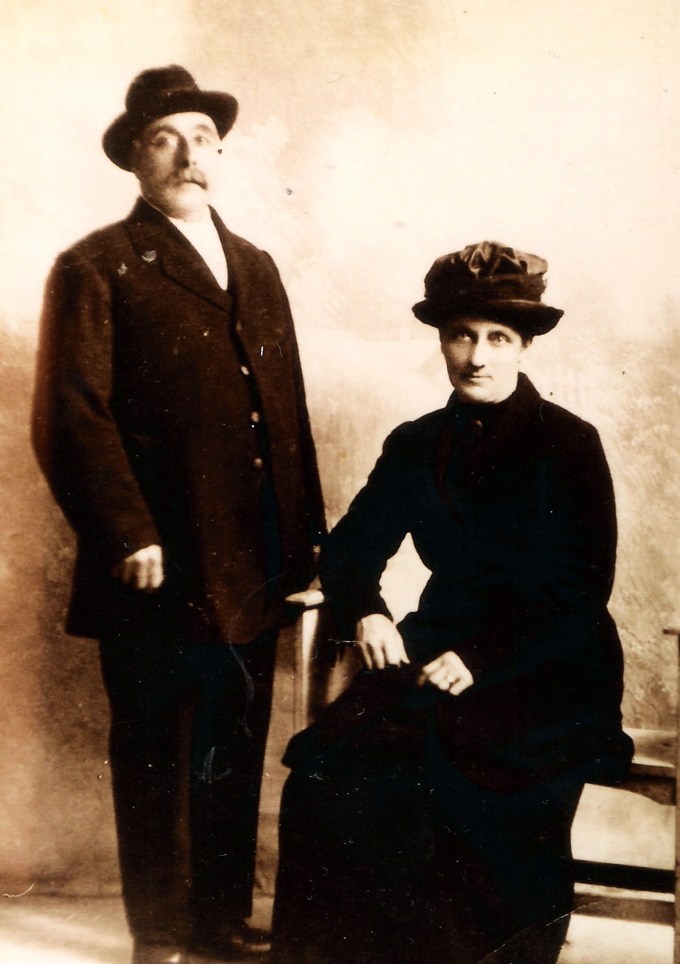
In the 1870s my Great Great Grandfather Frederick Henry Williams lived with his mother at 75 Manvers Street in Sneinton near Nottingham. At the same time, directly across the road at 80 Manvers Street, lived my Great Great Grandmother to be, Elizabeth Forbes Nevett. Elizabeth’s father was a shoemaker and Fred was a painter and decorator by trade, so they may have encountered each other from a business perspective, but Fred’s mother and Elizabeth’s father also died within 8 months of each other in 1878 and 1879. It is tempting to believe then that, in this case, a perfect storm of geographical and emotional proximity helped bring Fred and Elizabeth together. Could it have been different if their parents hadn’t died at that particular time?  Of course they may not have ended up living across the street from each other anyway. In any event they were married soon after their parents deaths, in December 1879…

JohnandMaryAnnieLees

Annie and John Lees

‘Annie’ Parker, my Great Great Grandmother, was born ‘illegitimately’ in the tiny village of Peatling Magna, Leicestershire in 1867. Her mother married a couple of years later and moved away from the village altogether to start a family with her new husband. Annie was left behind and lived with her Grandfather and later with an Aunt in Leicester. In the 1880s, however, and what changed is not clear, Annie moved back into the household of her mother and step-father. At this time they were resident in the Nottinghamshire village of Wilford. It proved to be a life-changing move beyond simple reconciliation with her mother. Whilst there she met John Lees,  a native of Wilford and my Great Great Grandfather, marrying him in 1888. How different it would have been if Annie had stayed in Leicestershire?…

Julia Annie Hawkes 1892


Julia Annie Buckingham aged 12 whilst living at Python Hill Farm

In the late 1890’s, after her widowed mothers second marriage, my maternal Great Grandmother Julia ‘Annie’ Buckingham became the step-daughter to one of Baron Saville of Rufford’s Farm Bailiffs. She lived at Python Hill Farm, Rainworth, Nottinghamshire and later at nearby Inkersall Grange Farm. One of the farm labourer’s working in the fields there just happened to be my Great Grandfather in-waiting, Joseph Hawkes. My imagination pictures the lowly labourer flirting with the bailiff’s step-daughter at a harvest festival dance or holding secret trysts behind the cow sheds. However romantically Hardyesque it might have actually been, Joseph and Julia Annie were married in 1901. It could have been so different though if Annie’s father hadn’t died in 1889. If he hadn’t then she would have remained a ropemaker’s daughter in a village 10 miles away…

Joseph Hawkes own father (also called Joseph), a native of Stow-on-the-Wold , Gloucestershire, only relocated to Nottinghamshire in 1874 upon leaving the army early following ill-health. Despite having never been there before, he chose to take the train to Nottingham directly from his demobilisation rather than return to Stow. It would appear that he did this because his Grandfather had already gone there to seek work in the Nottinghamshire coalfields – I presume that Joseph had the same idea in mind. Joseph senior married my Great Great Grandmother Charlotte Barker in Nottingham the following year, but what if his Grandfather had not made that move first?…

My paternal Great Grandparents, John Henry and Polly Williams, met after a football match in 1897. He played in the game and she served the after-match ham sandwiches. He ate rather more of them than he needed to. The result of the match was that they were married in 1902… but that after-match tea probably wasn’t compulsory and what if he was unable to play in the game for any reason on that particular day?

John Henry & Polly Williams 1937

John Henry and Polly Williams in 1937 with a fish… but it was ham sandwiches that brought them together.

Even closer to home: One day – before they had even started going out together – my dad took a detour on his motorbike en route to a darts match, to visit my mum at her house in Old Lenton, Nottingham. At this time they were no more than occasional acquaintances, even if dad had designs on getting to know her better! It turns that this visit happened, unknown to him at the time,  on the day before she and her family were due to move house. In fact they were not just moving house, but moving away from Lenton altogether, to another part of Nottingham entirely. Happily, after my mum made the revelation, my dad was able to find out where they were moving to and was encouraged to pay her a visit there, and the rest is history. Imagine, however, if that darts match had took place a couple of days later. My mum and her family would have already moved away  and they might never have got together at all!

A search for employment, an appointment made at a hiring fair, the ripple effect of decisions made by family members, the consequences of ill-health, choices made about where we live, our sporting predilections and our food preferences. In little more than a century of time, these are just some of the influences that led to forbears of mine coming together and which, in turn, manufactured my existence. These meetings were as much down to chance – or a string of chances – as the spin of a roulette wheel or the consequences that flow from the time and day that you happen to be walking down a particular street or looking in a particular direction. It’s family history equivalent of the movie ‘Sliding Doors’.  This is the essence of my fascination for genealogy and I was keen for it to be one of the backdrops to The Daylight Thief.

How lucky I am – how lucky we all are – that chance has given us a lifetime.

The Last Rope-makers: The Buckingham family and the end of an era.

This article was originally published in ‘The Nottinghamshire Historian’ in Autumn/Winter 1991. This is my revised text dating from 2008.

According to an obituary published in one local newspaper, the death on 23rd June 1952 of Alfred Henry Buckingham lost Nottinghamshire, “…one of its last remaining links with the craftsmen of old”. Eighteen years earlier an article in the Nottingham Evening News reported that he was the only man left in Nottinghamshire still engaged in making nets, rope and twine by hand. The passing of Alfred Henry Buckingham, therefore, and the demise of Nottinghamshire’s “cottage” rope-making industry were one and the same event.

The beginning of the story, however, can be traced back beyond Nottinghamshire, to within the shadows of Oxford’s dreaming spires, over a century before Alfred’s death.

Alfred’s father, my Great Great Grandfather, Henry George Buckingham, was born in Oxford on 11th October 1837. Henry was one of eight children, the son of John Buckingham, an Oxford University Policeman (the universities had set up a forerunner of modern Police forces in 1829). Neither Henry nor his four brothers followed their father’s footsteps, however. Three of them, Henry, Thomas and Alfred became rope-makers. Thomas eventually moved south to make his life in Plymouth, where the naval dockyards would have provided a thriving demand for rope. Henry and Alfred moved north to the agricultural heartlands of Lincolnshire and Nottinghamshire.

On 22nd March 1863 Henry married Julia Ann Floyd in Oxford. Shortly thereafter he took his new bride to live in the village of Ollerton, a hundred and thirty miles away in North Nottinghamshire.

We don’t know what prompted Henry to move such a distance away from the bustling Oxford suburb of Jericho to a sleepy country village, but he was to establish three ‘rope-walks’ in his new home. The first was on Newark Road, followed by two larger ones situated on Wellow Road and Hopyard Lane (behind the Hop Pole Hotel). Alfred Henry, Henry and Julia’s first surviving child, was born in the village on 31st March 1869 and from an early age he helped his father in the rope-walk . Young Alfred Henry started making nets at seven years old and soon afterwards he learnt how to make finished ropes.

On 9th August 1889, however, that great ravager of pre-Twentieth Century populations, Phthisis (Pulmonary Tuberculosis) claimed the life of Henry George Buckingham. He was fifty-one years old and had evidently been suffering from the disease for over two years. Alfred Henry, aged just twenty years old, was now the head of the family business.

A rope-walk was a strip of land up to a thousand feet long where the rope-maker set up his primitive machinery and stretched and twisted sometimes vast lengths of hemp into rope and twine. The three rope-walks running simultaneously represented the peak years of business for the Buckingham’s. The Newark Road site was used for making cart ropes, plough lines, washing lines, cords and twines. The other two rope-walks, being longer, were used for making ships cables and other very long ropes. These ropes were a ‘standard coil’ measuring a hundred and twenty fathoms in length. There was also a shop, in Church Street, where the finished products were sold.

A description of the Newark Road site exists in the records of the Science Museum in London. It reads:

“It is ninety yards long and twelve feet wide, running nearly east and west with a wall of farm buildings on the southern side. Upon this wall numbers are painted marking every five yards of its length. The land to the south side is laid out as allotment gardens. At the east end is a shed which protects the winding tackle and tools from the rain. Alongside it is the chimney of the tar boiler, where Stockholm tar was heated in a copper to a temperature above that of boiling water. This is needed for certain ropes to be drawn through it, the excess of tar being pressed out of the rope by  weighted beam.

The rope-walk is open to the sky – a neat cinder path with grass verges in which at intervals of about twenty yards are ‘T’ shaped posts of hand height, called “bearers”. In the horizontal bars of these posts are wooden pins, which keep the lines of rope or yarn separate and clear of the ground”.

Alfred Henry Buckingham related in later years that, in his early days as a rope-maker, if the rope-walk wasn’t long enough, hemp was stretched out across the main street to complete the work. Such was the tranquility of the country village before the reign of the motor car began.

The rope making process was an ancient one. Rope making scenes using similar methods to the one used by the Buckingham’s were depicted on the walls of a fifth dynasty tomb in Thebes. As the centuries passed rope became a much prized commodity performing an indispensible role in shipbuilding and agriculture. Rope-walks became part of the pre-industrial landscape (proliferating especially around ship-yards) and even today you can find reminders of these bygone craftsmen in the street names of our towns and cities.

Hemp, from long experience, was discovered to be the fibre most suited to rope manufacture. Originally hemp would have been combed and spun into yarn by the rope maker, but in later years it would have been purchased pre-prepared. Various types of hemp were available and each produced a different product. Italian hemp was the most prized with other materials also used including sunn, jute, sisal and Egyptian cotton (the latter evidently the best for making clothes lines).

The spun hemp (referred to as a yarn) was ‘laid’ or twisted into strands (a strand was usually made of three yarns). They were twisted by fastening them onto hooks in a ‘tackle-board’ before being turned by a large cogwheel. As the hooks were turned the yarns twisted together to form strands. During this process the yarns were stretched to equal tension supported by the posts along the rope-walk. Finally the strands from several yarns were combined again (by twisting) to form a completed rope. The finished product was then wound on a star handled reel. Plough lines and clothes lines were formed into a ‘knot’ (clothes lines are still purchased in this form) by being looped around two pegs in a hand reel. In a rope measuring 100 yards, about 150 yards of hemp was used. About a third of the total length of hemp was taken up in the twisting process.

By far the largest user of rope was the shipping industry. This was clearly the attraction for Henry George’s elder brother Thomas when he moved from Oxford to Plymouth. Its value in these locations meant that demand outstripped the supply produced by the large dockyard rope-walks and professional rope thieves were common. Most of the Buckingham ropes from Ollerton were sent to the dock towns of Hull, Grimsby and Gainsborough.

Second to the demand from the shipping industry was the business generated from the agricultural community of North Nottinghamshire. Before mechanisation took hold rope was a staple component of the farming industry and at the zenith of production in the 1870s and 1880s the Buckingham’s employed twenty people in the rope-walks of Ollerton.

Alfred Henry Buckingham at work on the Rope-Walk c 1950.

Alfred Henry Buckingham at work on the Rope-Walk c 1950.

The boom years, however, came to an end. Since the begining of the nineteenth century a series of inventions were patented, including Cartwright’s ‘Cordelier’, Huddart’s spinning machine and Norvell’s ‘endless’ ropemaking machine which produced strands and ropes at the same time. Larger businesses grew up on the new industrialised processes to take an increasing share of the market. Overseas competition began to loom large, most notably from the United States. The demand for the finished product itself also began to wane. Sailing ships were replaced by steam ships constructed from iron and steel and agriculture became more mechanised. However, it was the advent of synthetic fibres, which escalated following hemp shortages during the Great War, which sounded the final death knell for the village rope-maker.

Henry George Buckingham’s brothers also fell victim to this slump in demand for rope. Elder brother Thomas was listed as a rope-maker on the Plymouth census until 1881. By 1891 his occupation was given as ‘labourer’. At his death in 1895 (from “exposure to the sun”) he was working in a wood yard. Younger brother Alfred also moved north, initially to Lincolnshire, his occupation was described as ‘ropemaker’ at the time of his marriage in Grantham in 1870. By 1871 Alfred and his new wife Millicent were living with his brother Henry George and family in Ollerton and assisting with the ropemaking business there. By the mid 1870s they had moved to Newmarket, Cambridgeshire, close to where his mother Elizabeth and sister Clara were now resident. He died there in 1878 (also from Phthisis) whilst working as a stableman.

In Nottinghamshire in 1881, according to Kelly’s Directory, there were twenty-nine rope and twine makers in the county. By 1936 there were twelve, mainly larger businesses. Alfred Henry himself, accredited as being the last producer of handmade ropes in Nottinghamshire, was now using only one rope-walk (Newark Road for which he paid a £1 quarterly rent to Baron Saville’s Rufford Estate until 1939, when the estate was sold off) with only a single additional employee. This was despite the widely recognised quality of Buckingham rope which was used as far afield as Africa and New Zealand.

Alfred Henry refused to compromise on the quality of the finished product, he once said, “The great trouble you know is that ropes last so long. Dealers ask if I cannot make clothes lines of worse quality, but I refuse”. During the leaner times he tried his hand at other things. For a time he collaborated with a certain Mr. Hibbs, an Ollerton Wheelwright, to make bicycles. He also supplemented his income by delivering mail in the Rufford district. However, nothing could stop the village rope-maker from joining the blacksmith, the wheelwright and the miller, only to be found in the annals of folklore.

Alfred Henry Buckingham, possibly seated on a Hibbs-Buckingham bicycle (?) c 1900.

Alfred Henry Buckingham, possibly seated on a Hibbs-Buckingham bicycle (?) c 1900.

The tiny village of Ollerton now probably goes unnoticed by most motorists travelling along the busy A614 which now bypasses it. The village retains a certain sleepiness with its cottages and a working waterwheel (now a popular tea room) that leads the visitor to conclude that little has changed over the past century or so. Listening to the gentle flow of the River Maun running through the village and even despite the hum of traffic from the busy main road nearby, one can even imagine that it is quieter now than it was then. But things have changed, of course. Alfred’s rope-maker’s cottage is still there, however, and so is the site of the Newark Road rope-walk, which is now overgrown and forgotten. There is nothing at the site to remind anyone wading through the weeds that hemp was twisted and stretched into rope, in vast quantities for nearly a century in this place.

Alfred Henry Buckingham's rope-walk: Left c 1950 and, right, in 2008.

Alfred Henry Buckingham’s rope-walk: Left c 1950 and, right, in 2008.

Alfred Henry Buckingham died, aged 83 years, at the home of his daughter in Eakring, Nottinghamshire. He is buried in the churchyard there. All traces of his trade and the Buckingham rope-making heritage were not lost, however.  A number of years before his death he bequeathed his equipment to the Science Museum in London and after his death, nearly ninety years after his father first made rope in Ollerton, the tools of his trade were removed to Kensington. They now lie in a Science Museum warehouse in the south of England alongside other relics of Britain’s forgotten past.

Rope-makers in the Buckingham family (circled).

Rope-makers in the Buckingham family (circled).

Sources:

  • Rope (A History of the Hard Fibre Cordage Industry in the United Kingdom) by William Tyson – Wheatland Journals Ltd 1966.
  • Kelly’s Directory of Nottinghamshire 1881 and 1936.
  • Ollerton Parish Registers.
  • BMD Certificates obtained from the General Register Office.
  • Nottingham Evening News – article dated 24/01/1934.
  • Rufford Estate Sale Catalogue 1939 (Nottinghamshie Archives).
  • Material supplied by Mr. Charles Moore, curator of the textile and machinery collection for the Science Museum in connection with the bequest of the Buckingham ropemaking equipment in 1952.
  • Conversations with Mr. Robert Alfred Buckingham 1931-1999 (Alfred Henry’s grandson) in 1989/1990 – who also supplied the newspaper cutting containing the obituary of Alfred Henry Buckingham (which although not acknowledged was probably taken from the Mansfield Chronicle and Advertiser – now known as the ‘Chad’).
  • Conversation with Mr. Thomas Mettam, former mill owner, Ollerton.

Casualty of War: Raising Jack Oscroft from the dead 100 years on.

Jack Oscroft.

Jack Oscroft.

Exactly one hundred years ago, on 16th June 1915, Nottinghamshire lad Jack Oscroft was killed at Helles on the Gallipoli peninsula.

In the grand scheme of things his death was unremarkable. Despite the modern day hyper-focus on the admittedly significant and stirring Anzac contribution to the Gallipoli campaign, the largest numbers of allied combatants on the peninsula came from Britain. Estimates vary a little, but virtually all sources agree that the numbers of British dead of the Dardanelles alone exceeded the combined total of Australian, New Zealand, Indian, Newfoundland and French battle deaths.

The total number of British soldiers killed was around 30,000 (out of a total death toll on all sides of over 100,000). I have made the point in my previous blog about Holocaust Tourism that, in the face of such mind-bogglingly huge numbers (and the Gallipoli toll was nowhere near the scale of the Holocaust), individual stories tend to become invisible. Each casualty becomes a number lost in the dense and shocking fog of statistics… and the singular personal story behind it is left behind where it died in the bloody earth.

Jack sister - My Great Great Grandmother Emma Davis.

Jack’s sister – My Great Great Grandmother Emma Davis.

I first learned about Jack from my Grandmother (he was the brother of my Great Great Grandmother Emma Davis née Oscroft) and I can remember having my curiosity stirred as a child by the very exotic sounding word ‘Dardanelles’ … what on earth were the Dardanelles? I can clearly recall that question burning in my mind. Later on I was able to research his life and feel some connection to him but, his living relatives aside, to everyone else Jack remained just one of those sad statistics.

So now, on the centenary of his death, it feels like the right time to change all of that. It is the moment to shine a light on Jack’s life and to raise him up from the dust of Helles and from amidst the other tens of thousands of faceless dead of the Gallipoli Campaign.

When looking back at Jack’s story, it is striking, from a modern day viewpoint at least, that tragedy stalked his life from early on…

He was born on 14th November 1881 in Redhill, at the edge of the village of Arnold in Nottinghamshire. Jack’s parents William (a chimney sweep) and Louisa had already lost two children in infancy by then and a further daughter, Julia, succumbed to bronchitis when Jack was 8 years old. Even before Jack was born, in 1877, Louisa had spent a few months in the Lunatic Asylum at Sneinton on the edge of Nottingham. She was committed again the year after Julia’s death for a period lasting 7 months. However, her release was all too brief and she returned to the Asylum on 19th June 1891. This time Louisa did not come out and tuberculosis eventually ended her life in the County Lunatic Asylum at Saxondale in 1906. The following year Jack’s eldest sister, Grace, took her own life by hanging herself in the pantry of her house at the age of 36, apparently in fear that she had inherited her mother’s illness.

By then Jack had been married to Mary Agnes Bowley for a couple of years and they were living in The Meadows area of Nottingham. They too had lost a child in infancy, a boy called James, during a short-lived residency in Pogmoor, Barnsley, where Jack held a job at the brick works. The next few years were restless ones where Jack and Aggie moved home a number of times and Jack tried his hand at several different occupations. Two more children, Leonard and Eileen Blanche, also arrived. Tragedy, however, was again waiting in the wings ready to take the stage and scarlet fever took away Leonard in 1908, aged just 3 years old. Between then and the outbreak of war, another son, Wilfred, was born in 1910 and Jack’s father, William, passed away in 1912. In the years leading up to the war Jack worked as a Corn Merchant’s drayman and then a waggoner, latterly at Old Park Farm in Wollaton.

Royal Naval Division recruitment poster (Public Domain).

Royal Naval Division recruitment poster (Public Domain).

The Gallipoli campaign was to be the backdrop to the final tragic act of Jack’s life. The origins of the campaign and the folly that it became are well documented elsewhere (I would recommend L.A. Carlyon’s book as a starting point). Jack’s own journey from the fields and byways of the English Midlands to the shores of Turkey, began unwittingly, when he answered his country’s call to arms in Nottingham. On 8th September 1914 he signed up, not with the local regiment, the Sherwood Foresters, but with the Northumberland Fusiliers. If joining a Northumbrian regiment wasn’t the norm in Nottingham, then two days later he did something even more surprising, he enrolled in the Royal Naval Volunteer Reserve instead.

We’ll never know what methods of persuasion it took for Jack to sign up; if indeed he needed persuading. The RNVR was more usually associated with men from the great seaports on the Clyde, or the Mersey, or the Tyne… not usually farm men from Trentside. On 3rd November 1914 he was added to the muster of ‘C’ Company of the Royal Naval Division’s Anson Battalion. Jack didn’t know it at the time, but the RND was to have the misfortune of becoming part of the force assembled for the assault on the Dardenelles. In another twist of fate these men, held in reserve to serve the Royal Navy, were transformed into into soldiers to fight in a land war.

V Beach and it's cemetery.

V Beach and it’s cemetery.

And so it was that on 7th February 1915 Jack and his comrades marched out of Blandford Camp in North Dorset on their way, via Avonmouth, to Port Said in Egypt. Just two months later, on 25th April, they were aboard ships amassing on the sparkling Aegean Sea, poised for a full scale seaborne assault on the Ottoman Empire . It is likely that Jack was part of the force that landed at X-Beach on the western side of the tip of the Gallipoli Peninsula. If so, he was lucky. X-Beach was largely undefended… unlike V and W beaches to the south, where the main element of the British force landed. With Turkish gun batteries lying in wait up on the high ground above them, these beaches became a bloodbath.

W Beach today.

W Beach today.

The original plan was for a rapid advance up the peninsular and onto Constantinople, but instead the disastrous and bloody landings set the tone for what was to come. The Anson Battalion regrouped to participate in more failed assaults and skirmishes in the following weeks and months. In between they suffered from the unbearable heat, lice, dysentery (“the Gallipoli trots”) and an endless plague of flies. The insects were fat from feeding on the corpses lying unburied on the battlefield and they covered everything in sight, including the food the soldiers ate. But Jack survived all of this too.

In early June the Anson Battalion was pulled back into a rest camp at Seddulbahir, near the fort which stands at the tip of the peninsula, where the depleted force was re-organised and they took stock of kit and stores. Jack’s peacetime occupation meant that he had been allocated a role in the transport section. He was assigned the job of unloading stores and water from W and X beaches and transporting them to the camp using wagons and mules. Whilst he toiled, plans were drawn up to take the battalion off the peninsula for further rest and recuperation on the nearby island of Imbros.

Jack never made it.

© IWM (Q 13328) W Beach

Unloading stores on W Beach © IWM (Q 13328) .

The commander of the newly reorganised ‘C’ company, K. R. Dundas, wrote in his dairy on 16th June 1915:

 “Last night was quiet, but all this a.m. they have been shelling our camp… The Turks are dropping their new terror round us, the one from Asia that arrives without warning & explodes with a scream. It is a big gun, probably a 9.2 inch. One has just fallen and killed two of our transport men”.

Dundas was to lose his own life later in the campaign. The battalion war diary simply records that “2 men of Transport Section killed by shell 16/5/15”.

Jack was 33 years and 7 months old. There was nothing left of him to bury. Back home he left a 6 year old daughter and a 4 year old son who barely had chance to know him.

He is commemorated now on the memorial that stands at the tip of the Helles peninsula looking out across the Aegean Sea. In 2012 my aunt visited the spot to pay her respects and I did the same the following year. Because it was out of reach for the family he left behind, we are likely to be the only relatives to have ever made the 2000 mile trip in the century since his death.

The Helles Memorial.

The Helles Memorial.

There may seem to be a dark symmetry to the fact that a life full of tragedy and loss ended in the way it did. However, in the cold, harsh world in which he lived, Jack was just an ordinary working man striving through adversity to make a living and to do what he could to feed his young family. When his country needed him, he did his duty and stepped forward to answer the call. Like so many other casualties of the Great War, though, his reward was a glory-less and futile death. The greatest sacrifice he could have made became nothing more than a statistic of an escapade that was, ultimately, an embarrassment to the British Government.

Day 3 Gallipoli RNVR Panel 13 Helles 3

Jack’s name in the company of comrades on Panel 13 of the memorial.

Jack’s children may have been young enough to come through the enormity of his loss unscathed, but Aggie was hit hard. Despite re-marrying she carried Jack’s loss with her. She might not have known the words of Mustafa Kemal – the founding father of modern Turkey and better known now under the name Atatürk – which were addressed to the mothers of the allied soldiers who fell at Gallipoli. Had she been aware, however, then she may have taken some comfort from knowing that Jack’s sacrifice was at least acknowledged and embraced in a far away land:

“Those heroes who shed their blood and lost their loves…You are now lying in the soil of a friendly country so rest in peace.

There is no difference between the Johnnies and the Mehmets to us where they lie side by side here in this country of ours…

You the mothers who sent their sons from far away countries wipe away your tears. Your sons are now lying in our bosom and are at peace. After having lost their lives on this land they are our sons as well”.


Jack Oscroft was partly an inspiration for my novel The Man Who Found Treasure.

The excerpt from the war diary of the Hon. K. R. Dundas is taken from ‘The Jack Clegg Memorial Database of Royal Naval Division Casualties of the Great War’ compiled by Jack Marshall and available at http://www.ancestry.co.uk. The official war diary of the Anson Battalion for the period from 10th June  to 20th October 1915 is available at the National Archives under reference WO 95/4291 and now also at http://www.ancestry.co.uk .

The words of Mustafa Kemal Atatürk are taken from an inscription at the Turkish Martyrs Memorial on Hisarlık Hill overlooking Morto Bay, Gallipoli.

Wish you were here? …The unsettling allure of the Holocaust.

Whenever it was very cold my Mum was often heard to say, “It’s perishing”!
The phrase pops into my mind now, as I stand on the so-called ‘Judenrampe’ at Auschwitz-Birkenau. It seems an apt description. It is cold. Very cold. The freezing wind is blowing icy daggers of rain into my face, and my lips and fingers are numb. I think to myself, how on earth can I complain about the cold here, of all places?
9318a-auschwitz2bii2b-2bselection2bramp2bbw
The so called  “Judenrampe”

For over a million people this place, together with its slightly older counterpart a couple of kilometres away, was just that… perishing. On this very spot, towards the climax of  the Nazi’s reign of terror, thousands of people, mainly Hungarian Jews, climbed down from their transports and were immediately sorted, sifted and processed. Those who were deemed able to work by the camp doctors were marched away into their ‘new home’. The elderly, sick and infirm, together with many women and children (including those yet to be born) were taken on a short walk to the gas chamber.

The selections were a charade organised with mechanical precision… a careful deception, which gave away nothing of their fate to the unwitting captives. As a result, there was no panic as they trudged off to meet their end alongside the railway tracks on which they arrived. The cold in those days would have been, at its worst, many times greater than it is for me now; for the detainees there were no warm coats, gloves and scarves to protect against it. It occurs to me though, in the face of hunger, disease, grotesque medical experiments, summary executions and simply losing the will to live, that the temperature was the least of worries for those who survived the selections.

A shiver runs down my spine as I think about it. It’s not a shiver caused by the chill. This place is still bleak and desolate. As I look ahead towards the rail depot control tower, to my right are the brick huts used to house the more fortunate arrivals. I hesitate to use the word ‘fortunate’. It is a cause for debate amongst those I am travelling with and I, together with my wife and friends, find that our opinions differ about whether any group of arrivals would have recognised any fortune in their fate here. To my left, as far as the eye can see through the surrounding barbed wire, the decomposed skeletons of wooden huts run off into the distance. As a signal of the horror perpetrated in this place, only their chimney stacks remain. Behind me are the exploded ruins of a couple of the gas chambers.

Dotted around, among the physical remains of this place are the camp’s modern inmates… tourists. We too climb down from our transports and are sorted, sifted and processed. Our selection, however, merely results in us being allocated to a tour guide. At the older camp, now known as Auschwitz I, our group snakes around the rooms containing the exhibits, up and down the worn steps, hot on the heels of the party before us. Then we too are shipped off to Birkenau.

I notice that some of the tourists may have more claim to be here than others. Gathered by one of the broken gas chambers in Birkenau, a group of Israeli schoolchildren and their teachers, all of them draped in the Star of David, are holding some sort of service. They incant prayers. Tears are flowing. Around them other people are taking photographs, seemingly oblivious to the solemn act of remembrance taking place beside them. I find myself clicking away on my camera too and I wonder why we are here?

d37d3-auschwitz2bi2b-2bblocks2btower2bwire2bbw
Watchtower and huts at Auschwitz I.

I know that I wanted to come here precisely to feel the dark weight of history. At least that what I tell myself. I’m here – so goes my justification – to show solidarity with those who suffered. To add my metaphorical voice to those who say that this place… and what happened here and in other places like it… can never be forgotten. And there’s something else too. I feel passionately that we become better human beings by learning from our mistakes. That is especially true when we consider lessons from history. So I’m here too, to learn from one of the most heinous acts of recent human history. Everyone should know about this place, and to know about this place you have to experience it.

I find myself, unexpectedly, experiencing a physical reaction here too, especially standing on the ‘Judenrampe’ and looking at the exhibits at Auschwitz I. There you sense the blood drain from your body as you walk into a room to be starkly confronted by a mountain of human hair, cut from the heads of tens of thousands of the sorry souls who ended up here. We file dutifully past the shoes, luggage and prosthetic limbs taken from the dispossessed. My wife can’t face looking at a display of children’s clothes. But I can’t shake off the feeling that I am simply a tourist and that makes me feel distinctly odd.

ebbfa-pc582aszc3b3w2b
The site of the Płaszów Concentration Camp.

The holocaust has cast a lasting pall over this part of the world. In nearby Krakow, the picturesque city where we are based, we later tour Oscar Schindler’s factory, brought to life first by Thomas Keneally’s novel ‘Schindler’s Ark’ and then by Steven Spielberg’s film. It now houses an absorbing and compelling display detailing the history of Krakow’s Nazi occupation. I stand on the stairs where Liam Neeson appeared from his office and looked down to cast an eye over a prospective secretary in Spielberg’s film, only to find out that this was a much later addition to the building. It would appear that all is not what it seems. In Schindler’s actual office, the names of the people he helped save from extermination are enshrined within an installation built of facsimiles of the enamel pots that were made in the factory.

We take a tram and then walk to the site of Płaszów concentration camp. It is a memorial park now. There’s nothing much here, except some shattered remnants of the desecrated Jewish cemetery that stood here before the camp. Up on the hill Amon Goeth’s house still exists, a haunting presence, his balcony facing out towards where we stand. Back then he took pot shots at the inmates with his rifle. I try to imagine the sound of the shots ringing out and the fear and panic that would have caused. The house is now just one of several residential homes clinging to the hill; it’s further away than I imagined and easy to miss… as we did.

3801a-zgody2bsquare2bnow2bbohaterow2bgetta2b2
Plac Zgody Square (now Plac Bohaterow Getta).

It is raining. In fact it hasn’t stopped raining since we’ve been here. At the site of Krakow’s ghetto we stand in the square, Plac Zgody, which was the focal point of its horrific liquidation. It is now full of empty chairs, a silent but poignant tribute to those who were taken away from here, never to return. In the Jewish quarter, Kazimierz, there are more monuments to see as we walk past murals on houses commemorating families who had lived here for centuries, only to be wiped out completely in 1941.

bb0d1-auschwitz2bi2b-2barbeit2bmacht2bfrei2b2

I normally love treading the ground of history. I always feel the electric buzz of connection when I stand in a place where something of note happened in the past. I’ve been to countless castles and battlefields all over the world and I never fail to feel that pulse of excitement. But holocaust tourism feels very different. It feels necessary… yes, obligatory even for the reason already explained, but it feels uncomfortable too… bordering on the voyeuristic.

That sensation grows from the knowledge that the awful things which happened here… and the ordinary people they happened to… are graphically still on show and we are witnessing them anew. It also stems from the knowledge that the ground upon which  these events took place must still, surely, harbour some residue, however minute, , of the blood, pain, tears anguish and desperation that fell upon it. The screams of a million victims must still echo a little within the earth that remains and the bricks that continue to stand. An unimaginable millions of victims there may have been, but each one of them had an intensely personal story to tell… the Franks’, the Schindler Jews and others had a spotlight shone upon their stories. Others left no trace behind.  Perhaps this is why fiction can still bring a gut-wrenching and heart-stopping reality to it all. One need only to think of William Styron’s ‘Sophie’s Choice’, Tatiana de Rosnay’s ‘Sarah’s Key’, Lindsey Hawdon’s ‘Jakob’s Colours’ and even, for all the controversy it has sparked, John Boyne’s ‘The Boy in the Striped Pyjamas’ to emphasise the point.

I am thankful that I was born too late and too far away to be close to it. Despite the discomfort it engenders, though, I am glad I came. I can sense that both my empathy with the victims and my disgust at the perpetrators of these crimes has sharpened. I know that I could never stand by and let it happen in my world. I also know that that I will never complain about the cold again.

 Auschwitz I - Wire BW
Worth a look too… Auschwitz: A History in Photographs’ by Teresa Swiebocka, ‘Hanns and Rudolf’ by Thomas Harding, The Cracow Ghetto Pharmacy’ by Tadeusz Pankiewicz and Schindler’s Legacy’ by Elinor J. Brecher.