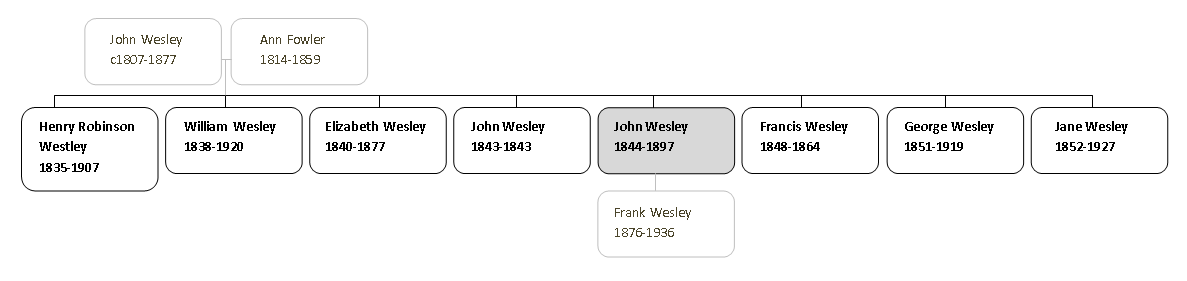
Siblings of Henry Robinson Westley.
Henry Robinson Westley (1835-1907).
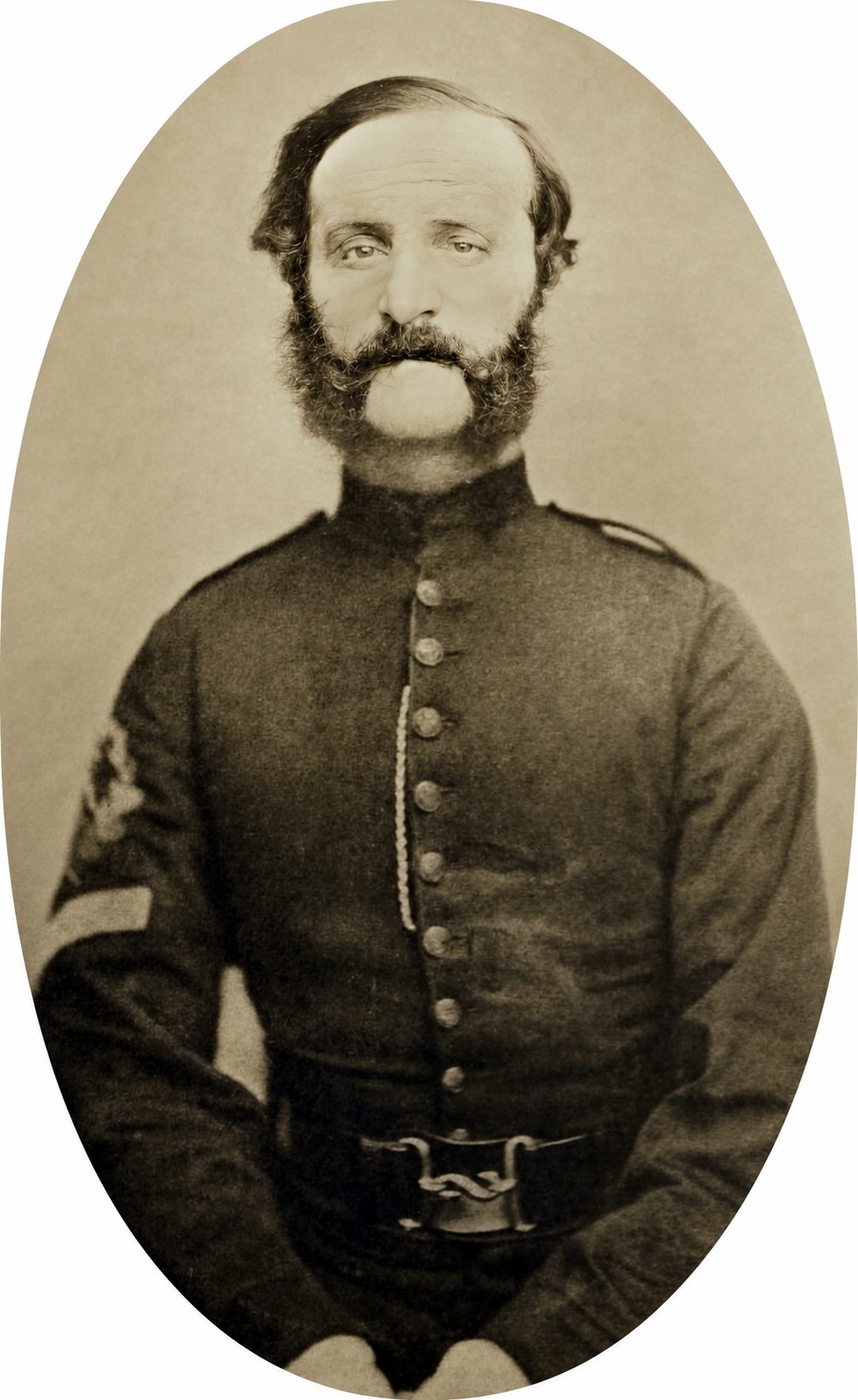
(1835-1907)
Born in 1835 on Albion Street, Nottingham, and baptised on 2nd December 1835 at St. Peters Church, Henry was the first child of John and Ann Wesley. By 1851 Henry, like the rest of the family, had briefly adopted the surname ‘Robinson’ and, aged 15, was working as Box Maker and lodging with his uncle William Fowler. On 16th June 1855, now going by the name of Henry Robinson Westley1, he signed on as a Private with the 1st Rifle Brigade at Northampton, transferring to the 4th Rifle Brigade in April 1857. He was to spend the next 21 years serving with the Brigade, including tours of duty in Ireland, Malta, Gibraltar, Canada and India. The only serious action the regiment saw during this time was in Canada when they were involved in crushing the Fenian revolt and for which Henry received his only campaign medal.
On 19th August 1863 he married Mary Killackey (the Irish widow of a Corporal from the 51st Regiment), adopting her son Joseph (1852-1921). They had four children of their own; Mark Harry (1864-1919) who was born in Gibraltar, Henry Robinson (1866-1867) ) who was born and died in Montreal during the tour of Canada, Basil Robinson (1868-1955) and Mary Alice (1872-1954).
Henry’s service with the 4th Rifle Brigade came to an end in June 1876. On 8th November 1877 he signed up at Chesterfield as a Sergeant with the 2nd Derbyshire Militia, also known as the 3rd Battalion Derby Regiment or the ‘Chatsworth Rifles’. He served until 1882, being discharged at York on 6th June of that year. The family moved back to Nottingham, living at 25 Hedderley Street and 4 Great Freeman Street, where Henry found work as a Cashier and Clerk. He acted as executor for his Brother John’s estate in 1897. His wife Mary died in 1905. Henry had been a serious drinker of Rum since leaving the Army (“a quart of Rum a week” according to evidence given at his inquest) and the effects of alcoholism led directly to his death at 43 Woodborough Road, the home of his daughter Mary Alice, on 17th June 1907, aged 72. Henry had only received his one campaign medal, for his service against the Fenian revolt in Canada in 1867, the previous month. He was buried in Nottingham General Cemetery four days after his death.
William Wesley (1838-1920).
William was born on 23rd Jan 1838 and baptised at St. Nicholas Church on 11th February 1838. He was born at the then family home on Castle Row in Nottingham. Castle Row stood alongside what is now Castle Boulevard, but which then was just a track leading to the village of Lenton. Just behind Castle Row stood the three canal wharves servicing the Town: Castle Wharf, Park Wharf and the Dukes Wharf. Around them were some of the many canal-side wood-yards. It was probably in one of these that William’s father John (my Great Great Great Grandfather) worked as a Sawyer. William, eventually, followed in his footsteps becoming a Sawyer himself. Before then, in 1851 – at the age of 13, he was recorded on the Census as a ‘Lace Threader’, an occupation that could only be done by children, running between machines in the lace factories.
On 4th March 1860 William married Maria Annie Morrison at St. Marys Church. His name was recorded as William Wessley Robinson, which reflected the name that the family was sometimes known as during the 1850’s. At the time of the 1861 census William and Maria, now back to the name of Wesley, were living at Carey’s Yard, just off Coalpit Lane. William was a witness at his sister Elizabeth’s wedding in June 1862 – Maria and Elizabeth were also friends, having worked at Wilson’s Hosiery Warehouse together. This was the last record of them in Nottingham.
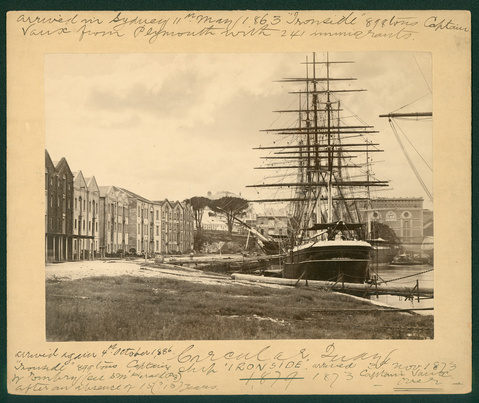
On 6th May 1864 William and Maria set sail from Gravesend on the ship ‘Ironsides’. They were accompanied by his sister Elizabeth and her husband George Waudby. Their voyage took them over the equator (which they crossed on 11th June) and round the Cape of Good Hope (on 4th July). Their destination was New Zealand, where they arrived in Auckland on 25th August.
1864 was the peak moment of assisted immigration to the colonies, four years before the end of convict transportation. Passage could be assisted by either the Government or private sponsors and William’s trade as a carpenter/sawyer and George’s trade as a plasterer would have been sought after skills in the emerging nations.
Although the conditions on board would have been better than those experienced on convict transports, the passenger ships would have been crowded and the conditions basic. It was normal for some passengers to die during the long journey and indeed two children died during the ‘Ironsides’ voyage (although two were also born on the crossing). The ship therefore arrived, as it began its voyage, with 197 souls on board.
William and Maria probably settled initially in the Auckland district of Newton (this is where Elizabeth and George’s son John Samuel was born in July 1866) before moving briefly with his sister and brother-in-law to Australia. Whilst Elizabeth and George then stayed behind in Sydney, William and Maria returned to New Zealand in around 1869. This was no doubt prompted by the ‘gold rush’ taking place in the town of Thames, near to Auckland. William didn’t make his fortune however, and instead, for a few years, he worked as a foreman for a builder called Mr. Dickson. Around 1876 William went to work for the New Zealand Railways as a foreman of works, a job he held for the next 27 years until he retired in 1903.
William and Maria made their home on Howe Street, Auckland in the 1870s, and afterwards at 14 Remuera Road. They ended their lives living at 20 Beresford Street.
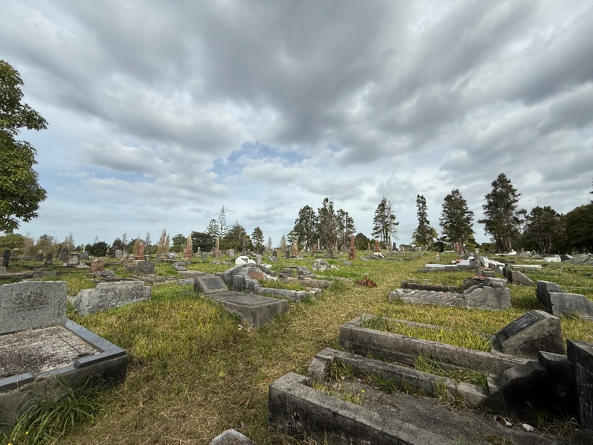
They celebrated their diamond wedding anniversary on 4th March 1920, but William died the following month on 22nd April 1920 of acute pleurisy, at the age of 82 years. He was buried in the Waikumete Cemetery at Glen Eden three days later.
Maria lived on until 1st September 1920, when she died of influenza aged 80 years. She was buried next to William on 4th September 1920. In a postscript to their story, Maria’s name lived on in the newspapers for a little while after her death, as a woman purporting to be Maria’s niece claimed that a deathbed agreement gave her permission to purchase the house at Beresford Road for £700 – considerably less than its real value. The case went to court in 1921, but the outcome was not recorded.
Elizabeth Wesley (1840-1877).
Elizabeth was born on 20th November 1840 and baptised at St. Nicholas Church on 27th December 1840. Like William she was born at Castle Row where the family lived until at least 1844. She was known in the family as ‘Betsy’, she was originally listed under this name on the 1851 census (this was crossed out and replaced with Elizabeth). In 1851 her occupation was given as ‘hose trimmer’. In 1857 she was one of five girls working in the Silk room at Messrs. Wilson’s Hosiery Warehouse on Houndsgate during August and September. She was a witness at a Coroner’s inquest following a fire under suspicious circumstances. One of her colleagues in the Silk room was Maria Morrison, who was later to marry Elizabeth’s brother William (see above). Elizabeth was still working in hosiery factories in 1861, by which time she held the position of ‘hose mender’.
The following year, on 16th June 1862, she married George Waudby, who was a plasterer by trade, at St. Matthews Church in Nottingham. As a portent of tough times to come their first two children (Elizabeth and John Henry, born in February 1863 and January 1864 respectively) both died after only 3 days of life. In the same year, as related above, Elizabeth and George accompanied her brother William and his wife Maria on voyage to a new life in New Zealand (see above). Another son, John Samuel, was born to the couple in the Auckland district of Newton on 19 July 1866.
Shortly afterwards both couples relocated to Australia, but while William and Maria returned to New Zealand, Elizabeth, George and their son stayed behind. They were resident in the Sydney by 1870, living at 225 Devonshire Street, when George was listed as a plasterer in the Sands Trade Directory for that year. By the following year they had moved to the Paddington district. Sands Directory records them living on Shadforth Street, directly opposite the entrance to Sydney’s Victoria Barracks. In 1871 their son William Henry Waudby (1871-1946) was born, named after George’s brother. Later newspaper reports indicate that they had at least two other children by this time, although birth records aren’t available for the period to confirm this. In 1873 another son, George Sydney, was born.
By 1873 Elizabeth and George were running the Britannia Hotel which was also located opposite the Victoria Barracks. In December 1874 they held election meetings in the hotel for the local magnate and politician John Sutherland.
January 1875 was an eventful month for the Waudbys. On 11th January their son George Sydney died, he was not yet two years old. On 29th January an incident occurred at the Britannia Hotel which led to Elizabeth Waudby suing for indecent assault. The Britannia Hotel was owned by a Mrs. Jones. Her son, James Lees, acting as her agent, attended the hotel on 29th January to show around a prospective buyer, a Mr. Cummings. Cummings failed to turn up so Lees asked George Waudby to go and fetch him. Whilst George was away running this errand, Lees asked Elizabeth to show him around the hotel. Whilst in a servant’s room Elizabeth alleged that Lees committed an assault on her. On the 18th May the Waudbys sued Lees at the Supreme Court. The Jury found in their favour and awarded them £25 damages (the equivalent of £ 1,750 today based on the retail price index).
A criminal hearing was held at the Police Court on 11th June 1875, and Lees was committed to trial at the Court of Quarter Sessions. The story had become a notorious one, Lees was a man of some status in the town, and the case was reported for several months in the Sydney newspapers and in other places across southern Australia. The trial took place on 3rd August and Lees was acquitted to applause and cheers from the watching crowd. One interesting facet of the story, as reported by journalists, was the reference to Elizabeth’s heavy drinking (clearly this was something that didn’t help her case) but it wasn’t to be the last time her alcohol consumption was discussed in the newspapers.
By 1876 the family had moved to live in Durham Cottage on Spicer Street in the neighbouring district of Woollahra. On Sunday morning 4th March 1877 George Waudby rose at around 5 O’clock in the morning and couldn’t find his wife. He called her name but received no response. After checking the children’s bedroom, he went downstairs to the kitchen. In the kitchen he found Elizabeth lying dead on the kitchen floor. She was wearing only her underwear and was surrounded by a large pool of blood and various kitchen utensils. An inquest was opened the following day at which a Dr. Quaife found that Elizabeth had died from a massive haemorrhage to her genital area. The coroner, Mr. Sheill, heard evidence that she had returned home in a state of drunkenness the previous evening. She had argued with George about her treatment of the children (he claimed that she had hit one of the children with a broom handle, drawing blood) and she went out again, returning only after George had gone to bed. The verdict was inconclusive, but the coroner suggested that the long handle of a saucepan lying next to her body was the most likely cause of her injuries.
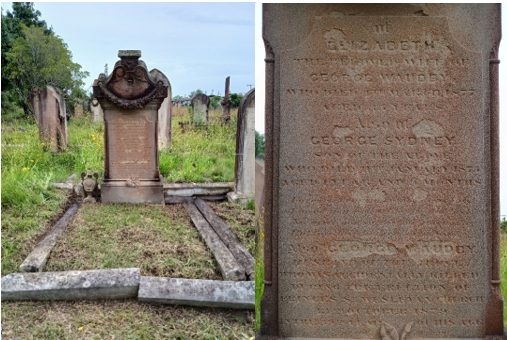
(Courtesy Chris Pigott via www.findagrave.com)
Elizabeth was buried at Rockwood Cemetery in Sydney (also known as the necropolis) on 6th March. Three days later, back in England, her father John died in Nottingham Union Workhouse, unaware of his daughter’s fate.
On 13th October 1879 George was accidentally killed during the construction of a church on Princes Street. In a tragic irony the church he was helping to build was a Wesley Chapel.
John Wesley (1843-1843).
John was the only one of John and Ann Wesley’s children to die in infancy. He was born on 19th February 1843 at Castle Row and died there on 5th March after suffering from ‘convulsions’. He was buried at St. Peters Church on 8th March 1843.
John Wesley (1844-1897) – My Great Grandfather.
Although becoming rarer, it was still not unusual for families to ‘recycle’ the names of children who died in the 1840’s. John Wesley senior was clearly very keen to have a son who bore his name, and so when their next child was born on 8th March 1844 (one year to the day since the funeral of their previous child) he too was christened John. He was the last of the four children to be born at Castle Row.
John started his working life as a plumber (he was listed as such on the 1861 census at the age of 17). By the time he married my Great Great Grandmother Annie Shaw on 10th June 1867 at Trinity Church, Nottingham, he was employed as a house painter. They set up home in Sneinton on West Street where four children were born (and two died in infancy) – Elizabeth (born and died November 1869), John Henry (1871-1921), William (1873-1874) and Frank, my Great Grandfather (1876-1936). By the time daughter Ethel (1883-1911) was born October 1883 John had taken over the running of the ‘Duke of Newcastle’ Beerhouse at 33 Upper Eldon Street, Sneinton. A Beerhouse keepers wine licence was granted on 27th August 1884.
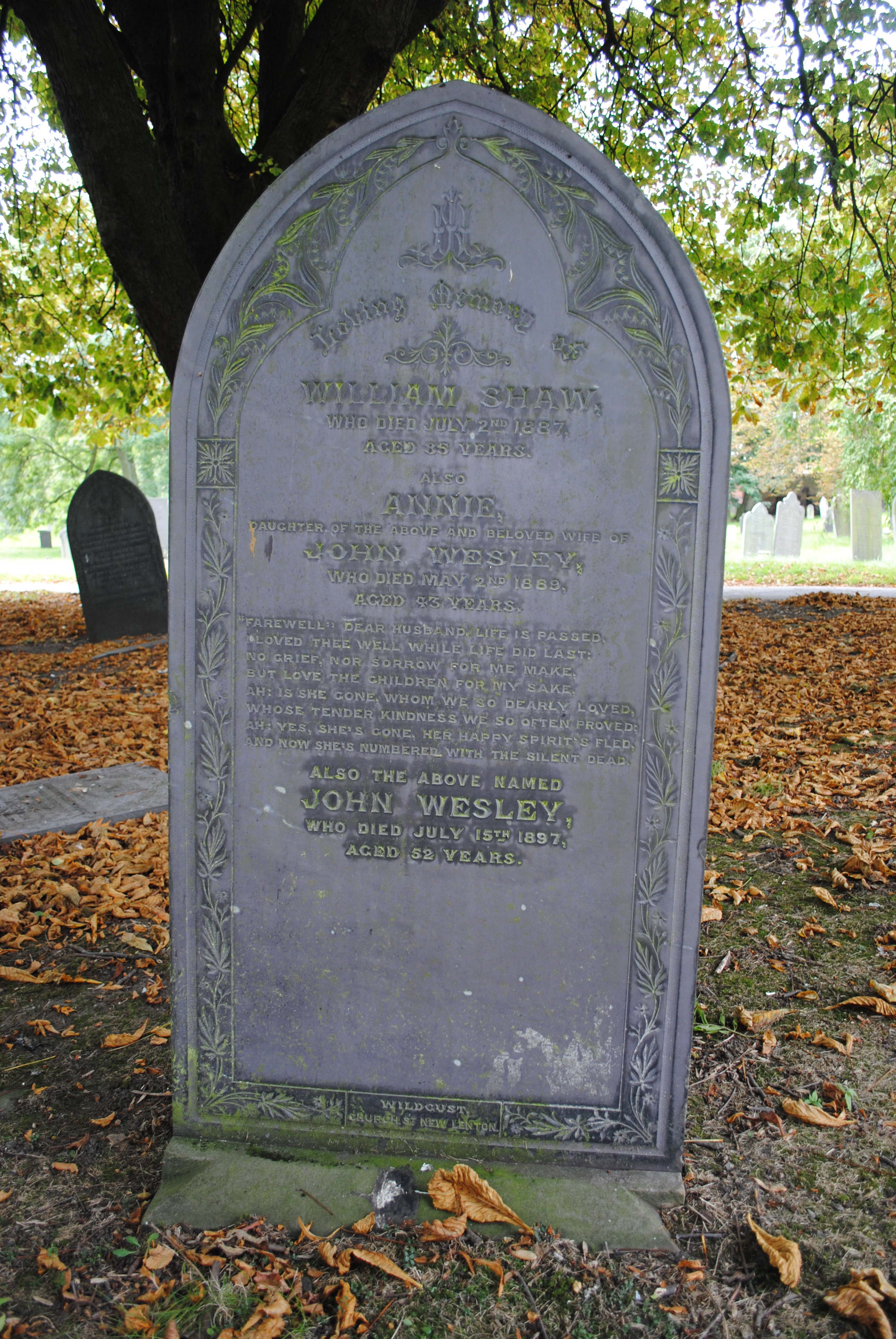
Although the business was apparently doing well (the Wesley’s were able to employ servants and John was comparatively wealthy at his death), tragedy struck in quick succession. Another son Jack – born in February 1885 – died the following month, and on 2 May 1889 Annie died from the heart condition Pericarditis.
Whether these losses were a contributing factor, or it was a longer-term affliction, John appears to have a drinking problem. In September 1892 and 1893 he appeared in local newspaper reports following fines for being ‘drunk and disorderly’, once assaulting a Police Office, and once being ‘drunk in charge of a Pony and Cart’2. As you will have already have read, alcohol also blighted the lives of at least two of his siblings.
John died at the age of 53 on 15th July 1897 of the kidney disease Nephritis (then known as Brights Disease) and was buried two days later alongside Annie, his father-in-law William Shaw, and the three children who pre-deceased him, at the General Cemetery in Nottingham.
Francis Wesley (1848-1864).
Francis, known as Frank, was born on 1st May 1848 on March Street, in St. Nicholas Parish Nottingham. On 26th November 1864, whilst the family were living at 1 Coalpit Lane, Francis died after suffering from Phthisis (pulmonary tuberculosis). He was 16 years old.
George Wesley (1851-1919).
George was born on 16th February 1851 at 1 Fountain Place on Woolpack Lane, Nottingham. At the time of the 1851 census, aged only 1 month, he was to be found living with his grandfather Francis Fowler on Cross Street, and not at the family home. Sometime before 20th July 1876 he was admitted to the Nottingham County Lunatic Asylum. It is not clear exactly why he was admitted to the asylum, in subsequent census returns he was described as an ‘imbecile’, sometimes ‘imbecile from birth’ and, in 1911, ‘Feeble Minded from birth’. These descriptions could have meant any number of things – the way that Victorians described mental health was limited – but it is possible, for instance, that he suffered from a condition such as Downs Syndrome.
The Asylum board of guardians meeting book for 20th July 1876 records that “The Guardians of the Nottingham Union are prepared to receive four chronic lunatics into their workhouse”. One of these “chronic lunatics” was George (although one wonders how ‘chronic’ if they were happy for him to be moved out of the Asylum). He was officially admitted to the Workhouse on 22nd July and was destined to spend the rest of his life as an inmate. When he was first admitted the Workhouse stood on York Street in Nottingham, by the turn of the century it had moved to temporary accommodation in a lace factory on Beech Avenue, Old Basford. Finally, around 1903, it (and George) moved to its final location at Bagthorpe (the current site of the City Hospital).
Despite this incarceration, it is clear that his family were close to him. On a number of censuses, and on his death entry, he is recorded as having an occupation as a ‘House Painter’. This was the pre-1883 occupation of his brother John (my Great Great Grandfather), indicating that George might have worked with John prior to his admission to the Asylum. George was the only sibling mentioned in his Sister Jane’s Will (although he eventually pre-deceased her) and at his death the informant to the registrar was William Winfield, the widower of George’s niece Ethel (who had died in 1911 aged just 27). William and his young family had been taken under the wing of George’s sister Jane.
George was a victim of the Spanish Flu epidemic of 1918-20. The disease claimed his life at a temporary workhouse infirmary set up in Sneinton Dale School on 21st February 1919. He was buried at the Church Cemetery, Nottingham, alongside his niece Ethel on 27th February 1919.
Jane Wesley (1852-1927).
Jane was the last child born to my Great Great Great Grandparents John and Ann Wesley. She came into the world on 18th September 1952 at the family home at 1 Fountain Place on Woolpack Lane, Nottingham. Early on she showed signs of following a conventional path for young women of her age, in 1871 and 1881 her occupation was listed on the censuses as “Lace Finisher” and “Sewing Machinist” respectively. In both years, however, she was boarding with other families. After the death of her sister-in-law Annie, she moved in with her brother John (my Great Great Grandfather) and his three children at the ‘Duke of Newcastle’ beerhouse on Upper Eldon Street, Sneinton. At the time of the 1891 census she was described as the family’s housekeeper.
At John’s death in 1897 she took over the running of the beerhouse, probably alongside his sons John Henry (“Harry”) and Frank, but Jane eventually became the sole licensee. By 1907, however, things weren’t looking good for the ‘Duke of Newcastle’. Under the Licensing Act passed in 1904, the City and County Licensing Authority was looking to close down any public houses, including beerhouses, that didn’t meet the requirements of the Act. Many that were deemed insanitary or possessed “unnecessary or objectionable entrances and back doors” were served closure notices, the ‘Duke of Newcastle’ was served notice on 27th February 1907 and closed the following January. Jane would have received some compensation for this and by April 1909 she had become the licensee for ‘The Boars Head Inn’ at 23 Pierrepont Street, Nottingham. Jane ran ‘The Boars Head’ until around 1920, when she retired to live at 8 Perlethorpe Avenue, Sneinton.
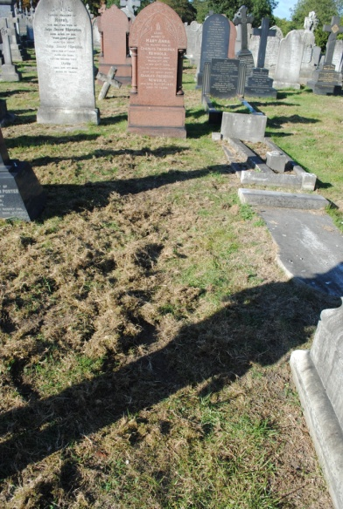
Despite her demonstrably independent life, Jane was close to her family. She made provision for her brother George in her will and probably paid for his funeral. After the death of her brother John she effectively took on the role of mother to his youngest daughter Ethel (who was only 5 years old at the time of her own mother’s death). When Ethel became ill with enteric fever, Jane took her in and cared for her until her death, aged just 27, on 5th May 1911. Jane became the favourite Aunt of Ethel’s two young children Jane and Emily Winfield leaving most of her estate to them at her death. Jane died on 19th February 1927, aged 74 years. The last of the siblings to die, she was buried in the Church Cemetery, Nottingham, alongside her niece Ethel and her brother George.
(Left): The unmarked burial plot at the Church Cemetery that is the last resting place of both Jane Wesley, her brother George and her niece Ethel.

